Thursday, August 29, 2019

For the Memorial of the Passion of St. John the Baptist


Barely four weeks that late Reverend Fr Paul Offu, Parish Priest of St. James Greater Catholic Church, Enugu, was shot dead, bandits on Thursday attacked Reverend Father David Tanko, at Kufai Amadu in Takum, Taraba state, killing him and setting his dead body and vehicle ablaze.

Read more at: https://www.vanguardngr.com/2019/08/breaking-bandits-set-catholic-priest-vehicle-ablaze-in-taraba/

Monday, August 26, 2019

Tearing Down Christ Cathedral


Formerly the Crystal Cathedral.

I came across an article from 1P5, posted by a friend, a critique of the renovation of Christ Cathedral, titled "The Dark Symbolism of California's Christ Cathedral", written by the well respected, Dr. Peter Kwasniewski.  In the beginning of his article, he references other notable scholars who have offered critique of the building, as well as diocesan sources for commentary on the renovation and the art.  The author in turn makes clear his intentions in his review stating:  "My goal in this article is not to cover again ground that has already been covered, but to delve into aspects of the cathedral that raise serious questions about the vision that stands behind it."

Fair enough.  I'm no expert to be sure, but even the author at the outset, makes a sort of disclaimer:
We cannot conclude with certainty that what I am about to cover is fully intentional on the part of Christ Cathedral’s designers, regardless of anyone’s pointed assumptions.  What is clear is that a choice was made to avoid normative Christian symbolism and to make use of signs associated with other religious traditions — elements that narrate a tale as shocking and scandalous as any report covering the abuse crisis. - Dr. Kwasniewski
After reading diocesan narratives, I'm not sure it is 'clear is that a choice was made to avoid normative Christian symbolism.' 

I've always admired the original architect, Philip Johnson but I never detected a shred orthodoxy in his new age pavilion for Hour of Power. It wasn't protestant or Christian. The diocese seems to have been dazzled by all the 'crystal'. That said, there is plenty of Catholic-Christian symbolism within the renovated structure.  


Dr. Kwasniewski's review is okay, but there's a lot of pickiness and suspicion expressed about the 'details' - as they like to say, 'the devil is in the details'.   The Masonic sanctuary comparisons have been made time and again about many modern churches as well as the Novus Ordo arrangement. In this case, it really comes across like that - but, it's nothing new.  Dr. Kwasniewski, his critique and questions, focused upon the mysteries apprehended by him, could be answered with a little research. (To be fair, he directs the reader to these links.)  It's online and the artist - like his work or not - is accessible. The stations of the cross and doors were created by Pablo Eduardo, a renowned sculptor based in Gloucester, MA. The Diocese itself has posted details on the art and architecture.

Angel


Granted, the place makes for an ugly church by traditionalist standards, and some of the symbolism appears to be New Age, but I wonder if the angel earpiece the author links to the occult, isn't an indigenous reference, considering the Mexican influence in So. California. And don't forget, crystals are referenced in both NT and Old. Maybe the author and many Catholics are not be aware of it, but St. Hildegard wrote on the healing power and significance of crystals, and she's a Doctor of the Church.

It's fine to criticize the place on the basis of aesthetics; to not like the art and architecture, to protest the amount of $$ to renovate the place, and even to criticize the bishop, but I think it's a bit crazy to read occult messages and pagan intent into the assemblage of decorative art and sanctuary seating.

Non-Catholics and non-believers think religious people are nuts anyway. Just saying.


These are Christian symbols,
some predate Christianity.
Protestants and now
even Catholics think they are
pagan and/or occult.


Thursday, August 22, 2019

It's not that I don't like him ...

Cardinal Burke - T. Nelson


I just think he's kind of a ...

I'm talking about Cardinal Burke.  I don't mean to be disrespectful, but in his apostolate of bringing back the Extraordinary Form of Mass, and all of the accoutrements which accompany it, he bolsters a strange resistance movement to the Pope and Post-Conciliar Church.  (I'm against classifying the Church as post conciliar, but I use the term as a convenience here.)

I don't really think the Cardinal is a ditz, yet he is always and apparently everywhere dressed as a Medieval prelate, making the rounds, blessing and celebrating 'at the Throne'. It's a wonderful patrimony we Catholics have, and we treasure it, and Pope Benedict opened the treasury to all Catholics, in the hope it would enrich the Church's Ordinary Form.  The problems arose before that, but escalated after Summorum Pontificum, used by some to force a counter reformation and as a means to denigrate the OF Mass.  Many claiming one is more sacred than the other, and God is more pleased with the EF than the OF - while insisting the increase of vocations is proof of that.

Cappa Magna Americano - T. Nelson


That's the tip of iceberg, as it were.

As Cardinal Burke travels about, his appearances seem to emphasize the differences, which are used to disparage the Ordinary Form.  Maybe he doesn't actually say that - but the impression is given, and the EF contingent play it that way.  So my point is, you can't say the 'new' Mass is a bad Mass, and you can't say Vatican II was a bad council - but that is exactly what 'they' are saying.

Cardinal Burke maybe doesn't say it outright - but he does imply it, repeating all the usual points as to what was wrong in the interpretation of the 'spirit of the council', along with pointing out all the liturgical abuses, which developed along the way.  That's not a bad thing, BTW - that is exactly how the Council bears fruit, and it is his job, so to speak.

That said, what is hard for me with Cardinal Burke, is not that he leads the devout who love the Traditional Liturgy, but the fact he is used by many to represent a rad-trad element which existed since Vatican II.  Included among the movement, many are also deeply influenced by a hardcore, right-wing political element.  Yes, the Cardinal has disassociated himself from Bannon, but there are plenty of his ilk in the mix.

Cardinal Burke also seems to accept the notion that the requests made by Our Lady of Fatima weren't properly implemented, the Consecration of Russia done negligently, and so on.  This echoes Fr. Gruner and those I refer to as Fatimists.  He seems to believe and is apprehensive that the fulfillment of other mystical dooms-day prophecies, especially as they apply to the crisis in the Church and Her liturgy, are enacted now.  What I'm saying is, he strikes me as one deeply influenced by the far-right, conspiracy theories, and dubious revelations and prophecies, which have been used to discredit the popes and magisterium.  Many of these prophecies were linked to fake apparition sites in the late 1960' -'70's, such as Necedah and Bayside.   They are all reformulated and repeated today in sensationalized books such as Taylor Marshall's 'Infiltration'.  Again - Burke doesn't officially, explicitly make clear statements to the fact, but one picks it up when his online followers and fans write articles or agree with him in com-boxes on social media sites.

Blognic in an Egg - T. Nelson


Don't mention the cappa, I did, but I think I got away with it.

So, this is kind of a can of worms and I'm simply trying to clarify what I meant in another post referencing the Cardinal.  To be fair, in his interview with Patrick Coffin, Burke didn't actually call into question the election of Pope Francis, he simply discussed the issue in his response to questions in the interview.  The interview touched on points others have used to cast doubt on the legitimacy of Pope Francis, e.g. the St. Gallen mafia conspiracy, as well as the infiltration theories contained in Taylor Marshall's book. The upshot being Burke concluded there's no way to prove this stuff without a corroborating eye witness.   Yet right there is how he feeds those who ardently believe these theories are fact.  Rod Dreher just wrote an article about stuff like that.

Yeah but - and many will defend him and support him, despite the fact his evident pearl-clutching exacerbates the suspicions and doubts of ordinary Catholics, who, despite the sexual abuse cover-up crisis, have all they can do to have the proper respect due to the office of bishop.  I might remind readers that Burke once gave permission for a transgender woman to live as a nun.  When reported to Rome, he expressed his displeasure towards the Catholic woman who reported him.  So he knows the good, bad and ugly of religious intrigue and back-biting involved in the infiltration paranoia.  He's maybe sought to protect his reputation more often than we know.

Finally, the amazing thing to me is how Cardinal Burke's supporters, followers-fans, become so defensive if anyone criticizes him, yet they willing and eagerly pick apart the Franciscan papacy, and make the most audacious claims against the Holy Father and his curia. To date, I've heard these people claim Francis is nuts, possessed, the Antichrist, or an anti-pope, and so on. Faithful Catholics say that crap publicly.  Cardinal Burke doesn't help dispel such nonsense - especially when he seems to be discussing it seriously in pod casts and at banquets.

Otherwise, I really like Cardinal Burke.  What?

My opinion doesn't matter.


Wednesday, August 21, 2019

The Holy Father has had his “Year of Mercy.” Now it’s time we had a Year of Justice... so says the Doctors of the Law in Crisis.

I expect as much from God's justice as from His mer­cy. 
It is because He is just that 
"He is compassionate and filled with gentleness, 
slow to punish, and abundant in mercy, 
for He knows our frailty, 
He remembers we are only dust. 
As a father has tenderness for his children, 
so the Lord has compassion on us! -S. Therese


"God’s justice is his mercy given to everyone as a grace that flows from the death and resurrection of Jesus Christ.” - Pope Francis

I came across an article on Crisis titled The Year of Mercy is over. The author wants justice, making the extraordinary claim:
"Pope Francis mightn’t be able to perceive the connection between mercy and justice—which may explain why the cabal of sexual predators and active homosexuals was allowed to operate right under his nose."  
His conclusion? "The Holy Father has had his “Year of Mercy.” Now it’s time we had a Year of Justice.
[...]
"But the solution isn’t a malnourished misericordia, the proper exercise of which requires a higher perfection of prudence.  
"Especially given the Church’s prolonged tilt toward misguided compassion, we need a corrective: a time to incarnate the truth that a prisoner can receive both punishment and pardon at once. God enacts His mercy by “doing something more than justice.” We can’t do something more than justice when justice itself is caricatured and denied. Our sorrowing hearts move to beg the Supreme Pontiff: in your mercy, declare a Year of Justice." - Joshua Hren
The author is Dr. Joshua Hren, he's an academic, and I'm an ignorant commenter. (I saw that label in a FB comment.) His appeal for a year of justice isn't new - during the Year of Mercy not a few critics of Pope Francis believed what was needed was justice. People want judgement. They like to judge. They want justice. They will appeal to the psalms and the scriptures, even tradition (they used to burn heretics), to support their protest (dissent) against a 'malnourished misericordia'. I have blog posts to demonstrate their resistance to mercy.

"[T]he company [Jesus] keeps with those the law considers sinners makes us realize the depth of his mercy." - P. Francis

That said, my go to Saint, Doctor of the Church, is the very 'little' and genuinely humble, Therese of Lisieux - she helps me understand Pope Francis and his pontificate of Mercy. She reminds me of the proclamation, "Eternal his merciful love, his love endures forever." Therese deliberately wrote her Story of a Soul, announcing, "I'm going to be doing only one thing: I shall begin to sing what I must sing eternally: The mercies of the Lord."

So what would the Little Therese say to the critics of Pope Francis and his proclamation of mercy? What would she say to the theologians who flatter themselves that they know more than the Holy Father, and deem themselves qualified to judge and demand justice for all the sinners surrounding the Pope? Perhaps this:
"A now-famous tussle with a Jansenist-tinged fellow Carmelite moved Thérèse to articulate her conviction about mercy. Her concluding words to Sister Fébronie were: "Sister, if you want divine justice, you will get divine justice. The soul gets exactly what it expects of God." 
"And Thérèse always expected mercy from God. "After all the graces with which he has overwhelmed me, I also expect him to grant me that of his infinite mercy." She prayed in her autobiography: "If your justice loves to release itself, this justice which extends only over the earth, how much more does your merciful love desire to set souls on fire since your mercy reaches to the heavens."" - Peter John Cameron, O.P.
So, if you want divine justice, you'll get it soon enough - but don't try to stop those who seek mercy. Or, as our Lord asks in today's Gospel, "Are you envious because I am generous?" 

"I saw the Holy Father in a very big house, kneeling by a table, 
with his head buried in his hands, and he was weeping. 
Outside the house, there were many people. 
Some of them were throwing stones, 
others were cursing him and using bad language. 
Poor Holy Father, we must pray very much for him." - Blessed Jacinta 

Friday, August 16, 2019

With deep anxiety and growing surprise ...


The Letter of Pius XI to the Bishops of Germany in 1937 should maybe be read again.

It seems to me we live in similar conditions.  This is not to  call any leader a Hitler or a Stalin, nor cite any political party Nazi or Communist, because corruption and a general lack of morality is widespread and pervasive, crossing party lines, so to speak.  I thought the following section especially timely for anyone confused by the various ideologies which infect our culture.

Moral and natural law.

To hand over the moral law to man’s subjective opinion, which changes with the times, instead of anchoring it in the holy will of the eternal God and His commandments, is to open wide every door to the forces of destruction. The resulting dereliction of the eternal principles of an objective morality, which educates conscience and ennobles every department and organization of life, is a sin against the destiny of a nation, a sin whose bitter fruit will poison future generations.
30. Such is the rush of present-day life that it severs from the divine foundation of Revelation, not only morality, but also the theoretical and practical rights. We are especially referring to what is called the natural law, written by the Creator’s hand on the tablet of the heart (Rom. ii. 14) and which reason, not blinded by sin or passion, can easily read. It is in the light of the commands of this natural law, that all positive law, whoever be the lawgiver, can be gauged in its moral content, and hence, in the authority it wields over conscience. Human laws in flagrant contradiction with the natural law are vitiated with a taint which no force, no power can mend. In the light of this principle one must judge the axiom, that “right is common utility,” a proposition which may be given a correct significance, it means that what is morally indefensible, can never contribute to the good of the people. But ancient paganism acknowledged that the axiom, to be entirely true, must be reversed and be made to say: “Nothing can be useful, if it is not at the same time morally good” (Cicero, De Off. ii. 30). Emancipated from this oral rule, the principle would in international law carry a perpetual state of war between nations; for it ignores in national life, by confusion of right and utility, the basic fact that man as a person possesses rights he holds from God, and which any collectivity must protect against denial, suppression or neglect. To overlook this truth is to forget that the real common good ultimately takes its measure from man’s nature, which balances personal rights and social obligations, and from the purpose of society, established for the benefit of human nature. Society, was intended by the Creator for the full development of individual possibilities, and for the social benefits, which by a give and take process, every one can claim for his own sake and that of others. Higher and more general values, which collectivity alone can provide, also derive from the Creator for the good of man, and for the full development, natural and supernatural, and the realization of his perfection. To neglect this order is to shake the pillars on which society rests, and to compromise social tranquillity, security and existence. - Mit Brennender Sorge

Monday, August 12, 2019

Pope Francis: “I am concerned because we hear speeches that resemble those of Hitler in 1934.”


Me too.

In light of the concerns Pope Francis expressed regarding the emergence of nationalism and political rhetoric of isolationism - a concern I share BTW: “I am concerned because we hear speeches that resemble those of Hitler in 1934.”  I want to link to a great article on how Trump is emulating Hitler's rise to power.  Don't freak out - no one is suggesting Trump is heading toward some 'final solution' to make America white again, as Burt Neuborne, the author of the book When at Times the Mob Is Swayed: A Citizen’s Guide to Defending Our Republic makes clear: "I don’t for a moment believe that Trump admires what Hitler eventually did with his power [genocide], but he damn well admires—and is successfully copying—the way that Hitler got it.”
People on FB seemed to disagree with what the Holy Father says, or they immediately assume he's picking on Trump, yet comparisons with fascist speeches from the 1930's is not difficult to do.  I found a very good article on Neuborne's book (cited above) comparing Trump's style to Hitler's rhetoric and policies, which sheds some light on what the Holy Father may be talking about. Though it needs to be repeated that the Pope didn't name Trump, nor is Trump alone among leaders to foster nationalism.  Elsewhere in the world nationalism is gaining a great deal of support in reaction to the ongoing migrant and economic crisis.


20 Common Themes, Rhetorical Tactics and Dangerous Policies

Here are 20 serious points of comparison between the early Hitler and Trump.
1. Neither was elected by a majority. Trump lost the popular vote by 2.9 million votes, receiving votes by 25.3 percent of all eligible American voters. “That’s just a little less than the percentage of the German electorate that turned to the Nazi Party in 1932–33,” Neuborne writes. “Unlike the low turnouts in the United States, turnout in Weimar Germany averaged just over 80 percent of eligible voters.” He continues, “Once installed as a minority chancellor in January 1933, Hitler set about demonizing his political opponents, and no one—not the vaunted, intellectually brilliant German judiciary; not the respected, well-trained German police; not the revered, aristocratic German military; not the widely admired, efficient German government bureaucracy; not the wealthy, immensely powerful leaders of German industry; and not the powerful center-right political leaders of the Reichstag—mounted a serious effort to stop him.”
2. Both found direct communication channels to their base. By 1936’s Olympics, Nazi narratives dominated German cultural and political life. “How on earth did Hitler pull it off? What satanic magic did Trump find in Hitler’s speeches?” Neuborne asks. He addresses Hitler’s extreme rhetoric soon enough, but notes that Hitler found a direct communication pathway—the Nazi Party gave out radios with only one channel, tuned to Hitler’s voice, bypassing Germany’s news media. Trump has an online equivalent.
“Donald Trump’s tweets, often delivered between midnight and dawn, are the twenty-first century’s technological embodiment of Hitler’s free plastic radios,” Neuborne says.
3. Both blame others and divide on racial lines. As Neuborne notes, “Hitler used his single-frequency radios to wax hysterical to his adoring base about his pathological racial and religious fantasies glorifying Aryans and demonizing Jews, blaming Jews (among other racial and religious scapegoats) for German society’s ills.” That is comparable to “Trump’s tweets and public statements, whether dealing with black-led demonstrations against police violence, white-led racist mob violence, threats posed by undocumented aliens, immigration policy generally, protests by black and white professional athletes, college admission policies, hate speech, even response to hurricane damage in Puerto Rico,” he says. Again and again, Trump uses “racially tinged messages calculated to divide whites from people of color.” - Finish reading here.

I'm amazed that many Catholics mistrust the Pope, yet place so much confidence in Trump and his nationalistic policies. 

"Got a match?"

Friday, August 09, 2019

Blessed Friars Michał Tomaszek and Zbigniew Strzałkowski, Martyrs


Fathers Michał Tomaszek and Zbigniew Strzałkowski 
were murdered by Shining Path guerillas 
in Pariacoto, Peru, on August 9, 1991.

"... [I]t was not a good time for Peru: the seeds of terrorism had been sown and produced much hatred, and with the participation of foreign elements, the soil was stained with the blood of martyrs – Fathers Michał and Zbigniew, and two weeks later Alessandro Dordi, a priest in Valle del Santa in the Diocese of Chimbote – and with the deaths of many other Peruvians and foreigners."  Finish reading here.

Today we remember the martyr, St. Edith Stein as well as the holocaust of Nagasaki...


This photo from Auschwitz doesn't show Sr. Benedicta of the Cross, 
but it does show nuns in habits entering the camp with the others ...
It' helps us understand that Edith Stein truly was 
called on behalf of her people ... how many people ...


And then three days later.


Wednesday, August 07, 2019

The Splendor of Truth


So what is truth?


I was reminded by a friend online that yesterday was the anniversary of St. John Paul's Encyclical, Veritatis Splendor, given on August 6, 1993, the feast of the Transfiguration. Last night I read passages I opened to at random, I did the same early this morning. This document has such an effect upon me, much like the disciples on the way to Emmaus when they remarked later, 'weren't our hearts burning within us?' In a time of extreme moral confusion there is nothing like drinking from an unpolluted fountain.


I read the section on Conscience and Truth, and this morning, Chapter 3, Lest the Cross of Christ be Emptied of Its Power. The section on martyrdom thrilled and encouraged me.  I was once again impressed by the following section intrinsically evil acts.

81. In teaching the existence of intrinsically evil acts, the Church accepts the teaching of Sacred Scripture. The Apostle Paul emphatically states: "Do not be deceived: neither the immoral, nor idolaters, nor adulterers, nor sexual perverts, nor thieves, nor the greedy, nor drunkards, nor revilers, nor robbers will inherit the Kingdom of God" (1 Cor 6:9-10).
If acts are intrinsically evil, a good intention or particular circumstances can diminish their evil, but they cannot remove it. They remain "irremediably" evil acts; per se and in themselves they are not capable of being ordered to God and to the good of the person. "As for acts which are themselves sins (cum iam opera ipsa peccata sunt), Saint Augustine writes, like theft, fornication, blasphemy, who would dare affirm that, by doing them for good motives (causis bonis), they would no longer be sins, or, what is even more absurd, that they would be sins that are justified?".134
Consequently, circumstances or intentions can never transform an act intrinsically evil by virtue of its object into an act "subjectively" good or defensible as a choice. - Veritatis Splendor

I first returned to the encyclical after having been so confused about former Cardinal McCarrick and the recent news story detailing how he groomed his victims - which for me meant that his sin was 'premeditated' and all the more evil on account of that.  (Story here.) The psalmist describes what goes on in the mind of the perpetrator when he says, "sin speaks to the sinner in the depths of his heart, as he plots the defeat of goodness while he lays upon his couch.  He so flatters himself that he knows not his guilt." 

It seems to me, that like the Judges in Susanna, McCarrick could only go on the way he did because he suppressed his conscience, wouldn't allow his mind and heart to be guided by prayer, and therefore forfeited right judgement.

We need to love the truth ... live the truth.  Otherwise we live a lie - which is why St. Paul says we need to stop lying to one another.  We can't be 'confessors' or 'witness' to the truth if we are liars.  We need to be attentive to the truth, as a lamp shining in the darkness, "until the day dawns and the morning star rises in our hearts."

89. Faith also possesses a moral content. It gives rise to and calls for a consistent life commitment; it entails and brings to perfection the acceptance and observance of God's commandments. As Saint John writes, "God is light and in him is no darkness at all. If we say we have fellowship with him while we walk in darkness, we lie and do not live according to the truth... And by this we may be sure that we know him, if we keep his commandments. He who says ' I know him' but disobeys his commandments is a liar, and the truth is not in him; but whoever keeps his word, in him truly love for God is perfected. By this we may be sure that we are in him: he who says he abides in him ought to walk in the same way in which he walked" (1 Jn 1:5-6; 2:3-6). - Veritatis Splendor

Monday, August 05, 2019

My hermitage garden ...

Ave Maria Room

Madonna 

View out.

View into Ave Maria 

The enclosure overgrown lilac woods.

Enclosure with lilac woods 
or as I call it,
 St. Joseph's Wood.

I mentioned on FB that I've let part of my garden go natural-wild, although I do conserve it and need to get in there and clean the stone paths.  I decided to leave it a bit wild to recover from rabbit damage - and yet to allow a sanctuary space for critters and the birds  and the bees to thrive.  It works!  Either St. Francis or St. Martin de Porres wanted such spaces in their gardens.  I also let the hedge grow tall to remain hidden from the neighbors - and now I no longer see their buildings or vast array of lawn ornaments and fairy villages.  They don't have to be distracted by mine, either - so it's a good thing.  Next season I hope to tame the hedge just a bit to create a green wall - that is, if the rabbits don't kill it.  In the meantime, it is a wonderful retreat for me.

I originally posted about it after reading an article on 'ungardening' or 'rewilding' yards by people who want to avoid chemical use and be more eco-friendly, while creating space for wildlife, e.g. birds, bees and butterflies, etc..  Story here.

My outer yard remains more cultivated and manicured - although I have some sculpting and trimming to do.

I should write something.


It's just so easy to post on Facebook.

I kind of neglect this blog.  FB is more interactive, but I'm less inclined to post serious stuff because so many of my relatives and friends of the family are linked to me there. 

I don't know them.

I left home as a senior in high school, and was never very close to anyone since then.  I stayed with my older brother and his wife during a transition period of my life, but I didn't stay close afterwards.  I tried to be close to my sister and her family after her husband died, but I wasn't successful, so it was more or less on again, off again.  (My brother-in-law said I wasn't welcome in their home after my parents outed me.  Dear old mums and dadums.)

Today is my brother Tim's birthday, I haven't been in contact with him for years.  When I left home, I said goodbye to him, and he cried.  He was under the control of my parents and so it was difficult to be close.  My older brother was a sort of mentor for Tim, as well as my sister's kids, and I couldn't compete.  Not that it was a competition, but I always felt as if I couldn't measure up.

Hence my distancing myself.

It doesn't mean I don't love them. 

They just don't know me.

Happy Birthday Timmy!

Friday, August 02, 2019

St. Francis and Our Lady of the Angels


Pray for us O Holy Father St. Francis!

Pray for me to obtain pardon.
Pray for me for the grace of repentance,
conversion,
compunction.
Pray for me to obtain pardon.
Pray for me to do penance.
Pray for us O Holy Father St. Francis,
that we may be worthy of the
promises of Christ,
and through the intercession of 
the Blessed Virgin Mary
obtain the Great Pardon of Assisi
for us.

In thanksgiving for favors granted:
Glory be to the Father
and to the Son 
and to the Holy Spirit
as it was in the beginning,
is now, and ever shall be,
world without end.  Amen. 


Prayer of St. Francis.

Hail, O Lady, Holy Queen,Mary, holy Mother of God:you are the Virgin made Church chosen by the most Holy Father in heaven whom He consecrated with His most holy beloved Son and with the Holy Spirit the Paraclete,in whom there was and is all fullness of grace and every good.
Hail His Tabernacle!
Hail His Dwelling!
Hail His Robe!
Hail His Servant!
Hail His Mother!
And hail all you holy virtues
Which are poured into the hearts of the faithful
through the grace and enlightenment of the Holy Spirit,
that from being unbelievers,
you may make them faithful to God. Amen. 
Hail His Palace!


Jesus grants Our Lady's request for St. Francis, 
granting the Great Pardon
indulgence of the Portiuncula

- Antoni Viladomat i Manalt


Tuesday, July 30, 2019

Today is the anniversary of the death of St. Leopold Mandic

Feast: 12 May (30 July in Roman martyrology)


 Pope Francis on Pope JPI and Leopold Manic.
“I once read a homily by then cardinal Albino Luciani, later Pope John Paul I, about Father Leopold Mandic´, who had just been beatified by Pope Paul VI,” Bergoglio says. “He described something that was very similar to what I just told you. “You know, we are all sinners,” Luciani said on that occasion. “Father Leopold knew that very well. We must take this sad reality of ours into account: no one can avoid sin, small or great, for very long. But,’ as Saint Francis de Sales said, ‘if you have a little donkey and along the road it falls onto the cobblestones, what should you do?’ You certainly don’t go there with a stick to beat it, poor little thing; it’s already unfortunate enough. You must take it by the halter and say: ‘Up, let’s take to the road again . . . Now we will get back on the road, and we will pay more attention next time.’ This is the system, and Father Leopold applied this system in full. A priest, a friend of mine, who went to confess to him, said: ‘Father, you are too generous. I am glad to have gone to confession to you, but it seems to me that you are too generous.’ And Father Leopold said: ‘But who has been generous, my son? It was the Lord who was generous; I wasn’t the one who died for our sins, it was the Lord who died for our sins. How could he have been more generous with the thief, with others, than this!’” This was the homily of then Cardinal Luciani on Leopold Mandic´, who was later proclaimed a saint by John Paul II.”
[...]No human sin —however serious—can prevail over or limit mercy. After serving for several years as the Bishop of Vittorio Veneto, Albino Luciani held some training exercises for parish priests, and when commenting on the parable of the Prodigal Son once said this about the Father: “He waits. Always. And it is never too late. That’s what he’s like, that’s how he is . . . he’s a father. A father waiting at the doorway, who sees us when we are still far off, who is moved, and who comes running toward us, embraces us, and kisses us tenderly . . . Our sin is like a jewel that we present to him to obtain the consolation of forgiveness . . . Giving a gift of jewels is a noble thing to do, and it is not a defeat but a joyous victory to let God win!”” - John Paul I and Francis

Pope John Paul I was, for me, an anticipation of Pope Francis - a sort of preview.  Both had/have devotion to St. Leopold, the confessor.  May St. Leopold obtain for those who are great and powerful in the Church to understand the lowliness and humility which characterized the little Capuchin priest, St. Leopold Mandic.  May St. Leopold pray for me and obtain for me humility, contrition and compunction.


St. Leopold, pray for us!


Saturday, July 27, 2019

The human person ...

Dali - Temptation of St. Anthony


Persona Humana.

St. Paul VI approved this document in 1975.  It's been more or less ignored since then, yet Catholic teaching does not change.

Someone who struggles with masturbation can, by the grace of God, overcome it.  Recently a friend of mine revealed to me a personal struggle, and mentioned how Catholic teaching has evolved on sexuality.  When I was an adolescent, a confessor distinguished between complete self abuse and incomplete.  It seems ludicrous to me today, but perhaps it was an important, albeit immature, for an adolescent back then.  I would be surprised if anyone would ask that today, much less teach it, especially since masturbation is often considered by some, to be no longer sinful.

I've always wonder how and why they can say that when from the earliest times it was considered a sin against chastity.  St. Peter Damian considered it sodomy, along with the sin of contraception.  (Hence my saying we are all Sodomites today.)  St. Benedict and St. Francis of Assisi tossed themselves in thorn bushes to avoid the sin.  Even the desert fathers and Cassian considered nocturnal emissions as unchaste. (They are involuntary and therefore not sinful of course.)  Yet masturbation itself remains a sin to avoid and struggle to overcome.  Peacefully and perseveringly.  

(Again, I'm only writing about this because of some things confided to me recently.  Without going into detail, I believe the change in thinking regarding masturbation had a negative effect in the formation of priests and religious, leading a sexual permissiveness, as seen in the secret lives of priests such as former Cardinal McCarrick, who saw nothing immoral in sleeping naked with seminarians and priests.)

"In the present period, the corruption of morals has increased ..."

Almost 45 years ago, back when society was just emerging from horrible, institutionalized, sexual repression - kidding - the Vatican - during the reign of Pope Paul VI, had the audacity to issue an official document entitled Persona Humana - Declaration on Certain Questions Concerning Sexual Ethics.
Given in Rome, at the Sacred Congregation for the Doctrine of the Faith, on December 29th, 1975.
The traditional Catholic doctrine that masturbation constitutes a grave moral disorder is often called into doubt or expressly denied today. It is said that psychology and sociology show that it is a normal phenomenon of sexual development, especially among the young. It is stated that there is real and serious fault only in the measure that the subject deliberately indulges in solitary pleasure closed in on self ("ipsation"), because in this case the act would indeed be radically opposed to the loving communion between persons of different sex which some hold is what is principally sought in the use of the sexual faculty.
This opinion is contradictory to the teaching and pastoral practice of the Catholic Church. Whatever the force of certain arguments of a biological and philosophical nature, which have sometimes been used by theologians, in fact both the Magisterium of the Church - in the course of a constant tradition - and the moral sense of the faithful have declared without hesitation that masturbation is an intrinsically and seriously disordered act.[19]
The observance of the moral law in the field of sexuality and the practice of chastity have been considerably endangered, especially among less fervent Christians, by the current tendency to minimize as far as possible, when not denying outright, the reality of grave sin, at least in people's actual lives. - Persona Humana
Of course, like Humanae vitae, many Catholics ignore this teaching.  I'm just a simple layman who accepts the teaching of the Church.


Friday, July 26, 2019

Something


Some things I just do not know hoe to respond to.

I got a call the other night from an old friend who wanted to tell me some thing of a very private and personal matter.  It was about something he struggles with.  I was taken aback, since I never even thought he could ever be so troubled.  I didn't know what to say.  Each time he mentioned a specific aspect of his struggle I suggested a book on the issue, or a biography of someone who went through similar things.  Then I suggested this prayer and more frequent confession, but of course he tried that.

It seemed to me he really wanted to unload on me and to express his fondness for me and so on.  I didn't know how to respond.  I knew suggesting this book or that was a slough off, something I've called out others for, but I didn't know how to respond.  I don't know how to respond.

I'm really old fashioned and traditional on sexual morality.  I do not like discussing it any longer.  I believe in what the Church teaches, and if there are any mitigating circumstances regarding culpability when it comes to sexual activity, that is between the penitent and the confessor.  I am not qualified to speak to that.

"Discover not thy heart to every one." - Ecclus, VIII, 22

The only response I can give is to affirm that through prayer and perseverance, chastity is a gift our Lord will give to those who never give up - especially if they have recourse to the Blessed Virgin.  It is sheer grace.  Nothing is impossible with God.  Excuses and justifications do not mitigate guilt - that is a temptation from the world.  If one falls, go to confession - but repent immediately before you get there.  Be sure to continue your spiritual exercises as if nothing happened, so to speak.  Don't give up prayer or repeat the sin, thinking 'I may as well, I'm going to confession anyway.'  That's a temptation from the devil and the flesh.

The remedy is constant prayer and recollection, with humble self-knowledge.  Over and over again, until we realize we can do nothing on our own, that we are absolutely powerless - that Christ has taken on our sins.  That is why we need to look deeply into his wounds, which mirror every sin, yet remain the antidote.  He's our healing and our salvation and our holiness - he is with us, not to guilt us but to free us.  I wish I had the words to express that better - but I would almost say, throw your books and laptops away and get a crucifix, an image of the scourged wounded Christ - as Angela of Foligno said, that is the only book you need.

There are some things I just don't know how to respond to.

Never take a man for your example - however holy he may be - for the devil will show you his faults. -John of the Cross

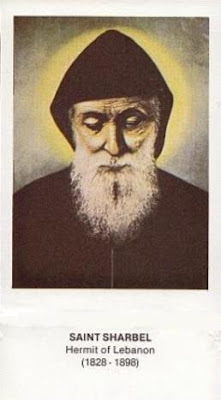

Wednesday, July 24, 2019

St. Charbel, Thaumaturgist.


The Wonder Worker of Lebanon

St. Charbel is one of my favorite saints. I especially admire his devotion to the Sacred Liturgy/Mass. He said Mass at mid-day, prayerfully preparing to do so the entire morning, and after Mass, offering his thanksgiving the entire afternoon. He was particularly devoted to the Eucharist and the Rosary of the Blessed Virgin.

I try to imitate him somewhat by preparing for Mass for an hour before, praying Our Lady's Rosary.  I try to stay a long time after Mass in silent thanksgiving.  Elsewhere online I noticed a question as to how long the real presence remains within us after communion.  It's a good question, I guess.  From my understanding, so long as the host/bread remains, Christ is with us, body, blood, soul and divinity.  Yet that strikes me as superficial, since Christ leads us into the bosom of the Holy Trinity who dwells within our souls.  We are his tabernacle. God dwells in our soul and Christ himself unites us to himself.  To remain quietly in thanksgiving after communion, contemplating these things is our sanctification.  There is no more intimate call to follow Jesus than that which he bids us in holy communion.  It is not unlike the invitation Christ made to “Zacchaeus -  come down quickly, for today I must stay at your house.”

The easiest way to practice mental prayer, and to acquire the prayer of recollection, is to spend time after Holy Communion in prolonged thanksgiving.  The best way to prepare for this mystical union is extended prayer with Our Lady in preparation to receive Jesus in the Eucharist.  Frequent spiritual communion unites us to Jesus in the Blessed Sacrament, reminding us throughout the day we are his tabernacle, God's temple, and the Spirit of God dwells in us.

St. Charbel demonstrates that.

St. Charbel, Wonder Worker of Lebanon, obtain for us conscious and deep reverence for Christ in the Eucharist, and heartfelt devotion to Our Lady.  Instill in us an abiding recollection of the Holy Trinity's indwelling that we may do everything in union with God's will.  Through Christ, our Lord.  Amen.

Friday, July 19, 2019

Before Christ’s second coming the Church must pass through a final trial that will shake the faith of many believers. - CCC


Feast of St. Elijah, Prophet

In the 19th century a Coptic manuscript was found, known as the Apocalypse of Elijah. Elijah is of course associated with the coming of the Messiah - for Jews and Christians - Muslims as well. Christ attested to his coming in the Gospel - in regard to John the Baptist. Jews still set a place at table for Elijah, and the Book of Revelation speaks of his return at the end times.

"No one is able to enter the holy place if he is double minded. The one who is double minded in his prayer is darkness to himself. And even the angels do not trust him." - Apocalypse

1.The word of YHWH came to me saying, "Son of man, say to his people, 'why do you add sin to your sins and anger the Lord God who created you ?' " 2.Don't love the world or the things which are in the world, for the boasting of the world and its destruction belong to the devil. 
13.Hear, O wise men of the land, concerning the deceivers who will multiply in the last times so that they will set down for themselves doctrines which do not belong to God, setting aside the Law of God, those who have made their belly their God, saying, "The fast does not exist, nor did God create it," making themselves strangers to the covenant of God and robbing themselves of the glorious promises. 
14.Now these are not ever correctly established in the firm faith. Therefore don't let those people lead you astray. 
25.Likewise no one is able to enter the holy place if he is double minded. 26.The one who is double minded in his prayer is darkness to himself. And even the angels do not trust him. 27.Therefore be single-minded in the Lord at all times so that you might know every moment. - Apocalypse of Elijah


July 20 is the feast of the Prophet Elijah.

Wednesday, July 17, 2019

St. Alexis


Story of St. Alexis.

S
t. Alexius the only son of Euphemianus, a wealthy Christian Roman of the senatorial class, fled his arranged marriage to follow his mysterious holy vocation. Disguised as a beggar, he lived near Edessa in Syria, accepting alms even from his own household slaves, who had been sent to look for him but did not recognize him, until a miraculous vision of the Blessed Virgin Mary singled him out as a "Man of God." Fleeing the resultant notoriety, he returned to Rome, so changed that his parents did not recognize him, but as good Christians took him in and sheltered him for seventeen years, which he spent in a dark cubbyhole beneath the stairs, praying and teaching catechism to children. After his death, his family found writings on his body which told them who he was and how he had lived his life of penance from the day of his wedding, for the love of God. (Source)


"Who would not have judged that poor Lazarus was supremely miserable and the rich man quite happy and content?  Yet such was not the case, for that rich man with all his wealth suffered more than poor Lazarus tormented by his leprosy. For the rich man's selfish will was alive, and this is the source of all suffering.  But in Lazarus this will was dead and his will was so alive in me that he found refreshment and consolation in his pain.  He had been thrown out by others, especially by the rich man, and was neither cleansed nor cared for by them, but I provided that the senseless animals should lick his sores.  And you see how at the end of their lives Lazarus has eternal life and the rich man is in hell." - The Dialogue, Catherine of Siena

Art: The Lotus Eater,  Carl Dobsky - John Pearce Gallery, San Francisco.  

Tuesday, July 16, 2019

Our Lady of Mount Carmel


Queen, beauty of Carmel!

O most beautiful flower of Carmel, 
fruitful vine, splendor of heaven, 
Blessed Mother of the Son of God, 
Immaculate Virgin, assist us in our necessity. 
O star of the sea, help us and show us the way. 
O Mary conceived without sin, 
pray for us who have recourse to you.

In the Ascent of Mount Carmel, St. John of the Cross wrote: “Oh that someone might show us how to understand, practice and experience what this counsel is which our Saviour here gives us concerning the denial of ourselves, so that spiritual persons might see in how different a way they should conduct themselves upon this road than that which many of them think proper.... Oh that someone would tell us how far Our Lord desires this self-denial to be carried!” This lament is addressed to us “spiritual persons,” who claim to be Christ’s friends. - Sr. Ruth Burrows ocd


In thanksgiving for the protection of the Blessed Virgin Mary of Mt. Carmel.