Showing posts with label In thanksgiving for a thousand graces. Show all posts

Tuesday, November 01, 2022

Loving the Heart of Jesus. By a Carthusian


A wonderful meditation.

"Loving the Heart of Jesus means knowing how to suffer a lot, always, alone, in silence, with a smile on your lips, under the gaze of him who scrutinizes hearts, in the complete abandonment of loved ones, without being understood, without being pitied and consoled. ; knowing how to hide the sacred "mystery of the cross" as a priceless treasure, in the depths of the pierced and aching soul, in the midst of a heart crowned with thorns.

To love him means to forget ourselves and our miseries in order to remember only him, who is the resurrection and the life, to throw into that adorable Heart every anxious concern for spiritual progress, and even when we see ourselves fallen for the hundredth time into the same imperfections, always get up again promptly with humility and peace, trusting in the perennial miracle of his almighty grace, resting in the infinite sweetness and forgiveness of God.

To love the Heart of Jesus means to venerate the glorious stigmata of the Crucifix in the suffering, and to surround with tender affection their livid and tortured limbs, in which he renews every day and perpetuates the ineffable poem of his Passion over the centuries.

To love him means to suffer with him for his pains, and to make amends in an affective and effective, practical, effective, indefatigable, generous, intelligent way for the enormous crimes with which his enemies profane his Person, crush his honor, debase him in the mud. his dignity, insult those who represent him, and at the same time atone for the sins - materially perhaps less serious, but formally more injurious - than those who should by profession and by free choice be his friends, and instead .. "they crucify again ..." (Heb 6, 6).

Loving the Heart of Jesus means favoring and helping "with the holiness and sincerity that come from God" (2Cor 1, 12) whoever struggles for his glory, renouncing without regret, for the common good, alleged rights of precedence or patents of invention, covering with the mantle of charity weaknesses and miseries, forgetting in silence and forgiveness bitter words, unkind gestures, carefully avoiding stings of honor, petty jealousies and rivalries, which so often compromise the dignity and the success of the ministry.

To love him means to fulfill our obscure duty with faith and solicitude, in the uniformity of a monotonous and hidden existence, without expecting approval, without denigrating those who emerge, without hindering, with badly concealed envy, the initiatives of others without exulting for their failure. , without trampling on those who have fallen without denying merit or slandering intentions, in a word without impeding or condemning the good, for the sole fact that it does not bear our trademark: "Provided that in every way ... Christ is announced" ( Phil 1, 18).

Loving the Heart of Jesus means knowing how to content ourselves with what is necessary in material things, and happily surrendering the superfluous to the works of the Church, to seminaries, to poor monasteries, to missions, to his university, to anyone who knows hunger, pain, hardship, infirmity, "persecutions for justice" (Mt 5:10).

To love him means to change the gold, the silver, the gems of our casket into those works of enlightened charity that do not fear rust or thieves: "making the stones become bread" (Mt 4.3), and that the undeserved gifts of Providence be changed into instruments of mercy.

To love the Sacred Heart means «to reciprocate it with all the love it requires of us; strong love, which does not allow itself to be bent, pure love, which loves without ulterior motives and without interest, crucified love, love of preference, of oblivion, of abandonment, to let the Sacred Heart act, cut, burn, annihilate in us how sorry he is. And that is why it is so necessary to let ourselves be led by him, and to let him work in us - all hours of the day, every day of the year, all the years of life - let ourselves be intoxicated by the madness of the cross, make the hardest sacrifices, not only with fidelity and perfect submission to his plans, but also with superabundant joy: "Because God loves those who give with joy" (2 Cor 9: 7); and both when he gives and when he takes back his gifts, bless him forever.

Loving the Heart of Jesus means loving his holy Church with passion, a virginal flower sprouted from his blood, with ever more complete adherence to his precepts, becoming each of us "obedient to death" (Phil 2: 8).

To love him means to share cordially the joys and sufferings of the Supreme Pontiff - "the sweet Christ on earth" (Catherine of Siena) - and to follow in everything and always, with docility and promptness, his commands, his exhortations, his recommendations, the expression of his desires, in whatever form and by whatever means they are transmitted to us: to accept them fully, even when they are contrary to our ways of seeing, to our short views, to the ever new demands of our interest, to the empty sophisms of which so fruitful is wounded self-love. Being devoted to the Heart of Jesus means burning with the desire to make him known and loved, to extend his kingdom, to glorify his name, to carry out his will in whatever aspect it manifests itself; it means to love the men who cost his blood: to love them all." - Cartusia Lover

(Manete in dilectione mea, pp. 105-110) - Dom Giovanni Battista Simoni

Friday, May 29, 2020

St. Paul VI


It was a wonderful consolation this morning when I realized today is the feast day of Pope Paul VI.

I am so grateful for his canonization, which is a confirmation of his sanctity and an affirmation of the good he accomplished as Pope.  It seems to me to also affirm Vatican II and the Ordinary Form of Mass.  Whenever one is tempted to doubt the efficacy of the Ordinary Form of Mass, Divine Providence has given us a sign in the canonization of Pope Paul VI, that Christ remains faithful to the Church, and his promises (to remain with us always) never fails.  Christ is faithful - even when we may not be.  He remains faithful, even when some depart, because they do not accept post-Conciliar papal authority, the Missal of Paul VI, and so on.

St. Paul VI, pray for us, that we may be made worthy of the promises of Christ.

Tuesday, October 01, 2019

The Essential Therese...

"I am resigned to being always imperfect, and I even find happiness in it.  
I keep an eye on myself to see if I can discover any new imperfections." 
- Therese to Mother Agnes of Jesus

"I will come down..."

I post these thoughts on St. Therese over and over.  For me the secret of St. Therese is her consent to be found at the 'table of sinners'.  She expressed that desire in the depths of her dark night, her trial of temptations against faith before she died. In that abject state, she experienced the faithlessness of the atheist, the bitter taste of rancor of the unbeliever, even the hollow, vacuous, hopelessness of those who hate the faith. Like her Master, "who had not known sin, yet became sin," thus she, who was innocent (as she had been once assured she had never committed a mortal sin), became sin, as it were. Not in the exact same sense of Christ of course, but she shared, or imitated His redemptive suffering in and through that experience... seated with Christ crucified, at the table of sinners.
Even if I had all the crimes possible on my conscience, I am sure I should lose none of my confidence. Heartbroken with repentance, I would simply throw myself into my Savior's arms, for I know how much He loves the prodigal son. I have heard what He said to Mary Magdalene, to the woman taken in adultery, and the Samaritan woman. No one can make me frightened any more, because I know what to believe about His mercy and His love; I know that in the twinkling of an eye all those thousands of sins would be consumed as a drop of water cast into a blazing fire. - Story of A Soul
"While Jesus was at table many tax collectors and sinners sat with Jesus and his disciples; for there were many who followed him... " - Mark 2: 13-17

Ordinary people complain that they lack her innocence, that they lack her love, that all they find in themselves is misery and the awful despair of knowing they are too sinful to attain the heights of sanctity. Yet it is precisely for those of us who find ourselves powerless and unfaithful, "miserated" by our selfish self indulgence and sin, who attract Therese and are most fitted to her little way. We do not have to worry about merit or accomplishments to attract her patronage, or much more, to attract the merciful love of God. This is what Little Therese teaches and demonstrates in her little way of confidence and love. It is our misery which attracts the divine mercy. It is our sins and our faults which so attracts God that he sent his only Son to be crucified for our sins. Therefore, who can not trust in merciful love when one is vulnerable enough, humble enough, to be embraced by it? The mystery is so deep, so wide.

Whoever is a little one, let him come to me... seated at the table of sinners.

I have so much trouble trying to express these things, but I'm convinced that St. Therese is much more the patron saint of sinners than she is anything else. It is almost like saying that Jesus Christ is the God of sinners as far as he made himself the bread of sinners, likewise he ate and drank with them, and most certainly, he came to call sinners, not the righteous... the Gospel proclaims that, and so does the life of St. Therese.


Wednesday, July 24, 2019

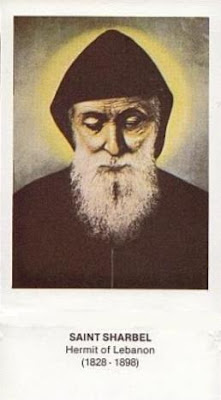
St. Charbel, Thaumaturgist.


The Wonder Worker of Lebanon

St. Charbel is one of my favorite saints. I especially admire his devotion to the Sacred Liturgy/Mass. He said Mass at mid-day, prayerfully preparing to do so the entire morning, and after Mass, offering his thanksgiving the entire afternoon. He was particularly devoted to the Eucharist and the Rosary of the Blessed Virgin.

I try to imitate him somewhat by preparing for Mass for an hour before, praying Our Lady's Rosary.  I try to stay a long time after Mass in silent thanksgiving.  Elsewhere online I noticed a question as to how long the real presence remains within us after communion.  It's a good question, I guess.  From my understanding, so long as the host/bread remains, Christ is with us, body, blood, soul and divinity.  Yet that strikes me as superficial, since Christ leads us into the bosom of the Holy Trinity who dwells within our souls.  We are his tabernacle. God dwells in our soul and Christ himself unites us to himself.  To remain quietly in thanksgiving after communion, contemplating these things is our sanctification.  There is no more intimate call to follow Jesus than that which he bids us in holy communion.  It is not unlike the invitation Christ made to “Zacchaeus -  come down quickly, for today I must stay at your house.”

The easiest way to practice mental prayer, and to acquire the prayer of recollection, is to spend time after Holy Communion in prolonged thanksgiving.  The best way to prepare for this mystical union is extended prayer with Our Lady in preparation to receive Jesus in the Eucharist.  Frequent spiritual communion unites us to Jesus in the Blessed Sacrament, reminding us throughout the day we are his tabernacle, God's temple, and the Spirit of God dwells in us.

St. Charbel demonstrates that.

St. Charbel, Wonder Worker of Lebanon, obtain for us conscious and deep reverence for Christ in the Eucharist, and heartfelt devotion to Our Lady.  Instill in us an abiding recollection of the Holy Trinity's indwelling that we may do everything in union with God's will.  Through Christ, our Lord.  Amen.

Tuesday, July 16, 2019

Our Lady of Mount Carmel


Queen, beauty of Carmel!

O most beautiful flower of Carmel, 
fruitful vine, splendor of heaven, 
Blessed Mother of the Son of God, 
Immaculate Virgin, assist us in our necessity. 
O star of the sea, help us and show us the way. 
O Mary conceived without sin, 
pray for us who have recourse to you.

In the Ascent of Mount Carmel, St. John of the Cross wrote: “Oh that someone might show us how to understand, practice and experience what this counsel is which our Saviour here gives us concerning the denial of ourselves, so that spiritual persons might see in how different a way they should conduct themselves upon this road than that which many of them think proper.... Oh that someone would tell us how far Our Lord desires this self-denial to be carried!” This lament is addressed to us “spiritual persons,” who claim to be Christ’s friends. - Sr. Ruth Burrows ocd


In thanksgiving for the protection of the Blessed Virgin Mary of Mt. Carmel.

Wednesday, May 22, 2019

St. Rita


Today is the feast of the great Italian wife, mother and nun, St. Rita of Cascia (Margherita). Patron saint of impossible cases. She, St. Anthony and St. Joseph, Jude and others are wonder workers who can undo the most impossible situations - especially when it come to reconcilling one to the Church and the Sacraments. If you are like me, life is a mess - and Rita can fix it. Saints like Rita show us that 'nothing is impossible for God.' Nothing. Then of course, when things get really messed up, we have recourse to Our Lady Undoer of Knots. I go to her everyday because every day I screw up. Yay! It's all good! Go out and make a mess! (I know a guy in Rome who says that!)

Sunday, April 14, 2019

Palm Sunday


Sorry to say, Palm Sunday celebrations are my least favorite in the Liturgical life of the Church. It seems so phony to me, because we know what happens immediately after the entrance hymns are sung, and the liturgical dance is over. We know what the nuvo-Scribes and Pharisees are planning. We know he will be abandoned and betrayed and even denied by his priests and bishops and so many of us. It's the schizoid nature of the Church, the contradiction of the Cross, which stands out for me this day.  It reminds me that popular opinion and politics are destined to disappoint.  The message of the Cross is foolishness to the worldly minded, therefore I'm content to be an ass on this day.


Tuesday, March 19, 2019

Solemnity of St. Joseph


San José, refugio de pecadores
San José, refugio de pecadores, grabado, siglo XVIII. 
Archivo General de la Nación, México.

Friday, December 14, 2018

St. John of the Cross and Purgatory


 A person's sufferings at this time cannot be exaggerated...


It is interesting to note that when speaking of the suffering of souls in the "deep, terrifying darkness" of the actual dark night (the initial stages of contemplation or the purgative stage), the intensity of their suffering is likened to that of the soul in purgatory.  Keep in mind John of the Cross is speaking about contemplatives here.  Nevertheless there is something analogous to what every soul experiences sooner or later - later meaning purgatory if we are fortunate.  The following is an excerpt from The Living Flame of Love, by John of the Cross, just for your edification.


All the soul's infirmities are brought to light; they are set before its eyes to be felt and healed. 


19. Before the divine fire is introduced into the substance of the soul and united with it through perfect and complete purgation and purity, its flame, which is the Holy Spirit, wounds the soul by destroying and consuming the imperfections of its bad habits. And this is the work of the Holy Spirit, in which he disposes it for divine union and transformation in God through love. 
The very fire of love that afterward is united with the soul, glorifying it, is what previously assailed it by purging it, just as the fire that penetrates a log of wood is the same that first makes an assault on the wood, wounding it with the flame, drying it out, and stripping it of its unsightly qualities until it is so disposed that it can be penetrated and transformed into the fire. 

Spiritual writers call this activity the purgative way. In it a person suffers great deprivation and feels heavy afflictions in the spirit that ordinarily overflow into the senses, for this flame is extremely oppressive. 

In this preparatory purgation the flame is not bright for a person but dark. If it does shed some light, the only reason is so the soul may see its miseries and defects. It is not gentle but afflictive. Even though it sometimes imparts the warmth of love, it does so with torment and pain. And it is not delightful, but dry. Although sometimes out of his goodness God accords some delight in order to strengthen and encourage it, the soul suffers for this before and afterward with another trial. 

Neither is the flame refreshing and peaceful, but it is consuming and contentious, making a person faint and suffer with self-knowledge. Thus it is not glorious for the soul, but rather makes it feel wretched and distressed in the spiritual light of self-knowledge that it bestows. As Jeremiah declares, God sends fire into its bones and instructs it [Lam. 1:13]; and as David also asserts, he tries it with fire [Ps. 17:3].

20. At this stage persons suffer from sharp trials in the intellect, severe dryness and distress in the will, and from the burdensome knowledge of their own miseries in the memory, for their spiritual eye gives them a very clear picture of themselves. In the substance of the soul they suffer abandonment, supreme poverty, dryness, cold, and sometimes heat. They find relief in nothing, nor does any thought console them, nor can they even raise the heart to God, so oppressed are they by this flame. This purgation resembles what Job said God did to him: You have changed to being cruel toward me [Jb. 30:21]. For when the soul suffers all these things jointly, it truly seems that God has become displeased with it and cruel.

21. A person's sufferings at this time cannot be exaggerated; they are but little less than the sufferings of purgatory. I do not know how to explain the severity of this oppression and the intensity of the suffering felt in it, save by what Jeremiah says of it in these words: I am the man that sees my poverty in the rod of his indignation. He has led me and brought me into darkness and not into light. Only against me he has turned and turned again his hand. He has made my skin and my flesh old, and he has broken my bones. He has surrounded me and compassed me with gall and labor. He has set me in dark places as those who are dead forever. He has built around me that I might not get out. He made my fetters heavy. And besides this when I have cried out and prayed, he has shut out my prayer. He shut up my ways with square rocks and turned my steps and paths upside down [Lam. 3:1-9].  - Living Flame of Love

Monday, October 22, 2018

St. John Paul II

St. Paul VI and St. John Paul II


It occurred to me this morning that Pope Francis is following closely in the footsteps of his predecessors, not only St. John Paul II but his predecessor St. Paul VI, and of course, Emeritus Pope Benedict XVI.

Friday, September 14, 2018

Exaltation of the Holy Cross


Since 'they' insist that icons are 'written', I do not need to write anything today.  Read your icons, class.

Friday, June 08, 2018

He first loved us ...

Sacred Heart of Jesus, I trust in you.
One summer day in Montreal ... many tears ago.
This is where it began - my return to the sacraments.


“It is not us who first loved God,” it's the other way around: “it is He who loved us first” he said. 
The Pope said the prophets used the symbol of the almond blossom to explain this reality highlighting the fact that the almond blossom is the first to bloom in spring. 
“God is like that: he is always first. He's the first to wait for us, the first to love us, the first to help us” he said. - Pope Francis, Solemnity of the Sacred Heart of Jesus

Sunday, June 03, 2018

Corpus Christi ...

Solemnity of the Body and Blood of Christ, 


Yeah.  So the next time someone tries to tell you the Pope doesn't kneel before the Blessed Sacrament, show them this photo.  

Friday, February 02, 2018

La Morenita

N.S. Candelaria


O, Son of God, who became man in the womb of the Blessed Virgin,
we thank you for giving your consent to be brought to the temple by your Mother
in order to be presented to God the Father in payment for our sins against divine justice.
By the infinite merits of your presentation in the temple of Jerusalem,
and through your act of redeeming us, grant us the grace we need.
O Jesus, Light of the World,
enlighten our minds and be our guide in this valley of tears.
Give us living faith, firm hope and a burning love of God and neighbor,
so that in the hour of death we can, like the prophet Simeon, say
“ Now O Lord you can dismiss your servant in peace
for my eyes have seen the salvation of your people – Israel.”

Sunday, October 15, 2017

Tres Beatos Niños de Tlaxcala, Cristóbal, Antonio y Juan, protomártires de América

"Soon we shall reach the wedding feast!" - Words of S. Catherine of Siena
to Niccolo di Tuldo moments before his execution.  The wedding garments of
the martyrs and the penitents are washed in the Blood of the Lamb...
Christ receives their "blood into his own blood."

So many martyrs canonized today.
The newly-declared saints include 30 so-called “Martyrs of Natal,” who were killed in 1645 in a wave of anti-Catholic persecution by Dutch Calvinists in Natal, Brazil.
Also from Latin America was a group of three indigenous martyrs from Mexico - Cristobal, Antonio and Juan - known as the “Child Martyrs of Tlaxcala.” Aged between 12 and 13, they were among the first indigenous Catholics of Mexico, murdered between 1527 and 1529 for refusing to renounce their faith and return to their ancient ‎traditions.‎ - Vatican Radio
This is a great sign.

The Pope is the Pope.  The Church is Catholic.  One, Holy, Catholic and Apostolic. 

Love is the only way to defeat evil
This is what love does, the Pope said, because this is the only way that evil is defeated.
And inviting us all to live in true love and “practice” love every day, Francis said “the Saints who were canonized today, and especially the many martyrs, point the way: They did not say a fleeting ‘yes’ to love; they said they ‘yes’ with their lives and to the very end”.
At Baptism, he concluded, we received a white robe, the wedding garment for God: Let us ask him, through the intercession of the saints, our brothers and sisters, for the grace to decide daily to put on this garment and to keep it spotless” by approaching the Lord fearlessly in order to receive his forgiveness”.
“This is the one step that counts, for entering into the wedding hall to celebrate with him the feast of love” he said. - VR