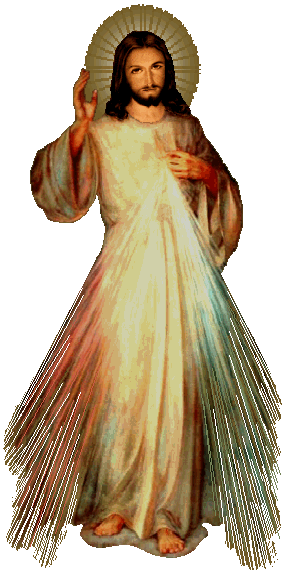
Showing posts with label Divine Mercy. Show all posts

Sunday, March 22, 2020

The Holy See Grants 'Emergency' Conditions to Receive the Plenerary Indulgence Attached to the Divine Mercy Chaplet.


"This great news was announced in an official decree from the Apostolic Penitentiary on March 20, 2020.

"New Plenary Indulgence:  Because of the pandemic, anyone who, with “the will to fulfil the usual conditions (sacramental confession, Eucharistic communion and prayer according to the Holy Father's intentions), as soon as possible,” recites the Divine Mercy Chaplet with the intention “to implore from Almighty God the end of the epidemic, relief for those who are afflicted and eternal salvation for those whom the Lord has called to Himself,” can receive a plenary indulgence each day." - Read more here.

The Church has the right and the duty to appeal to the God of mercy 'with loud cries' " (Rich in Mercy, 15).

This is very good news. It seems to me if there is any 'bright side' to the pandemic and quarantine, it is the freedom from exacting rules and regulations attached to Catholic worship.


I'm serious. Think about parents with families who scramble to get everyone ready for Mass and just make it on time every Sunday. Or those families who have to drag unbelieving kids to Mass, only to put up with their disgruntled attitude. Think of those people who feel unwelcome at church for whatever reason - maybe they are like the woman at the well, who had been married 5 times? Think of fat people who are embarrassed to go to church, or the poorly dressed and so on. Or those, 'steeped in sin since birth' - now they can assist at Mass and devotions from home, make spiritual communions, without suffering 'ridicule' such as was served to the man born blind in today's Gospel.


Perhaps, since some churches are closed, and Mass is not offered publicly, it is ironically now finally opened to all? A sort of anticipation of Revelation 21 - 'I saw no temple in the city, for its temple is the Lord God almighty and the Lamb. During the day its gates will never be shut, and there will be no night there.' This interior prayer of recollection unites us to Christ's silent loving action in the Eucharist, to his constant intercession before the Father.


Likewise, the extraordinary efficacy of the DM Chaplet is once again made available to all who simply have the 'intention' of fulfilling the protocol for gaining a plenary indulgence. The Mercy of God is everwhere present in a more profound way than we ever realized before this crisis. 'There is no pit so deep, that is love is deeper still.'

Souls that make an appeal to My mercy delight Me. To such souls I grant even more graces than they ask. I cannot punish even the greatest sinner if he makes an appeal to My compassion (Diary, 1146). Beg for mercy for the whole world (570). No soul that has called upon My mercy has ever been disappointed (1541).

No one who comes to me will I ever reject.

Saturday, April 27, 2019

Divine Mercy Sunday


The Feast of Mercy.

The last Day of the Easter Octave - the Feast of Mercy - it is as if Christ calls out: Come to me, all of you, no matter who you are, where you are, what you are doing - no matter how far away.

Jesus told St. Faustina:
"I desire that the Feast of Mercy be a refuge and shelter for all souls, and especially for poor sinners."
He seeks us first, even though it seems like we seek him first, especially in times of trouble, danger, sadness and grief.  As soon as we call, as soon as we pray - he hears us.  He catches us when we fall and restores us to life in Him.  We have proof of that in Minnesota!

In my experience, the devotion to Divine Mercy has been like my foot in the door of salvation. Christ's invitation is really a 'come as you are' invite. "Come to me, all you who are heavily burdened and weighed down ..." He came to call sinners - those who are well do not need a doctor - those most in need of mercy do.
On that day the very depths of My tender mercy are open. I pour out a whole ocean of graces upon those souls who approach the fount of My mercy. The soul that will go to Confession and receive Holy Communion shall obtain complete forgiveness of sins and punishment. - Jesus to Faustina
Yet, even without these requirements, our Lord's invitation to those most in need of mercy stands out in a singularly unique manner on the Feast of Mercy.  We can never measure or limit the extent and depth of his mercy. He told St. Faustina to go throughout the world, extending his invitation to come to him, to come to his image, depicted for her, and revealed for us, as the Divine Mercy, signed with the prayer, "Jesus I trust in you!" He promised unimaginable graces to those who turn to him:
 "My mercy is so great that no mind, be it of man or of angel, will be able to fathom it throughout all eternity."
I'm convinced He has many ways of grasping us and attracting us to his merciful love.  When we trust him, and express that trust in prayer, no matter who we are or where we are at, he comes to us and can enter through any door, locked or unlocked.  Time after time.

His Mercy endures forever!

Saturday, March 17, 2018

Asking prayers for my friend Larry


My friend Larry Damico seems to be 'transitioning' in his last days. His daughter posted a note saying as much on his Caring Bridge site. Please pray for him - and his family of course. This is the summit of one's earthly life, so to speak. It's an awesome moment. It is an honor and a great act of charity to assist, to tend to the dying. I can only do so in prayer, and feeling inadequate at that, I ask my online friends who don't really know Larry to join me in prayer for him now, in these last days. Thank you.

Saturday, April 15, 2017

Many conversions happen in Holy Week and throughout the Easter Octave.


Mine did.

Years ago my friends used to like to go to the Good Friday services high.  We were all raised catholic, and so something beckoned us I suppose.  One year, no longer high, I encountered Christ.  It was Paschal time.  It was pretty stunning.

Legend has it that at Monte LaVerna in Italy, the rocks split apart during the earthquake at the moment Jesus died on the cross.  I like to think of those legends, how the dead arose and appeared, the earth shook, the curtain in the Temple was torn in two, people beat their breasts.  And Christ descended into hell, among the dead, truly the Son of God ... he descended.

So these miracles continue, especially during this holy season - I'm convinced of it.  I also think these miracles happen especially during the Divine Mercy novena.

So, let nothing impede you.  Drunk or high, steeped in sin, filthy from rolling in the mud of your passions, stop into a church.  Visit the 'tomb'.  Visit Christ in the tabernacle.  Stop and look at the Divine Mercy image, or the Sacred Heart, or the crucifix.  Just look.  Whisper a little prayer, a thought, show him your wounds ... light a candle for Our Lady.  She opens our hearts - and Christ rushes in.  Love overcomes all.

Nothing is impossible with God.  No situation, no addiction, no lifestyle.  Nothing is impossible for God to fix.

I'm convinced many conversions happen during Holy Week and Easter.  The lame walk, the blind see, the deaf hear, the dead are raised.  The power flowing from his Resurrection is living and active, sharper than any two-edged sword, piercing to the division of soul and of spirit, of joints and of marrow,  and able to discern reflections and thoughts of the heart.  He who descended among the dead is closer to you than ever ...

Jesus, I trust in you.


Wednesday, December 02, 2015

The Jubilee Year - an Extraordinay Holy Year of Mercy.

He who refuses to pass through the door of My mercy 
must pass through the door of My justice. - Jesus to St. Faustina


Something neo-Albigensians seem to see no need for ...

Protestants would reject the idea as well:  You don't need a holy year to show mercy.  All you have to do is ask for forgiveness, confess Christ, welcome him into your heart, and you'll be saved.  We are all saved, right?  Catholics don't think like that - or do they?  Some seem to be heading in that direction - kinda sorta.

I read a post on the Pope's visit to the mosque in CAR.  Within that post, a blogger I can sometimes appreciate, commented, or more or less questioned the 'need' for a Holy Year of 'mercy':
Mercy! What that adds or expresses about the mercy always available from the Church is unexplained. It is like if I told my wife, "Starting December 8, for a whole year, I'm going to love you!" She would be justified in wondering what that implies about the "normal" time outside of the Year of Love. One suspects more PR: focus the people's attention on the mercy of the Church. The Bear supposes this is not such a bad thing, but it does make it sound "new and improved!" Still, the Bear is inclined to withhold judgment until we see it in action. - Source
I think he's an attorney as well.  Attorneys are smart.  I know some attorneys - they are really smart.

So anyway.

So here's the deal.  I wonder if some of the Catholics who see no need for a Holy Year of Mercy maybe just do not realize the significance of a Holy Year in Judeo-Christian tradition?  Then, I wonder if they are unfamiliar with the Devotion to Divine Mercy, as revealed to St. Faustina and promulgated by St. John Paul II?

The Jubilee Year is an entire year wherein the faithful may receive 'the Great Pardon' or plenary indulgence - the full remission of the penalties of sin through confession and firm purpose of amendment.  As the Holy Father points out in Misericordiae Vultus:

A Jubilee also entails the granting of indulgences. This practice will acquire an even more important meaning in the Holy Year of Mercy. God’s forgiveness knows no bounds. In the death and resurrection of Jesus Christ, God makes even more evident his love and its power to destroy all human sin. Reconciliation with God is made possible through the paschal mystery and the mediation of the Church. Thus God is always ready to forgive, and he never tires of forgiving in ways that are continually new and surprising. Nevertheless, all of us know well the experience of sin. We know that we are called to perfection (cf. Mt 5:48), yet we feel the heavy burden of sin. Though we feel the transforming power of grace, we also feel the effects of sin typical of our fallen state. Despite being forgiven, the conflicting consequences of our sins remain. In the Sacrament of Reconciliation, God forgives our sins, which he truly blots out; and yet sin leaves a negative effect on the way we think and act. But the mercy of God is stronger even than this. It becomes indulgence on the part of the Father who, through the Bride of Christ, his Church, reaches the pardoned sinner and frees him from every residue left by the consequences of sin, enabling him to act with charity, to grow in love rather than to fall back into sin. - Holy See
[One really ought to read the entire document, Misericordiae Vultus - the Holy Year is much more than the indulgences attached.  For a more complete catechesis on the Jubilee Year go here: USCCB.]


The Second Sunday of Easter is the Feast of Divine Mercy and is privileged day to gain a plenary indulgence on, as is the Franciscan feast of the Portziuncola and the Carmelite Toties Quoties of Our Lady of Mt. Carmel.  All Catholics know there are designated days and seasons for liturgical rites, as well as opportunities to gain special indulgences - even Traditional Catholics know of these - I say it that way because some seem to reject the Devotion to the Divine Mercy and its liturgical Solemnity.

Devotion to the Divine Mercy seems to be well known to most Catholics, although I suspect the Holy Year will be a time to promulgate the devotion and practice even wider - throughout the world. I find these quotes from the Diary of St. Faustina helpful in understanding the need we have for a Jubilee Year of Mercy - and Extraordinary Holy Year.

You will prepare the world for My final coming. (Diary429)
Speak to the world about My mercy ... It is a sign for the end times. After it will come the Day of Justice. While there is still time, let them have recourse to the fountain of My mercy. (Diary 848)
Tell souls about this great mercy of Mine, because the awful day, the day of My justice, is near. (Diary 965).
I am prolonging the time of mercy for the sake of sinners. But woe to them if they do not recognize this time of My visitation. (Diary 1160)

Before the Day of Justice, I am sending the Day of Mercy. (Diary 1588)
He who refuses to pass through the door of My mercy must pass through the door of My justice. (Diary 1146).

For more information on Devotion to the Divine Mercy go here.

Saturday, April 11, 2015

Tell the whole world about My mercy and My love.


"Tell the whole world about My mercy and My love. The flames of mercy are burning Me. I desire to pour them on human souls. Oh, what pain they cause Me when they do not want to accept them! ... do whatever is within your power to spread devotion to My mercy. I will make up for what you lack. Tell aching mankind to snuggle close to My merciful Heart, and I will fill it with peace. Tell [all people] that I am Love and Mercy itself." (Diary, 1074) - Jesus to St. Faustina

Some priests I've known have said this devotion is out of place in the Octave of Easter, since we just came from Lent and Holy Week's emphasis on the Passion of Christ - Easter week should be celebratory.  I don't think the devotion detracts from the joy of Easter at all.  I think we can forget that when Jesus appeared to the Disciples, he often reminded them of his Passion and how necessary it was for him to suffer all of those things in order to enter into his glory.  Beginning with Moses and the prophets, interpreting to them all that referred to him in the Scriptures.

Likewise, the Second Sunday of Easter is all about the forgiveness of sins, as well as his holy wounds - testimony to his sorrowful Passion.  So, it seems to me the devotion is perfectly situated on the evening of the first day of the week - the Second Sunday of Easter.

Jesus, I trust in you.  You yourself established and confirmed this Solemnity.

Thinking about the Sacrament of Penance


St. Leopold Mandić

Like an early desert father - he took upon himself the penances others thought he should be giving his penitents. Isn't that kind? Isn't that generous? Isn't that love? Isn't that mercy? Carrying one another's burdens. Being moved with pity by the weakness of others. St. Leopold made himself available for confession - like a watchman, he waited at the gates and in the confessional to reconcile those who passed by.

A couple of quotes from St. Leopold...

"Some say that I am too good. But if you come and kneel before me, isn't this a sufficient proof that you want to have God's pardon? God's mercy is beyond all expectation."
"Be at peace; place everything on my shoulders. I will take care of it." He once explained, "I give my penitents only small penances because I do the rest myself."
"A priest must die from apostolic hard work; there is no other death worthy of a priest."

Leopold suffered from esophagus cancer, which would ultimately lead to his death at age 76. On July 30, 1942, while preparing for the liturgy, he collapsed on the floor. He was then brought to his cell, where he was given the last rites. Friars that had gathered at his bed began singing the Salve Regina and saw that Leopold died as they sang "O clement, O loving, O sweet Virgin Mary." - Source


St. Leopold pray for us to Our Lady.

Sunday, April 05, 2015

On the evening of the first day of the week ... John 20:19

ISIS is reportedly in Damascus this Easter.

"Look! Don’t you see many roads, paths and fields full of people 
crying of hunger, not having anything to eat?
. . . And the Holy Father in a Church praying next to the Heart of Mary?"
- Bl. Jacinta Marto


Jesus, I trust in you!


Once, while driving home after Mass one day, I imagined I encountered Christ with masses of people behind him, populating rolling hills as far as the eye could see - it reminded me of the passage in the Book of Revelation (7:9):  "After this I had a vision of a great multitude, which no one could count, from every nation, race, people, and tongue. They stood before the throne and before the Lamb, wearing white robes and holding palm branches in their hands."  I imagined that I fell to my knees and begged for His mercy.

It was only flash of my imagination - lasting less than an instant - but the sudden, unexpected 'meditation' generated great confidence in the Divine Mercy.


"My Heart overflows with great mercy for souls,

especially for poor sinners.

It is for them that the Blood and Water

flowed from my heart as from a fount

overflowing with mercy. For them

I dwell in the tabernacle as King of Mercy."


Prayers for the persecuted, those facing martyrdom.

Then one of the elders spoke up and said to me, “Who are these wearing white robes, and where did they come from?”  I said to him, “My lord, you are the one who knows.” He said to me, “These are the ones who have survived the time of great distress; they have washed their robes and made them white in the blood of the Lamb. 
“For this reason they stand before God’s throne
and worship him day and night in his temple. 
The one who sits on the throne will shelter them. 
They will not hunger or thirst anymore,
nor will the sun or any heat strike them. 
For the Lamb who is in the center of the throne will shepherd them
and lead them to springs of life-giving water,
and God will wipe away every tear from their eyes.”
- Revelation 7

Saturday, April 04, 2015

The Divine Mercy

Divine Mercy sanctuary - Vilnius

"Imprint in our heart, Lord, sentiments of faith, hope and charity, of sorrow for our sins, and lead us to repent for our sins that have crucified You." - Pope Francis

I watched the Stations of the Cross from Rome last evening.  I was deeply impressed with the prayers, especially the last, prayed by the Holy Father.  He looked very tired to me, and sounded so 'soft' - and I loved how he wove all that troubles mankind into an appeal for mercy.
O Christ crucified and victorious, Your Way of the Cross is the summary of your life, the icon of Your obedience to the will of the Father, and the realization of your infinite love for us sinners. It is the proof of Your mission. It is the final fulfillment of the revelation and the history of salvation. The weight of Your cross frees us from all of our burdens. In Your obedience to the will of the Father, we become aware of our rebellion and disobedience. 
In You, sold, betrayed, crucified by Your own people and those dear to you, we see our own betrayals and our own usual infidelity. In Your innocence, Immaculate Lamb, we see our guilt. In Your face, slapped, spat on and disfigured, we see the brutality of our sins. In the cruelty of Your passion, we see the cruelty of our heart and of our actions. In Your own feeling of abandonment, we see those abandoned by their families, by society, by attention and by solidarity. 
In Your body, sacrificed, ripped and torn, we see the body of our brothers who have been abandoned along the way, disfigured by our negligence and our indifference. In Your thirst Lord, we see the thirst of Your merciful Father, who desired to embrace, forgive and save all of humanity. In You, Divine Love, we see even today, before our very eyes, and often with our silence and complicity, our persecuted brothers and sisters, decapitated, crucified for their faith in You. - Pope Francis

Don't forget the Divine Mercy devotion - especially as we prepare for the Holy Year - and of course, the Synod on the Family.  I look forward to both - I have such peace regarding these two events.  All the fears, the talk, the gossip, the reaction against the Holy Father, the Synod, and even an apparent resistance to the proclamation of Mercy itself, seems to me, to be unwarranted.  I think my confidence is a grace, the fruit of Divine Mercy:  Jesus I trust in you!

So, whatever your state of mind - indeed - your state of soul - turn to the Divine Mercy.  The novena began on Good Friday, but you can begin it anytime - the essential element of the novena is the Chaplet of Divine Mercy - pray that and use the image to captivate all your senses, all the faculties of your soul.

I know many images exist and many may not appeal to some Catholics - but try to overlook the variety of styles.  Mortify your artistic sensibilities, and like a child, in an attitude of spiritual poverty, find a representation which appeals to your heart.  I prefer some of the earliest images, within the context of the sanctuaries wherein they are venerated.  Imagine yourself, in the light pouring forth from the sacred image, in the blood and water flooding your soul, immerse yourself therein and suspend yourself in that light - or let yourself be suspended, lifted up in His merciful love.

Tuesday, April 22, 2014

"We are living on borrowed time ..."

“Oh Lord, be merciful to me, a sinner” (Lk. 18:13).


Pope Francis said that.

He was speaking to the priests of Rome during their retreat last Month.  He was speaking on Divine Mercy, once again pointing out that we are "living in a time of mercy, for the past thirty years or more, up to today.”
“We are not here to take part in a pleasant retreat…but rather to hear the voice of the Spirit speaking to the whole Church of our time.” Any place, even Rome, is every place. The Spirit speaks to “the whole Church of our time, which is a time of mercy.” - Pope Francis
A couple excerpts from Fr. Schall's article:

"Logically, a time of mercy or of grace would mean that era should be otherwise. We are living on borrowed time. Here, Francis recalls the canonization of Sister Faustina Kowalska and the Divine Mercy Sunday that John Paul II began. At that time, John Paul II clarified a most significant doctrine. God, John Paul observed, would forgive everything that could be forgiven. Some things even God could not forgive. What are these? On those men who refused to be forgiven—who reject mercy—God cannot impose His will. He does not wish to undermine genuine free will. To do so, would undermine the whole redemptive order, the whole worth of His free relation to man. Heaven cannot be populated by human beings who refuse to be there, whose lives indicate they do not want to be there.

The Pope adds that besides “open wounds,” we have “hidden wounds.” “There are people who distance themselves through shame.” They do not want their wounds to be seen, so they hide themselves. They are “bitter against the Church, but deep down there is a wound. They want a caress!” The Pope then asks the Roman clergy whether they know “the wounds of your parishioners?” To be close to them is “the only question.” This reflection leads the Pope back to the rigorist and laxist priests. “It is normal that there be differences in the style of confessors, but these differences cannot regard the essential, that is, sound moral doctrine and mercy.” Francis doubts if either the rigorist or the laxist confessor ever really knows the problem of the penitent. “True mercy takes the person into one’s care, listens to him attentively, approaches the situation with respect and truth, and accompanies him on the journey of reconciliation.” This journey has to include “pastoral suffering, which is a form of mercy.” It is not an easy journey to suffer with someone. - Catholic World Report
Divine Mercy - if you have left the Church and the sacraments, if you are sad like Mary Magdalen, weeping, unconsoled at the tomb; or if you are like the disciples who disappointed, left Jerusalem for Emmaus, do not lose heart - turn to the Divine Mercy.


H/T PML for Catholic World Report article.

Tuesday, April 15, 2014

The story of Judas scares me.

Blood and water flowing from the side of Christ as a font of mercy for us, I trust in you.


I never really considered myself a Judas, that is I never  wanted to place myself in a meditation that he showed up in.  In fact I always tried to avoid thinking too much about the man who betrayed Christ.  He was just a warning for me, something to be feared and put off.  This year is different.  The Gospel passage where Judas feigns innocence, asking Our Lord, 'is it me who will betray you?'  'surely it's not me?' has resounded in my heart.

I often wondered if Judas was somehow really innocent, yet it seems to me his questions demonstrated that he actually knew Our Lord was referring to him.  

Did you ever do that?  Not in big things like Judas of course.  But - he who is not faithful in small things will not be faithful in big ones.  So.  Did you ever do something like that?  Get caught in a lie?  Then dissimulate and act as if you were innocent when someone suggested that you were lying?  Or pretended that you didn't even know they knew you knew they knew you lied?  Only later to try and cover up your lie with protests that those you betrayed somehow betrayed you?  Crazy logic - blame the victim for your little lie.  Convincing yourself you were somehow justified.

I think Judas thought he was not only full of good intentions, but that he himself was good; I'll bet he never thought of himself as a liar or a thief.  I think he felt in control, in charge of his life, like the faithful steward doing his duty, although he was surely the dishonest steward.  Somehow he justified himself.  I think he always did that - and he believed he was virtuous.  Today we might call that denial.  He demonstrated that when he complained about the ointment used to anoint our Lord, suggesting it should have been sold and the the proceeds given to the poor, perhaps reserving a small 'fee' for himself.  He perhaps had 'good' intentions, but it wasn't his call.  Of course he did 'good' things - he followed Jesus, he prayed and evangelized with him, he was a 'faithful' disciple and Jew - he kept the Law.  So what happened?

He could have repented.  Our Lord would have forgiven him as he did Peter.  As he did Zacchaeus.

"Look, half of my possessions, Lord, I will give to the poor; and if I have defrauded anyone of anything, I will pay back four times as much." - Luke 19

How can I repay?  How can I repair?  I repent.  I pray for those I have offended and ask their forgiveness.  I'm sorry.

But who can detect all of his errors?
From hidden faults acquit me.

From presumption restrain your servant
and let it not rule me.
Then shall I be blameless,
clean from grave sin. - Ps. 18 

Friday, March 07, 2014

“The entire Church in our time” is “living in the time of mercy,” Pope Francis


“We are not here to perform a spiritual exercise for the beginning of Lent, but rather to listen to the voice of the Spirit that speaks to everyone in the Church in this, our time, which is indeed the time of mercy”. - Pope Francis to the Clergy of Rome


I don't know about you, but I think it is awesome the Holy Father keeps mentioning the fact that we are living in the time of Mercy - this time specifically referring to St. Faustina and the devotion revealed to her by Our Lord.

Speak to the world about My mercy… It is a sign for the end times. After it will come the Day of Justice. While there is still time, let them have recourse to the fountain of My mercy. —Divine Mercy in My Soul, Diary of St. Faustina, 848

Sunday, April 07, 2013

Contact high or flashback? Just reading about psilocybin makes me feel all warm and fuzzy...


"We live in a world of insanity..."

I know you know that I used to do drugs - way, way, back when I wished that the world could be... just... like... Woodstock.  I wasn't doped up all the time of course, but I did enjoy my weekends.  Fortunately for me, my very best friends became all spiritual - but not religious - and because of peer pressure - Donna and Jim dissing me for being so low class as to continue using - I stopped.  Kind of.  I didn't do as much, and went on 'trips' by myself.  But that's another post.

Anyway.

This morning I was reading an article on how researchers are testing psilocybin, the hallucinogenic ingredient in 'magic mushrooms', to help patients with severe depression.  The problem for researchers is the drug is illegal...
David Nutt, (I know!) president of the British Neuroscience Association and professor of neuropsychopharmacology at Imperial College London, said he had been granted an ethical green light and funding for the trial, but regulations were blocking it. "We live in a world of insanity in terms of regulating drugs," Nutt told a neuroscience conference in London on Sunday.
[...]
Psilocybin - or "magic" - mushrooms grow naturally around the world and have been widely used since ancient times for religious rites and also for recreation.

Researchers in the United States have seen positive results in trials using MDMA, a pure form of the party drug ecstasy, in treating post-traumatic stress disorder.

"What we are trying to do is to tap into the reservoir of under-researched illegal drugs to see if we can find new and beneficial uses for them in people whose lives are often severely affected by illnesses such as depression," - Nutt said. - Read more here.
No doubt it would work and not only be effective, but highly desirable as well ... the whole world is depressed, right?  $$$.  Wasn't there a novel about the use of Soma?  Soma is like MDMA - yes, I experimented with that too.  Ah, too bad.  As if the world isn't prescription drugged up enough now?

My recreational use is decades past - I don't want drugs in my life.  Thanks be to God.  Years ago a priest once suggested one of the reasons my conversion experience may have been so extraordinary was that Our Lord needed to overcome the effects of the drugs.  He laughed when he said it, but only God knows.  God's love is so much greater, deeper, and lasting than anything we can do to ourselves.  And no, I was never in treatment - not that it's a bad thing, but my conversion was instantaneous, and I experienced no withdrawal from the drugs or alcohol.  Praise God. 

Praise His Divine Mercy!


Song for this post here.

Thursday, April 04, 2013

When you least expect it...


"My Heart overflows with great mercy for souls, especially for poor sinners... It is for them that the Blood and Water flowed from My Heart as from a font overflowing with mercy.  For them I dwell in the tabernacle as King of Mercy. [Diary 367]


Tuesday, April 02, 2013

Divine Mercy

Jesus, I trust in you.


Usually I try to post something on the novena to Divine Mercy, but this year I was distracted ...

I did not forget to begin the novena on Good Friday however.  If you forgot, it is never too late to join in.  It ends on Sunday, the Feast of Divine Mercy.  Keep in mind that praying the chaplet of Divine Mercy is the essential prayer of the novena - our intentions may be the same as St. Faustina's, or we may make our own.

The devotion also requires us to show mercy to one another.  Our Lord told Faustina:
I demand from you deeds of mercy which are to arise out of love for me.  You are to show mercy to your neighbors always and everywhere.  You must not shrink from this or try to excuse yourself from it. [Diary, 742]
 
Blessed Alberto Marvelli always prayed, "for the grace to be merciful to others."
Help me, O Lord, that my eyes may be merciful, so that I may never suspect or judge from appearances, but look for what is beautiful in my neighbors souls and come to their rescue. - St. Faustina

Monday, April 09, 2012

Lent is over - it's Easter now.

Jesus, I trust in you.


Are you changed?

Or was it wasted on you?

Divine Mercy Sunday is coming.

Saturday, April 30, 2011

The Pope of Divine Mercy


Jesus, I trust in you!

I desire to grant unimaginable graces to those souls who trust in My mercy.  …  Through the Chaplet you will obtain everything, if what you ask for is compatible with My will. - Christ to St. Faustina.
.
Terry of Idle Speculations posted the photo I am using here in an entry informing us that the Chaplet of the Divine Mercy will be included in the Liturgy for the Mass of Beatification of Pope John Paul II.
.
I'm so happy for this - if I understand correctly, the Chaplet will be recited at some point within the Mass?  The Divine Chaplet is the one prayer Our Lord especially urged to be propagated throughout the world, and prayed every day during the Novena, which concludes today.  In fact he asked St. Faustina to pray it unceasingly.  He promised that if the most wretched sinner, the most fallen, hard hearted, repeat offender recited this Chaplet even once, that soul would not fail to receive His grace.  I can tell you from experience this is absolutely true.  The Divine Chaplet proves 'there is no pit so deep that his love and mercy is not deeper still.' (Betsy Ten Boom)
.
Another reason I rejoice that the Chaplet may be enclosed within the Liturgy for the Beatification is because I've come to understand it as a liturgical prayer - that is, a prayer based upon the source and summit of the Liturgy, the Eucharist.  I experience it as a prayer that is able to unite one deeply to the Holy Sacrifice of the Mass.  I believe the prayers of the Chaplet express what the priest does at Mass:  At Mass, the priest offers the Body, Blood, Soul, and Divinity of Our Lord Jesus Christ to the Father in atonement for our sins and those of the whole world.  Holy Mass is the memorial of His sorrowful passion, in season and out of season as it were - that is in Lent and Eastertide, Advent and Christmastide, after Pentecost and Ordinary time. 
.
It seems to me that the Chaplet is a form of prayer deeply uniting the soul to the liturgy - a sort of spiritual  active participation in the prayer of the Church outside the celebration of the Mass or the Liturgy of the Hours.  The Chaplet is a means that unites us to every Mass offered throughout the world, to the silent, loving action of Our Lord in the Eucharist - in other words, to the unceasing prayer of Christ before the Eternal Father.  I'm convinced it can unite us so deeply to Christ that it can become a form of spiritual communion - a means of union with God.
.
(These thoughts are simply my private opinion of course, to my knowledge neither the Diary of St. Faustina, nor the Church have ever expressed the devotion of the Chaplet in this way.  The promises of Christ attached to the Chaplet are sufficient to convince any one to pray the Chaplet with devotion.)
.
From John Paul II:  (H/T Idle Speculations)
.
"The Message of Divine Mercy has always been near and dear to me. It is as if history had inscribed it in the tragic experience of the Second World War. In those difficult years it was a particular support and an inexhaustible source of hope, not only for the people of Krakow but for the entire nation.

.
This was also my personal experience, which I took with me to the See of Peter and which in a sense forms the image of this Pontificate.
.
I give thanks to Divine Providence that I have been enabled to contribute personally to the fulfilment of Christ's will, through the institution of the Feast of Divine Mercy. Here, near the relics of Blessed Faustina Kowalska, I give thanks also for the gift of her beatification. I pray unceasingly that God will have "mercy on us and the whole world" (Chaplet)." - Shrine of Divine Mercy, Krakow, 7 June 1997
.
Our Lord's Promises Attached to the Chaplet of Divine Mercy:

.
“The souls that say this chaplet will be embraced by My Mercy during their lifetime and especially at the hour of their death.” (Diary 754)
.
“When hardened sinners say it, I will fill their hearts with peace and the hour of their death will be a happy one.” (Diary 1541)
.
“No soul that has called upon My mercy has been brought to shame. I delight particularly in a soul that placed its trust in My goodness.” (Diary 1541)
.
“When they say this chaplet in the presence of the dying, I will stand between My Father and the dying person, not as a just judge but as a Merciful Savior.” (Diary 1541)
.
“Whoever will recite it will receive great mercy at the hour of death.” (Diary 687)
.
“Priests will recommend it to sinners as their last hope of salvation. Even if there were a sinner most hardened, if he were to recite this chaplet only once, he would receive grace from My infinite mercy.” (Diary 687) - Source
.


Today is the last day of the Divine Mercy Novena...


And tomorrow, the Second Sunday of Easter, is the Feast of Divine Mercy.
.
"Go and learn the meaning of the words, 'I desire mercy, not sacrifice.'  I did not come to call the righteous but sinners." - Matthew 9:13


Friday, April 29, 2011

What is most important...


Jesus, I trust in you.

The Divine Mercy.
.
It seems to me that the Divine Mercy encompasses all the events of our day: The wars, the storms, the tsunamis, the earthquakes, the Royal Wedding, the Beatification, and so on.  Every event, every joy and sorrow, every person is seen by the Risen Christ.  It occurred to me this morning while praying the chaplet that the prayers of the novena are intended to reveal that - or better said, meant to reveal the presence of Christ to each and every group of souls in the family of mankind.  And within the varied categories of humanity, no matter ones status, state in life, ethnicity, religious affiliation, non-believer, souls in purgatory, what have you - the Lord seeks to reveal himself and his merciful love to each and every individual.  Thus he asks us to participate in and through the prayers of the novena, exercising ourselves in mercy and love by our prayer for one another, specifically, one by one, day by day - a group of souls and every particular soul within that group.  It is an unimaginable grace to be justified by the Divine Mercy.
.
Let us remember those who continue to suffer from natural disaster and war and ethnic conflicts.  I received an email from a friend asking for prayers especially for the children, victims of the recent tornadoes:
.
"It is with a heavy heart that I write you this morning asking for prayers for the children affected by tornadoes yesterday.  Children's Hospital is full and many of the critically injured children are just known only as "Disaster patient ####"  due to no known identity.  There is no telling how many more children will be coming today as the clean up process begins across our area." 
.
.

Art: The Descent into Hell, TINTORETTO

Mercy and Trust, Confidence and Love.

Jesus, I trust in you.


For he knows how we are formed, he remembers that we are dust. - Psalm 103: 14
.
It seems to me that the hallmarks of the Divine Mercy devotion align perfectly with the 'little way' of St. Therese of the Child Jesus...
.
Mother Agnes of Jesus on her sister and her heroic virtue of hope:
.
"Trust in God had become her special characteristic.  She once told me that she had been struck from childhood by this verse from the Book of Job: 'Even if he were to kill me, I would continue to hope in him.'
.
She expected as much from God's justice as she did from his mercy, 'How nice it is to think that God is just!' she said.  'It means he takes our weakness into account and knows full well how frail we are by nature.'  She also said she would prefer to live without consolation, because that way she could give God greater proof of her trust in him."  St. Therese By Those Who Knew Her, testimonies for the process.
.
Ven. John Paul II also alludes to the justice of God and his mercy in the encyclical, Dives Misericordia,  discussing the parable of the Prodigal Son: 
.
In the parable of the prodigal son, the term "justice" is not used even once; just as in the original text the term "mercy" is not used either. Nevertheless, the relationship between justice and love, that is manifested as mercy, is inscribed with great exactness in the content of the Gospel parable. It becomes more evident that love is transformed into mercy when it is necessary to go beyond the precise norm of justice-precise and often too narrow. - On The Mercy of God, John Paul II