Monday, December 04, 2006

The Divine Liturgy


Reports are that the SSPX is infiltrating the Ukraine, and drawing people away - or attempting to do so - from the Byzantine rite. (I don't know for certain if this is really the intention of the SSPX however.) Although it seems to be the fear, Gerald covers this on The Cafeteria Is Closed.

It seems as if the SSPX may be more sinister than imagined - if it is true. One ought not to fool around with the Byzantine rite, which has equal status with the Roman rite - then and now. This is a point of contention the separated Orthodox have misgivings about, that Rome could impose Vatican II type "renewal" in their liturgies as has been done in the Roman rite - if they ever consent to union, that is. Of course, the Ukrainian Byzantine Catholics are in union with Rome, and autonomous as far as liturgical rites, nevertheless, the insurgence of SSPX and the Traditional Roman rite poses some serious problems.
The SSPX are not the Roman Catholic Church, they are in schism with the true Church - people have to realize and understand that. If they are attempting to usurp the venerable and ancient Byzantine rite, they are no better than protestants or Jehovah Witnesses. Oy! The hutzpah! Talk about being more Catholic than the Pope all they want, it seems to me they are trying to be more holy than the Church.

Saturday, December 02, 2006

The Holy Father's First Vespers of Advent

Read all about it here:
Ist Vespers In St. Peters

It reads like a review of an opera or a play. Critical analysis, checking out who was there and what they wore, etc. (That's what I don't like about St. Agnes sometimes. I often think many people are there just for the music and the liturgical costumes.)

How prayerful.


(Sorry, still no ability to upload photos.)

Friday, December 01, 2006

Worst Christmas Ad - so far...

"Peace, Love and Gap"
Way too ghetto.

Nevertheless, and I mean less, it's telling as to what kids want. Isn't rap over yet? Could the Marketing Director for Gap get fired or something? It misses - the ad just misses.

Thursday, November 30, 2006

Wednesday, November 29, 2006

The Pope in Turkey


Benedict is fairing very well in Turkey, praise God. Aside from the prayer of the faithful, I wonder if his friend Bl. John XXIII is not offering special protection, since the Holy Father entrusted this trip to his intercession. Perhaps to reward John XXIII, the Holy Father will canonize him soon.
The media hypes this trip as something done to make peace with Islam after the uproar over the Holy Father's remarks at an address at Regensburg in Germany awhile back.
The point of the pilgrimage, or Apostolic Visit is to meet with the Patriarch Bartholomew of Constantinople, the "First Among Equals" of the Eastern Orthodox Catholic Church. It is an effort to restore union to the Church. His courage in going to a land where his life has been threatened, must demonstrate dramatically to the Orthodox the Pope's sincerity and love for The Eastern Churches, as well as his hope for unity. I think the entire world must also be impressed by his courageous actions.
May St. Andrew, the Apostle of the Eastern Churches, whose feast we celebrate tomorrow, hasten this union and continue to protect our Holy Father, Benedict XVI.

Monday, November 27, 2006

Feast of the Miraculous Medal


Today is the commemoration of the apparition of the Immaculate Conception to St. Catherine Laboure at Rue d' Bac, Paris in 1830.
Pictured is the image of the Blessed Virgin as she appeared to Alphonse Ratisbonne, an agnostic Jew, effecting in him an instantaneous conversion to the Roman Catholic Church. (The Church is in Rome and is called S. Andrea della Fratte.) Ratisbonne had been persuaded by a friend to wear the Miraculous Medal, or as it was first known, the medal of the Immaculate Conception.
As a result of his conversion, the devotion of the medal swept Europe, thus gaining recognition as the Miraculous Medal, due to countless graces generated through the devotion.
O Mary conceived without sin, pray for us who have recourseto thee.

Sunday, November 26, 2006

The man with the Blackamoor on his coat.


Coat of arms that is.

That would be Pope Benedict XVI of course and he is getting ready to visit Turkey.

A fine priest said I shouldn't even discuss such things as the possibility of as@%*^nation. Yet there is that novel written about it, and lots of protest in Turkey over his impending visit, as well as 'unprecedented security' - as they always say - covering the visit. In the land of intrigue known for cloak and dagger politics, populated by radical Islamics, I'm not comfortable with this visit. Today the Holy Father asked for our prayers to accompany him on his pilgrimage of reconciliation. He has mine.

I like his coat of arms. (I like bears.) Who is the Moor however?

He is the Moor of Freising:

"The Moor's head is an heraldic charge associated with Freising, Germany. The origins of the Moor's head or caput ethiopicum in Freising is not entirely known. Typically facing left it appeared on the coat of arms of the old principality of Freising as early as 1316. Some theories of its reference include:

Balthasar, one of the Magi, by some legends a Moor
Saint Maurice, a Roman-Egyptian martyr
Saint Zeno, frequently shown as a Moor
Saint Sigismund, often confused historically with Saint Maurice
Saint Corbinian, founder of the Diocese of Freising, mistakenly thought to have been a Moor
" - Wikipedia - I like that place.

A recent book has been published about the third secret of Fatima, (and Rocky says, "Again"?) claiming the entire secret has not been revealed, just the visuals - sans text. Fatima conspiracy theorists love this stuff. Here is a snip from Catholic World News:

"A new book entitled The Fourth Secret of Fatima, by Italian writer Antonio Socci, questions whether a part of the message delivered by the Virgin Mary to the children at Fatima have been hidden by Church leaders for diplomatic reasons.

Socci claims that the famous "third secret," which was revealed in 1995 to describe an attack on a “bishop dressed in white,” is only a fragment of the full message. Socci bases his claim primarily on an analysis of the books Faith Report by then-Cardinal Joseph Ratzinger, and Crossing the Threshold of Hope, by Pope John Paul II. To a lesser extent he analyzes homilies, discourses, and public documents by the two Pontiffs.

Rumors and theories about the "third secret" had circulated for years, until in May 2000 the content of the secret was disclosed by Pope John Paul II. The secret detailed a vision of the "bishop dressed in white" who was caught up in a battle against an atheistic system that oppresses the Church. That bishop "falls to the ground, as if dead, after a volley of gunfire." The vision apparently predicted the assassination attempt against John Paul II. Sister Lucia, who at the time was the sole surviving Fatima seer, confirmed in 2000 that the "bishop dressed in white" was the Pope. (Sister Lucia died in February 2005.)" - Catholic World News

I personally believe we have gotten enough of the third secret, and it was interpreted quite well by Cardinal Ratzinger, who admittedly said, "It seems as if these events may have been in the past" - which leaves open the question, was JPII really "the bishop in white who collapsed as if dead amidst a hail of bullets"? Or could it be another future pope? See, visions and prophecies are hard to figure out, and if there is a missing text of Our Lady's words, we probably just don't fit the description of those having "a need to know".

But what if the blackamoor is a prophetic symbol and there really is a missing text to the third secret? Now that's the stuff I shouldn't even mention.

Regardless, the Holy Father is snugly in the hand of God, albeit he is embarking on a very dangerous journey. He asked for our prayers, and like I said, he has mine.

Viva il papa!

The Knights of Columbus are urging Catholics to accompany the Holy Father with prayer as a spiritual pilgrimage as he visits Turkey. Here is the prayer:

Prayer for the Pope

"Heavenly Father, from whom every family in heaven and on earth takes its name, we humbly ask that you sustain, inspire, and protect your servant, Pope Benedict XVI, as he goes on pilgrimage to Turkey – a land to which St. Paul brought the Gospel of your Son; a land where once the Mother of your Son, the Seat of Wisdom, dwelt; a land where faith in your Son’s true divinity was definitively professed. Bless our Holy Father, who comes as a messenger of truth and love to all people of faith and good will dwelling in this land so rich in history. In the power of the Holy Spirit, may this visit of the Holy Father bring about deeper ties of understanding, cooperation, and peace among Roman Catholics, the Orthodox, and those who profess Islam. May the prayers and events of these historic days greatly contribute both to greater accord among those who worship you, the living and true God, and also to peace in our world so often torn apart by war and sectarian violence.


We also ask, O Heavenly Father, that you watch over and protect Pope Benedict and entrust him to the loving care of Mary, under the title of Our Lady of Fatima, a title cherished both by Catholics and Muslims. Through her prayers and maternal love, may Pope Benedict be kept safe from all harm as he prays, bears witness to the Gospel, and invites all peoples to a dialogue of faith, reason, and love. We make our prayer through Christ, our Lord. Amen." - Knights of Columbus

Politics and the feast of Christ the King


Monarchists should love this feast day, while they most likely would have celebrated it according to the old calendar. The modern Church, yes even the encyclical of Pius XI, stresses the spiritual significance of the Kingship of Christ. Americans do not understand monarchy, therefore the Lordship/Kingship of Christ is more palatable to our revolutionary understanding when it is understood spiritually, not so much terrestially - we are much like our revolutionary cousins in France in this respect.

The purpose of the feast:
"Pope Pius XI instituted the Solemnity of Christ the King on 11 December 1925 in his encyclical Quas Primas. At that time he saw the rise of atheistic communism and secularism as a direct result of man's turning away from Christ's sovereignty, and man's denying of the authority of Christ's Church. This result was "disorder" or a move away from the Divine Order. The Feast of Christ the King was set on the last Sunday in October." - Wikipedia

The hoped for effects:
"25. Moreover, the annual and universal celebration of the feast of the Kingship of Christ will draw attention to the evils which anticlericalism has brought upon society in drawing men away from Christ, and will also do much to remedy them. While nations insult the beloved name of our Redeemer by suppressing all mention of it in their conferences and parliaments, we must all the more loudly proclaim his kingly dignity and power, all the more universally affirm his rights." - Pius XI, Quas primas

A few weeks ago when all the debate concerning the liberal use of the pre-Vatican II ordo of Pius V was circulating around the news and blogworld, a few people discussed the political ramifications affecting resistance towards this 'indult' apparently centered within the French hierarchy. In France, as well as Austria, Spain and other nations, there is a contingent of royalists, or monarchists supporting the liberalization of the Tridentine rite. Monarchists tend to be traditionalists, while not all traditionalists tend to be monarchists.

Considering this, it seems to me on some level, the Mass has sometimes become a political statement. I wondered if perhaps that is why it changed so dramatically the years following Vatican II, which occasioned such license in liturgical innovation. The priest facing the people, being on a horizontal plane with the congregation, the exclusion of pageantry and ritual, the inclusion of laity and ideology into the celebration? People who claim communists infiltrated the Church at the time of the Council, also claim they got their way by desacralizing the liturgy. Perhaps it wasn't as sinister as all of that however, perhaps it was simply a misguided attempt just to be more relevant to the modern world that has rejected every form of monarchy?

At any rate, it seems to me that the Mass has sometimes been used as a political tool in the hand of propagandists. I think it is a good idea to restore the Mass, both rites, to a place of dignity - without regard to politics, offering fitting praise and worship to Christ the King. Growing up, the homilies for this feast always were interjected with socio-political ideals, once again placing the emphasis upon man as opposed upon God - most of the homilies continue to be this way - I don't know what else a priest could say about the feast however.

When I think of the end of time, because this feast also focuses our attention upon that reality, I'm reminded that there will be "new heavens, and a new earth". Which means there are two things I don't get; one, I'm rather apolitical and so not a monarchist, hence the feast of Christ the King isn't a big one for me; two, I want to go to heaven while there is a natural part of me that rebels against the idea of having to land back on a "new earth" - since the old one sucks.

I need to pray for an increase of hope it seems. Pray for me if you are one of the two or three people who read this blog.

Thursday, November 23, 2006

My fondest Thankgiving memories...

Thanksgiving with my closest friends.


Remember when Ross says that he is having one of his worst Thanksgivings ever because of his divorce from Emily and eviction?

Chandler jumps in to remind everyone that he is "the king of bad Thanksgivings" and proceeds to tell the first of a series of Thanksgiving flashbacks.

Thanksgiving 1978: A young Chandler is told that his parents still love him, but his father would rather sleep with the house-boy than with his mother.

Phoebe claims she has an even worse Thanksgiving story.

Thanksgiving 1862: Phoebe is a medic for the Union Army during the American Civil War. She is tending to a wounded soldier when her arm gets blown off, prompting her to say, "Oh no."


Ross says that the Thanksgivings have to be limited to this life (as Phoebe was referring to a Thanksgiving that occurred in a 'past life'). Rachel says she knows Monica's worst Thanksgiving, but Phoebe interrupts with a story about the Thanksgiving when Joey got a turkey stuck on his head.

Thanksgiving 1992: Phoebe (who was living with Monica at the time) walks in to their apartment and is shocked to see Joey with a turkey on his head; Joey put it on to scare Chandler. Monica enters and freaks out, but she and Phoebe can't get the turkey off his head. Chandler enters and screams, and Joey tries to point and laugh at him, but keeps pointing in the wrong direction because he can't see.

From the out-takes:

In the tenth season episode entitled "The One Where Chandler Gets Caught", the same 1992 Thanksgiving flashback of this episode is used, yet Phoebe replies to Joey's complaining about the turkey smelling really bad with "Yeah, of course it smells bad. You've got your head inside a turkey's ass." instead of the "Well, of course it smells really bad. You have your head up a dead animal." As written for this episode. - Wikipedia

My friends were so fun! Miss you much - at least I have the DVDs. When co-workers ask who I'm spending Thanksgiving with, I always tell them "I'm having a few friends over" - that's not a lie, is it? Anyway, they are always so consoled I won't be spending it alone.

I am so going to sing "Memories" now - followed by "The Way We Were" and I may as well sing, "What Becomes of the Broken Hearted" while I'm at it! (Thank God for my home-karoke machine.:) The holidays can be so nostalgic can't they?

Maybe I'll go to Walgreen's and stop by Kmart - I think they're open today. (Just kidding, Ross and Rachel are coming over with Phoebe and Regina Falangi.)

EAT FRESH! :) :) :) :) :) :)


Tuesday, November 21, 2006

November 22 and the loss of innocence...


Mark Balma's "Pieta"
He's a wonderful painter. I haven't seen this painting in person but it was presented at the Cathedral of St. Paul with much fanfare last week. I like what I see in photos, although it seems a bit 'stiff' - however, I think it is just the photo - paintings need to be 'experienced' in relationship with the viewer, in person. Balma is a fine artist, the photo cannot do it justice.
The anniversary of the assassination of JFK is the 22 of November. It was 1963. I was in class, after lunch, when the announcement came over the intercom and we were all dismissed from school. I remember starring at the intercom in disbelief as the announcement was made. Returning home to watch non-stop footage on television. It is like yesterday to me.
Just a couple of years earlier Sr. Lillian led us all in prayer that this Catholic Senator would be elected President of our Country.
I, along with most of the world loved President Kennedy, and Jackie. We knew them as Jack and Jackie. They gave an international dignity and style to the White House and the presidency.
Bobby was later assassinated, and Jackie said, "They are killing Kennedys." And she took her children out of the country. Some people resented that. Not I.
I think Bobby's death hit me much harder than Jack's. He would have made a better President. I remember vividly his funeral train heading to Washington for his burial at the Arlington National Cemetery - the tracks lined all of the way with mourners. I remember it all so well..."The Battle Hymn of the Republic" played along the way. I remember Dr. King too. I do not want to look at footage of these events ever again, because they are emblazoned upon my memory. Yet younger people need to see it - they need to locate the pivotal moment of our decline.
Our Country entered it's decline in those days. I don't think we can ever recover. I know we haven't.
"Fallen, fallen is Babylon the great!
She has become a dwelling place for demons.
She is a cage for every unclean spirit,
a cage for every unclean bird:
For she has made the nations drink
the poisoned wine of her lewdness." Revelation 18: 2-3
In many respects, that is us, exporting our MTV, movies, fast food, Hollywood morality, condoms and Planned Parenthood, what have you. We've fallen with our President.

Bishop Paul Dudley


I have just learned that Bishop Dudley passed away last evening at 10:30PM, I'm sorry I do not have more precise information at this time.
Bishop Dudley, shown here at an ordination at Holy Apostles Seminary, was a very humble, devout priest and servant of God. I am certain he is a saint.
May he rest in peace+

Monday, November 20, 2006

November 21st - on this date in history...


The third session of Vatican II closed in 1964.
The Servant of God, Pope Paul VI closed the third session of Vatican Council II on this day by announcing a change in the Eucharistic fast and formally declaring Mary as "Mother of the Church," as had always been taught.
Maybe His Holiness Pope Benedict XVI will use this anniversary to announce the new indult for the liberalization of the traditional rite known as the Ordo of Pius V.
Probably not - but when he goes to Turkey next week, if he were to be assassinated there, will it ever be promulgated?

Saturday, November 18, 2006

Pray without ceasing...


One of the greatest mistakes a person caught in sin makes is neglecting prayer. The Lord hears our prayer when we are reduced to hopelessness and find ourselves turning to him asking for help - especially when there is no one else, or anything else to turn to.
"There is no pit so deep that his love is not deeper still." Betsy Tenboom said that amidst the horrors of the concentration camp.
Saturday's Gospel always speaks to my heart when "Jesus told his disciples a parable about the necessity for them to pray always without becoming weary." Luke 18
The Gospel of Luke is particularly focused upon the mercy of Jesus. Jesus was speaking to sinners. Sinners who seek freedom from habitual sin. Some may come so far as to pray daily, go to confession, do everything in their power to break free of a particular sin. Or they may find themselves steeped in some addiction, and only when faced with their hopeless condition, turn to the Lord for mercy. Then our Lord, moved with pity at the sight of our misery, for that is the meaning of mercy, finally lifts the soul up, grants the grace of freedom. It may take years, but the Lord responds because of our persistence.
Never give up prayer, even when caught in some sin. Do not think about merit or anything else, just keep crying out. God hears the prayer of the sinner, the person in dire straights. People think they have to be good to pray - no! - God always hears the sinner when he cries out for help, for mercy.
He asks for our sins when we have nothing else to offer.
He welcomed sinners and ate with them.
He said those who are well do not need a Doctor - sick people do.
There is just not any pit so deep and dark that his love is not deeper still.
Today's Gospel is so encouraging - never let anyone discourage you from prayer.

Saturday, November 04, 2006

The Vampire - a gay metaphor? (REVISED)


(I mistakenly posted this in the draft stage - hopefully I can do some damage repair on it! And maybe it will be more coherent than the new RSV Bible translation.)

Have you ever noticed that vampire movies are replete with sexual tension?

The vampire steals into the bedroom of his victim and assaults him - or her, sucking the life-blood of his victim in order to feed his craving, thus continuing his life amongst the living dead. It is a totally selfish act, exploiting the victim for the vampire's pleasure, without regard for his victim's humanity and eternal soul.

Again, I'm thinking about the Ted Haggard scandal! Although I am not implying he is the victim here.

I believe, in cases of married men seeking same sex pleasure, there are those who unconsciously attempt to derive some sort of affirmation of their sexuality, their maleness, while asserting a sense of power or dominance over the other. On the other hand, the gay man, again unconsciously as well as symbolically, may be seeking to 'sap' this energy - that is, the man's virility, away from the other - it becomes a 'victory' of sorts. Gays refer to 'tops' and 'bottoms' in their sexual partnerships, which translates to dominant and submissive behavior. The 'roles' can be interchangeable, yet the terminology is very telling, as well as fundamentally demeaning. It is the epitome of weakness.

Many homosexuals are attracted to the 'manly man', the straight, masculine man, due in part to their insecurity regarding their own manhood. Because the straight man appears to be so unobtainable, he may present a challenge, thus becoming more attractive to the active, and/or passive homosexual. When one considers that one of the 'cures' for same-sex attraction is a wholesome, non-genital same-sex friendship, it is obvious that sexual encounters between men represent this need to find affirmation and validation of their masculinity, albeit perverted by genital expression.

Descending to the level of anonymous homosexual encounters in latrines or any other semi-public place, as well as in the solicitation of a prostitute, men encounter the more predatory homosexual. The encounter must be more sexually exciting because of the danger of being caught. It would be an adrenaline rush. I imagine it has to have something to do with the excitement of the illicit along with the risk involved. Regardless of the motivation, what is happening is a mutual exploitation for sexual pleasure, yet more deeply, a vain attempt to satiate an obscure psychological, emotional, and spiritual deficit. (Although the hedonist may well be simply seeking pleasure for pleasure sake.)

Married or unmarried, homosexual or heterosexual, all promiscuous men enjoy the chase, the hunt, and catching their prey. While some men may continue to enjoy the hunt after marriage, even if they 'play' the part of the pursued - they are still hunting. The dynamics are so much more complicated than these thoughts, and I ought not generalize so arbitrarily. Nevertheless, I keep wondering what is it that would cause a married man to leave his marriage bed for another man?

The next time you watch a vampire movie, look for the homosexual overtones - or rather, all the perverted metaphors - then connect these to the actions of certain types in our culture. I think the vampire has to be a metaphor for the many types of aberrant sexual behavior that occur in our decadent society.

(I don't know if I tackled this issue very well.)

Friday, November 03, 2006

The Vocation of Lay Brother


Today is the memorial of St. Martin de Porres, a wonderful mystic from Lima, Peru. He was of mixed blood, born of a Spanish father and a negro mother. He entered the Dominican order as a familiar, not having the status of a professed religious, although I believe he became a lay brother later.

He is known as a patron of peace and justice. His ministry to the poor who came to the monastery, as well as his medical knowledge caused him to be very popular amongst Lima's lower class. He is often shown in art with little domestic animals, with whom he enjoyed a special relationship and understanding, perhaps much like our father Adam.

All of his attributes, portrayed in art or literature, exist to illustrate for us his remarkable holiness and union with God. He wasn't a la-ti-da romantic, rather a penitent whose penances are rather repulsive to read about for the modern anglo mind. Gifted in prayer he was known for miraculous occurrences, such as levitation and bi-location. All the while exercising himself in his duties with the simplest practicality and devotion.

What we see in him is a humble soul exalted by God, given the immense grace of union with God in charity. This is what devotional paintings attempt to convey, his participation in the very life of God with the peace and joy, and reconciliation with nature Divine Grace effects in the purified soul.

After Vatican II, the status of lay brother in most monasteries and religious orders changed, there remained little distinction between choir religious and lay religious, most became brothers of more or less equal status, save for those in Holy Orders. Brothers enjoyed a new prestige and ministry, especially in the mendicant orders. Many pursued higher education if they did not already have it. They were more likely to teach or have some form of apostolate.

Unfortunately, the vocation of the simple lay brother, who was responsible for the more menial tasks of the monasteries, more or less fell by the wayside. I know brothers who insist that the idea of the lay brother as a servant in the community is insulting to their status as a religious. As a result, some monasteries hire people to do the menial work, including the cooking and cleaning. This may also be due to a lack of vocations. Although one wonders if the lack of vocations might also be the result of discouraging this humble vocation.

The vocation of lay brother is a lofty vocation in the Church, with many, many saints to attest to the beauty of a life of humility, hidden with Christ in God. Their lives were marked by many mystical graces and lofty prayer, as well as miracles, while they served the more contemplative brothers and fathers of the community. Perhaps some of the orders will reinstate this vocation one day.

Wednesday, November 01, 2006

All Souls - remembering the souls in Purgatory.


November is the month of remembering the Holy Souls. Catherine of Genoa pretty much explains why they are "holy".

St Catherine of Genoa's mystical treatise on purgatory is the very best literature I have ever read on the subject. It is so doctrinally sound and much more substantial than anything else most contemporary writers have to offer. (I'll go after a couple of these at another date; writings that seem to pander more to curiosity and sensationalism.)

St Catherine was a no-nonsense woman, very practical, and quite an able administrator. Before her conversion she would have been someone we might describe as a 'bitch', lacking charity as well as any sense of humor, while being rather worldly and vain. Her conversion, when she had gone to the Church to make her confession, was an intense experience of the love of God, and her life was forever changed. She devoted herself to the care of the poor and the sick, founding a hospital, of which she became the Administrator.

She combined the practice of the contemplative life with the active life in an extraordinary fashion, never compromising herself with the world or lukewarm Christians and Ecclesiastics.

Presented is an excerpt from her "Treatise":

"The state of the souls who are in Purgatory, how they are exempt from all self-love.

This holy Soul (Catherine of Genoa) found herself, while still in the flesh, placed by the fiery love of God in Purgatory, which burnt her, cleansing whatever in her needed cleansing, to the end that when she passed from this life she might be presented to the sight of God, her dear Love. By means of this loving fire, she understood in her soul the state of the souls of the faithful who are placed in Purgatory to purge them of all the rust and stains of sin of which they have not rid themselves in this life. And since this Soul, placed by the divine fire in this loving Purgatory, was united to that divine love and content with all that was wrought in her, she understood the state of the souls who are in Purgatory. And she said:

The souls who are in Purgatory cannot, as I understand, choose but be there, and this is by God's ordinance who therein has done justly. They cannot turn their thoughts back to themselves, nor can they say, "Such sins I have committed for which I deserve to be here ", nor, "I would that I had not committed them for then I would go now to Paradise", nor, "That one will leave sooner than I", nor, "I will leave sooner than he". They can have neither of themselves nor of others any memory, whether of good or evil, whence they would have greater pain than they suffer ordinarily. So happy are they to be within God's ordinance, and that He should do all which pleases Him, as it pleases Him that in their greatest pain they cannot think of themselves. They see only the working of the divine goodness, which leads man to itself mercifully, so that he no longer sees aught of the pain or good which may befall him. Nor would these souls be in pure charity if they could see that pain or good. They cannot see that they are in pain because of their sins; that sight they cannot hold in their minds because in it there would be an active imperfection, which cannot be where no actual sin can be.

Only once, as they pass from this life, do they see the cause of the Purgatory they endure; never again do they see it for in another sight of it there would be self. Being then in charity from which they cannot now depart by any actual fault, they can no longer will nor desire save with the pure will of pure charity. Being in that fire of Purgatory, they are within the divine ordinance, which is pure charity, and in nothing can they depart thence for they are deprived of the power to sin as of the power to merit." "Treatise On Purgatory"

I do not dispute that God, in His Providence, has permitted souls to appear, speak, ask for prayers, what have you. Yet I believe the "Treatise" gives a better understanding of what the experience of purgatory is, as well as encouraging our prayers and suffrage for the Holy Souls.

Tuesday, October 31, 2006

All Hallows Eve


Remembering the dead.

November is the month Catholics do this, remember the dead in prayers and suffrages for their repose.

Pictured here is a photo of the "Purgatory Museum" in Rome. I've never visited it, but I've seen other photos. It's interesting; scorched footprints and other signs of souls having visited from purgatory to implore prayers.

Padre Pio encountered souls from purgatory, as did St. John Mascias and many other saints. St. John Mascias was reputed to have freed thousands of souls from purgatory by his prayers, especially the rosary of Our Lady.

Halloween is a time when people love to retell ghost stories. I listened to a few on the radio in the car as I drove home tonight. It's fun to listen to ghost stories.

This morning I arrived early at work and few employees were there yet. I heard a baby crying. I thought someone had brought one of their children to work, yet this was a baby, everyone there had older children - and no one had brought their children to work today. I looked outside, no one was on the street. I asked if anyone else heard it, no one had. I thought it may have been a radio - but it wasn't. It was eerie. What if...

In high school, my friends and I used to sit in another friend's car, at night, outside a house that resembled the architecture of the Dakota in NYC - the building "Rosemary's Baby" was filmed at. The house we sat outside of is alleged to be haunted. We sat for hours, freaking ourselves out thinking we saw something. It was so fun. The house is still there. It used to be where a witch lived and a gathering spot for people in the occult. In fact, a few years later, when I worked at Dayton's, it turned out that a couple of co-workers, the Director included, used to meet at the house. They were wiccans, or as I came to refer to them, bitches. Very decadent and nasty people they were.

One of our friend's Dad was a meter reader for the city and this haunted house was on his route. He claimed many unusual experiences in that house. The only one I can clearly remember is that something knuckled him on his head when he was in the basement reading the meter - and he left immediately. He had another story about seeing something, a figure standing on a stairway, that suddenly disappeared. That is pretty much why we sat outside the house late at night in high school scaring ourselves.

Down that same avenue, Summit Avenue in St. Paul, was an old house our 6th grade teacher, Sr. Lillian, told us was haunted. She said it had been torn down and exorcism salt had been sprinkled upon it. Later a school for handicap children was built on the spot and it was called Christ Child School. She was a nun, so we had to believe her.

I've never seen a ghost - or a soul from purgatory - but the stories are cool.

Kids like the occult - they are fascinated by it. It is reason to guard, or guide their reading and entertainment. I think of "Harry Potter" - I appreciate the fantasy, but if I were a kid, I'd want to be a witch after reading it. I would definitely delve deeper into the occult as a result.

It is interesting that the root of the word 'fascinate' comes from the French, 'fasciner' meaning to entrance or charm, as in witchcraft, while our modern usage of the term still relates to the meaning, to be bewitched or held spell bound.

Fascinating!

Sunday, October 22, 2006

The Bridge


A documentary depicting suicides off the Golden Gate Bridge in San Francisco, by Eric Steele.

It opened in London this weekend, and not to rave reviews. I saw an interview with Eric Steele, actually a couple of them. He strikes me as very sympathetic and sincere, yet not at all voyeuristic or exploitative, but rather serious about revealing the desperation of persons seeking the final solution in their lives. In the process of filming, he and his crew did everything they could to prevent the suicides he filmed, and were indeed successful a few times.

I wonder what it is about the bridge that attracts people from around the world to end their lives there? It is beautiful, but kind of cold, yet it remains the most popular place in the world to end one's life.

I've known people who have ended their lives. I never thought they were particularly neurotic or mentally ill. They just seemed to have no other alternative. One fellow struggled with alcoholism and a dead end career. Coming from a wealthy family, I know he felt as if he had failed in life. Of course he must have suffered from depression in order to kill himself, but he isolated himself, and no one could have helped him - he wouldn't let anyone in. Evidently, life simply lost its purpose, its meaning for him.

Does anyone remember the famous French couture-model/actress, Capucine? She played opposite Peter Sellers in "Pink Panther" portraying the wife of Inspector Clousseau. Several years ago she threw herself out of a Parisian hotel window, killing herself. Audrey Hepburn said in an interview about her friend that it was because she couldn't face growing old. - that sounds depressing.

For years we have hidden the idea of suicide, never is it mentioned in the obituaries, although you can usually tell who killed themselves when it reads, "died unexpectedly" - obit-code for suicide. We've heard more about it in the last few years due to the increase of teenage suicides, yet it still is rarely discussed except to say things like "what a waste" or, "what a stupid thing to do - why didn't they ask for help?"

To answer that I would be willing to guess that the suicide thought their life was a waste as well, while they probably did try to reach out for help at various times in their life. I also think that they would agree, if we could hear them speak, that it was definitely a stupid thing to do, adding, that they would have preferred not being filmed in the act - it's never graceful - and that is meant to be a double entendre.

Nevertheless, I believe the film is an important work in the study of suicide - although I have not viewed it, only clips. I think we need to care about the subject - more precisely, the people.

Monday, October 16, 2006

St. Margaret Mary and the Sacred Heart of Jesus


Today is the feast of St Margaret Mary Alacoque, to whom Our Lord revealed the modern devotion to His Sacred Heart.

It is the refuge of sinners.

I stole this picture from Don Marco's blog because I like it so very much.

Sacred Heart of Jesus, I trust in you.

Don Marco has a beautiful Act of Reparation to the Sacred Heart on Vultus Christi. While the Penitent Blogger has some of St. Margaret Mary's words on the vision of the Sacred Heart of Jesus.

Sunday, October 15, 2006

A question about the tilma of Guadalupe.


From Ray: I've been waiting for you to set up this Q&A program because I have asked this question several times of others on the Internet and have not yet got a definitive satisfactory answer. And I'm not that fussy.

The question is about the Tilma of St Juan Diego with the image of Our Lady of Guadalupe on it. If you look at images of the one in the Shrine in Mexico City and most copies, you will note that the "halo" around the image of Our Lady appears to be cut off at the top.

Was the Tilma desecrated at some time in the past? My most recent answer said that Tilma was folded over because the frame wasn't big enough for it. I find that very hard to believe. If you are building a basilica that will hold 30,000 people (or whatever), I suspect the cost of a larger frame for the Tilma would have fit into the budget.

Second of all, now that I am thinking about it is, "how tall is the Tilma?" I doubt that St Juan Diego could have been taller than 5' 5". If he wore the Tilma with the "tall" side being up, the Bishop might not even have recognized that there was an image on the Tilma. Did he wear it "horizontally", wrapped around him? Like a cope? That makes more sense, I guess.

Dear Ray: You have not been waiting for me to do this!

But here is my best shot: The tilma is about 4'.6" tall or 1.43 meters. It would not have been trimmed to fit a frame or any other reason. I believe the aurora, sun, glory, what have you, surrounding the Virgin ends abruptly with the cloth. In reproductions it is interpreted as light coming from heaven, so this also may be an explanation, although I'm sure it ends abruptly as it is shown, probably due to how it was held by Juan Diego - meaning - it's the top of the cloth.

The image on the tilma appeared as the roses fell out onto the floor - it was itself an 'apparition' before the Bishop's eyes and it was miraculously documented upon the tilma as a photograph would be imprinted upon paper. The fact that the image was 'live' is documented in magnified studies of the eyes that reflect the people in the room at the time. (For Juan Diego, the castilian roses in December is what he thought would be the miraculous sign the Bishop requested.)

The tilma was the target of a bomb once, while everything else was damaged, the image remained unharmed. Once in cleaning the frame, nitric acid seeped under the glass onto the tilma, which should have burnt it. Only a yellow stain remained that has since vanished. The preservation of the tilma itself is considered a miracle, since the agave fibers should have long ago disintegrated.

(Did you know "Wishbone" played the part of Juan Diego in an episode of his series on PBS?)

Is the fire of purgatory real?


Just Me asks: The question for the "Ask Terry" column: "Is the fire of Purgatory real or is it just an allegory to describe the intense longing of the soul to reach Heaven?"

Terry says: As Jean-Paul Sartre demonstrated in his play, "No Exit" 'hell is other people' - just so purgatory must be, since it exists in the same precincts. NOT! No one really knows for certain, do they? Another John Paul referred to it as a 'state' of being as opposed to a place.

The mystics speak about God's purifying fire inflaming the soul in love in the stages of prayer and mystical graces. St. Paul speaks of God as a "Consuming fire" while Elizabeth of the Trinity discusses that aspect in terms of contemplative prayer, as does John of the Cross in the "Living Flame of Love". In the image of the burning bush seen by Moses, it was aflame yet not consumed. Is the fire physical? Our bodies are not in purgatory, so it must be a spiritual fire - not allegorical - nevertheless, a spiritual reality.

The pain and suffering is intense and unimaginable for us who live in the physical world. Teresa of Avila writes that spiritual sufferings of the souls in hell, as well as those in purgatory, are much greater than the physical pains one can endure upon earth, of which burning alive would seem to be the worst. Because of her experience of the excruciating pain, albeit delightful, endured in the various stages of prayer and the union of the soul with God, she deduces the suffering of the soul in purgatory is beyond our comprehension. I recommend a serious reading of the writings of John of the Cross and Teresa of Jesus on the purifications and the Divine touches of God in prayer that may help one to understand the nature of the purgatorial fire somewhat better.

Catherine of Genoa is another saint whose treatise on purgatory is very revealing. Just as the soul upon the way of perfection, suffers at the thought of one's sins with the weight of worldly attachments, thus causing the resultant distance from God - although consoled in the knowledge one's sins are forgiven - just so the soul in purgatory. Except the soul in purgatory, I would think would know even more clearly the reason it suffers, emerging from the darkness of earthly life into the knowledge and love of God - albeit obscure, while it's suffering with longing for the Beatific vision may be said to increase as the soul is purified. Whatever the case, the soul would seem to be obliged to accept with peace, that God's mercy and justice have intersected within the soul. Just so, I think the soul understands that it's sufferings are deserved because of it's sins and impurity, while, it seems to me, increasing with longing to see God, remaining steadfast in charity throughout it's ordeal.

It can be consoling to think the fire of purgatory is simply an allegory for the longing of the soul for God - It somehow makes it seem palatable for our nature. Nevertheless, the knowledge of one's sins and attachments, their nature and the offense caused to the Divine Majesty, as well as the natural order, is an immense suffering for the soul, which would cause it to desire to die again, if that were possible, in the most complete, all-consuming holocaust. Again, in purgatory, the fire of Divine Love at the same time must encompass the soul and in in a sense "consoles" it (or better put, "sustains" it) within that unimaginable pain, by having granted it the knowledge that he can no longer sin and therefore the conviction of it's salvation.

Whatever the case may be, it is so important to pray for the souls in purgatory since they can no longer merit nor help themselves, as the Church teaches.

Anyway - that's my thought on it - read your catechism - I'm so not a theologian or a mystic - so I don't want to be brought before the Inquisition - except to be corrected if my thoughts do not accord with Church teaching. We'll know the true nature of purgatory when we get there however. (Someone once said the demons can torment you there as well...)

St. Teresa had a sense of humor.


Pictured, Bea Arthur in the role of Teresa of Avila.

Mystical Doctor of the Church that she is, she had a very homely manner of writing, a wit that shows through even in her loftiest works. The digressions she indulges in as she wrote her autobiography dramatize her personal style while lending us ever new and revealing insight into her personality, that some have described as vivacious. Curious term for a contemplative nun.

Recently there has been discussion concerning a new movie in the works exploring her sexuality, which I find disturbing. Not knowing much about it, there is little I can say about it, except - NOT!

Nevertheless it got my creative juices flowing and I came up with an idea of a sit-com based upon her life. I immediately thought of Bea Arthur ("Maud", "Golden Girls") in the role of Teresa, with Christine Baranski ("Cybil Shepard Show", "The Birdcage") as the Princess of Eboli. They could spar over her writings as they did in real life - only make it funnier - wasn't it the Princess who had an eye-patch - or am I getting my nobility mixed up? Actually, the sit-com could focus on the Princess, after the death of her husband, when she entered the monastery of Pastrana, and became the source of so much grief - now that's a show.)

In one scene, Teresa could be traveling to make another foundation, the coach falling in the river, Bea Arthur, with her dead pan humor, looking up to heaven, as in the photo here, saying, "No wonder you have so few friends when you treat them like this." Then guffaws of canned laughter. The entire production could be done similarly to the British sit-com, "Absolutely Fabulous!"

I think it could work. Maybe I should contact "Act One" in Hollywood to see if they'd be interested. I better write a script first.

What did Lovitz have to say when I pitched the idea to him?
"Oooooo! EDGY!"

:) :) :)

Saturday, October 14, 2006

Continuum


A friend mentioned a book by Michael O'Brien and I went to read about it, finding O'Brien's website instead. He has some very interesting essays, one on modesty in dress that I snipped a portion of and posted below. It works well in line with my various posts concerning art, modesty, as well as identity. I'm going to continue thinking about these things and posting what I discover. Read my excerpt from O'Brien if you wish.

“Dad,” each of our children has asked me at one time or another, “Am I in my body or am I my body?”

The look of puzzlement and intense curiosity on their faces when they ask this is a sign that ultimate questions are working their way up from the soul to the consciousness. But how do you explain it to a six year old, or a twelve year old, or a fifty year old? Of course, the body is not a container, nor simply a biological organism, nor is it a machine. It cannot be owned, manipulated, used, bought, sold or violated without something drastic and negative happening to one’s well-being.

Which is why the Pope was so insistent about lust in marriage. The body is part of the gift of life from God. We are in exile and weakened, but we are beloved of God and capable of sharing in his divine love. We are made in his image and likeness. We are damaged but not destroyed. Since the Incarnation an added significance has been given to our flesh, for we are now temples of the Holy Spirit and Christ dwells within us.

Saint John of Damascus once wrote that when man first sinned he retained the image of God but lost the likeness of God; and since the coming of Christ we are freed to be restored to the original unity. Thus, any diminishment of this truth is an offence against God; any harm inflicted on our bodies or the bodies of others is ultimately an act against Love.

In his encyclical on the family, Familiaris Consortio, John Paul II teaches that God calls man into existence through love and for love:“God is Love, and in himself he lives a mystery of personal loving communion. Creating the human race in his own image and continually keeping it in being, God inscribed in the humanity of man and woman the vocation and thus the capacity and responsibility of love and communion.

Love is therefore the fundamental and innate vocation of every human being . . . Conjugal love involves a totality in which all the elements of the person enter: the appeal of the body and instinct, power of feeling and affection, aspiration of the spirit and will. It aims at a deeply personal unity, the unity that beyond union in one flesh, leads to forming one heart and soul; it demands indissolubility and faithfulness in definitive self-giving; and it is open to fertility.” Michael O'Brien

More on Suffering and Identity


"The Martyr Sebastian Being Rescued By the Matron Irene." - Ribera


Please excuse me for accommodating the poetry of St. John of the Cross regarding the suffering a soul endures as a result of childhood sexual abuse...


Nevertheless, the verses can just as easily be applied to a soul in mortal sin, or a person suffering from a variety of addictions, and most likely, even depression.

"I live, but not in myself...
I have neither God nor myself.
What will life be?
It will be a thousand deaths,
Longing for my true life
And dying because I do not die.

What life do I have
Except to endure
The bitterest death known?
I pity myself
For I go on living,
Dying because I do not die.

Lift me from this death,
My God, and give me life;
Do not hold me bound
With these so strong bonds;
See how I long to see you;
I am so wholly miserable
That I die because I do not die.

What death can equal
My pitiable life?
For the longer I live,
The more drawn out
Is my dying.

I will cry out for death
And mourn my living
while I am held here
For my sins.

Dying because I do not die." (My free-base John of the Cross)

I left out most of the contemplative references to God to show the acute suffering a person in this state experiences. Contrary to the words, "I pity myself" it is not a whine of self pity the soul utters, it is the acknowledgement of the state of his soul. The person suffering doesn't seek pity - no one could penetrate that wound so deep and thorough, except God. On some levels it is the lament of hell, yet for the soul who prays and frequents the sacraments, it is part of the purgation process, that results ultimately in healing, although never satisfactory until eternity, since the pain continues to ebb and flow, as the night follows day.

(And please excuse me for dwelling on this subject for so many days. It's for "you". :)

Identity and Conversion


I was thinking of the first reading from today's Mass as it regards identity. Paul states;

'There is neither Jew nor Greek,
slave nor freeman,
there is not male and female,
for you are all one in Christ Jesus." Galatians 3

I thought of my friend who is struggling with the issue of identity. As well as others who may have been abused or degraded at some point in their life, who struggle with low self-esteem and a shattered self-image. Even women not unlike the Samaritan woman who perhaps have been married several times in some unconscious effort to find validation in the love of a man. Or the promiscuous whose identity is and emotional life is affirmed and assuaged by meaningless sexual encounters.

From what I understand, recently in this Archdiocese there had been a 'coming out' prayer service for so-called gay people at one of the Catholic churches in town. That is just unfortunate. Again, I think it is based in an identity problem. (If it had been a healing service, that would be all together appropriate, yet a prayer service, a coming out service, is a rebellious act.) Gay culture wants people to come out as a political act - it is not so much a liberation of self. Certainly there is a camaraderie and a modicum of acceptance amongst peers, but it is in the end a political act. The more self-proclaimed gays coming out, the more clout for the gay agenda - whose battle cry is that the gay life-style is normative. Hence, not only their demand for recognition and acceptance, but validation by Church and society.

The person who experiences same-sex attraction should understand this as an aspect of personality, not as their core identity. Their identity is as Genesis states, "Male, female, God created them." Each person's identity is that of being a human being created and loved by God, and now, as a baptized Christian, his true identity is in Christ, that he has become a co-heir with Christ. That is the starting point in conversion, the beginning of self-knowledge and discovery of identity. At least, that is what I always think of when I hear St. Paul's letter to the Galatians. Let me change some of Paul's words;

"There is neither black nor white,
addicted nor free person,
there is not male or female,
gay or lesbian,
therian or animal person;
for you are all one in Christ Jesus.
You are a new creation."

We have been created in the image and likeness of God - Christ came to restore that image. He has subjected all creation to Himself, and therefore to us. To mistake our true identity for something else is a form of idolatry on some level. We are placing the creature above God as it were. Christ, the Church calls men to conversion, to turn from what is false, to turn from their idols, and to be converted. There is indeed a wave of diabolical illusion sweeping the world, distorting the truth, while ensnaring many souls.

Elsewhere, Paul speaks about those of us who engaged in all sorts of sin and he tells us emphatically "you must put all that aside now." (Colossians 3) I do believe, however, there is good reason in the "school of self-knowledge" to accept the distorted image of one's self in an effort to understand and deal with it - not to fear it, since oftentimes the adoption of the identity was a result of fear, thereby becoming a coping mechanism in one's life. To accept one's 'therianism' (therian - derived from theriomorphic- is a person who believes his core identity is that of an animal, or an animal's spirit I believe. It seems to be associated with African or Native America animism.) or to accept one's homosexuality, is a first step in understanding the self. After all, same-sex attraction can be a rather neutral thing, if not acted upon. While the idea that one is a bear remains neutral, unless one begins to live like a bear. (Acceptance does not mean acting from it.)

The key would be in understanding what these experiences mean for the individual. What need is being satisfied, what does it do for the person? When did you first encounter it? Get to the bottom of the issue; where did it originate? Gradually one will unlock the secret and lessen it's power. It requires faith, courage, and perseverance. To understand the why and wherefore, is to begin the process of healing and conversion. Prayer, the sacraments, a good confessor is a necessary component in the process - because everything is a grace.

"Do not surrender your confidence; it will have great reward. You need patience to do God's will and receive what He has promised." Hebrews 10: 35-36

(Just some thoughts for "you" and you know who you are. :)

Friday, October 13, 2006

The desert...


"If I had the wings of a dove, I would fly away and be at rest." from the Office of St. Bruno.

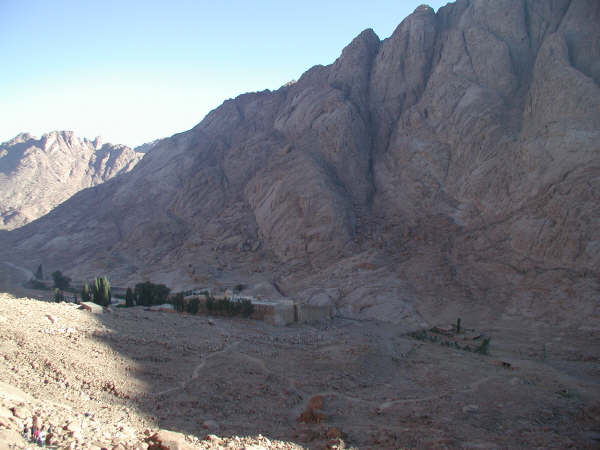
Pictured, St. Catherine's Monastery in the Sinai.

I love the desert fathers. If they only had showers. My VP at Dayton's (eventually Marshall-Fields, now Macy's.) was Greek and once in a conversation I spoke glowingly of the monks on Mt. Athos - hoping as an Orthodox Catholic he'd have some great tales about the holy mountain. He sneered - "I hate those monks - they never bathe!" He was very "The Devil Wears Prada." yet, for all his high and mightiness, he enjoyed conversing with me.

When testing my vocation in monastic life, very few monasteries appeared to me to be observant enough for my ideals. Few seemed poor enough, or if I found a community that was poor, there seemed to be a lack of stability. While some 'new' orders seemed a tad pretentious and ambitious as well as lacking any spiritual maturity. Of course I found, in my opinion, the Carthusians to be the best, but I wasn't suited to their life.

My experiences in good monasteries left me with a prejudice regarding other forms of religious life, and an imperious attitude towards new communities as well as hermits, not to mention neo-gyrovagues. Gradually, I learned never to judge whether a person or community was living a fervent life or not, that there are many instances in the spiritual life of persons seeking the will of God that do not conform to our prejudices.

There is a story from the desert fathers wherein a monk went to see another, renowned for his wisdom and holiness. The monk was scandalized that the father lived in relative luxury compared to what he had been used to in his scete. The father drank wine, slept on a bed of straw, bathed, and ate rather well, although he fasted and was faithful to the rule of psalmody and other exercises peculiar to the eremitical state.

The young monk left the father to return to his skete. The father knowing he had been scandalized called him back and questioned him as to his life. It turned out the monk had been a shepherd, sleeping in the fields and eating a very meager diet, without any comforts, no bathing, except in the river, and so on. In the skete, he had regular meals, a mat to sleep upon, in a hut for shelter.

The father then told him of his past. He had lived like a prince in Rome, with many attendants and great luxury, dining sumptuosly every day. Upon his conversion he renounced all of that and went into the desert to live the ascetic life as the young monk could see.

Filled with compunction, the young monk recognised his presumption and asked the father's forgiveness, often returning to him for spiritual instruction.

The story taught me as well. If a sister lives in an apartment and drives a car, she may no longer have had a convent to live in. If a friar lives in a nice friary, or a monk has a beautiful monastery to live in wherein every need is met, that does not mean he is not a fervent religious.

If a lay person dresses well, lives in a nice house, watches TV, or listens to rock music, or does anything else worldly, while striving to live a devout life, albeit hidden - that does not mean that person is living in sin. No more than two men or two women sharing the same house, or a man and a woman sharing the same house, are living in sin.

"Judge not and you will not be judged." I think Jesus said that.

A 'desert father-like' story.


About Bishop Carlson

I heard a story about him that when he was instructing a young couple who were preparing for marriage, he told them that it was inappropriate for them to live together before the wedding.

They had been living together for some time and their two incomes were necessary to keep their residence. Bishop Carlson said the young man was welcome to live at the Bishop's house with him, free of charge. He meant it.

The couple eventually found a way to live apart until marriage and kept the residence.

That's a good Abba, don't you think?

Wisdom from the Thebaid


Remaining sick today, after returning to work yesterday, I'm reading the sayings of the desert fathers.

A few of the sayings refer to that temptation which has been mentioned so frequently in our time. It made me think of the scandals in the Church that might have been avoided if there had been a greater vigilance on the part of the elders.

"Isaac from the Thebaid said to his brothers, 'Do not bring boys here. Boys are the reason why four monasteries in Scetis were deserted.'"

"A hermit said, 'Do not give or receive anything from worldly people. Take no notice of women. Do not remain long in the company of a boy.'"

To be honest, I found the warnings against boys or young men strange. Then Gustav Aschenbach, obsessed in his pathetic infatuation with Tadzio, came to mind. ("Death In Venice") In another place I again read that monks should avoid spending a long time in the company of the junior monks and never to steady one's gaze upon young men. I can't remember if it was from Dostoyevsky or Archbishop Brianchaninov - but I believe it was from the Russian Thebaid. It would be prudent to say these cautions would easily be applied to looking at young women as well.

Then for those who may pass judgement upon others, suspecting everyone as gay, there is this story.

"A brother, being tempted by a demon, went to a hermit and said, 'Those two monks over there who live together, live sinfully.' But the hermit knew that a demon was deceiving him. So he called the brothers to him. In the evening he put out a mat for them, and covered them with a single blanket and said, 'They are sons of God and holy persons.' But he said to his disciple, 'Shut this slandering brother away in a cell by himself; he is suffering from the passion of which he accuses them.'"

The desert fathers were hermits of course, yet their teachings are profitable for all, informing us of all sorts of temptations the demon uses. Discretion and vigilance are good sentries for any state of life.

Thursday, October 12, 2006

October 13, the Miracle of the Sun at Fatima


"A woman clothed with the sun." - Book of Revelations

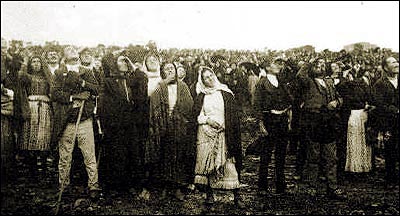
Newspaper photo of pilgrims experiencing the Miracle of the Sun at Fatima in 1917.

The Miracle of the Sun:

"The proclamation of a public miracle caused the most intense speculation throughout Portugal. People from all parts of the country descended, in their tens of thousands, on the Cova, despite the terrible storm that lashed the mountain country around Fatima, on the eve of October 13.

A page from Ilustracao Portugueza, October 29, 1917, showing the crowd.

The children reached the place around noon, and then saw the flash of light as Mary appeared before them. For the last time, Lucia asked what she wanted: "I want to tell you that a chapel is to be built here in my honour. I am the Lady of the Rosary. Continue always to pray the Rosary every day. The war is going to end, and the soldiers will soon return to their homes.

"Then rising into the air and opening her hands towards the sun, growing more brilliant as she did, she disappeared, being replaced by various visions seen only by the children.At the same time the vast crowd of approximately 70.000 people experienced a visible miracle.

The black clouds parted, and the sun became visible, looking like a dull grey disc that could be looked at directly quite easily.

A journalist, Avelino de Almeida, described the event as follows: "...one could see the immense multitude turn towards the sun, which appeared free from clouds and at its zenith. It looked like a plaque of dull silver and it was possible to look at it without the least discomfort. It might have been an eclipse which was taking place. But at that moment a great shout went up and one could hear the spectators nearest at hand shouting: "A miracle! A miracle!" Before the astonished eyes of the crowd, whose aspect was Biblical as they stood bareheaded, eagerly searching the sky, the sun trembled, made sudden incredible movements outside all cosmic laws - the sun "danced" according to the typical expression of the people..."

"People then began to ask each other what they had seen. The great majority admitted to having seen the trembling and dancing of the sun; others affirmed that they saw the face of the Blessed Virgin; others, again, swore that the sun whirled on itself like a giant Catherine wheel and that it lowered itself to the earth as if to burn it with its rays. Some said they saw it change colors successively..."

The crowd experiencing the Miracle of the Sun.

Many other witnesses testified to the terrifying nature of the solar miracle: "It turned everything different colours, yellow, blue, white, and it shook and trembled; it seemed like a wheel of fire which was going to fall on the people. They cried out: 'We shall all be killed, we shall all be killed!' ... At last the sun stopped moving and we all breathed a sigh of relief. We were still alive and the miracle which the children had foretold had taken place.

"Other people witnessed the solar miracle from a distance thus ruling out the possibility of any type of collective hallucination. A final intriguing, and important, point was that the heat of the sun, as it descended on the people, also had the effect of drying their clothes and the ground, so that they went from being completely soaked to being dry in about ten minutes." - Courtesy, "Living Miracles" website.

The New York Times also reported upon the event.

Wednesday, October 11, 2006

"Que muero porque no muero."


"That I die because I do not die." - John of the Cross.

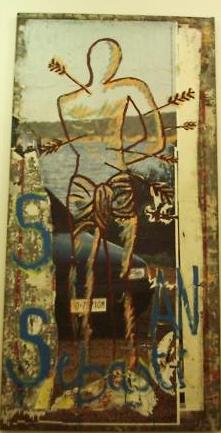
Pictured, "St. Sebastian" by Mimmo Rotella

I have often painted St. Sebastian, who had been shot with arrows, left to die, only to be revived and submit himself for martyrdom again. In a sense, for me, he became an allegory for what happens to a person who has been sexually abused in childhood. The image shown here by Rotella, is particularly poignant since the saint is visible only as an outline, his body simply a shell, his identity obscured.

Speaking to a friend who had been abused and degraded as a child, we discussed the issue of identity, self image, and dissociative experience. Oftentimes, at the moment of violence, the victim removes herself mentally from the actions being performed upon her. This can result in a dissociative personality disorder that endures throughout one's life. Or, it can be simply a coping mechanism that does not become pathological. Then again, the person may so identify with the personality they either invented or embraced, they become conditioned to accept it as being their true identity. In such a case, this new, safe identity helps them to navigate through life, unknown to outsiders.

My friend is going through great passages of self-knowledge and acceptance, experiencing a wonderful freedom of spirit. At times however, the wounds reopen and she goes through difficult times dealing with the hurt, the pain, and the anger - as well as the lonely sense of isolation that is the result of having one's self-image disfigured by abuse. I mentioned my concept of St. Sebastian, having died in a sense, only to be revived, yet the stigmata of his wounds remaining. However it is a long, difficult process of healing that one must go through. Something someone cannot just "get over".

I compared it to the mystery of the saints who actually had the stigmata, which would open and bleed on Fridays and feasts of the passion. In similar fashion, I believe the person who has been abused, while on the road of recovery, perhaps all of their lives, will periodically relive the event with all it's pain and suffering - only now, like the stigmatist, the person may have a better awareness of who they are and what happened to them and what the pain means. In a sense, the suffering becomes redemptive and healing. (This is best accomplished if the person prays and frequents the sacraments, as my friend does.) Nevertheless, no outsider can ever understand the person's interior martyrdom of spirit. They die because they do not die.

Abuse is a terrible crime against a child, it kills the spirit in a manner, it devastates the identity. The person's resurrection from this death is difficult, although often taking a lifetime, it is not impossible. Oftentimes we mistake others behavior, even their sinful life, as a willful moral failing. To be sure, sin is sin, yet I have met prostitutes and promiscuous people, as well as homosexuals, whom I believe are living in such a way as to assuage their pain. Often victims of sexual abuse or some other trauma, they adopt an identity or way of acting that alleviates their misery, or in the worst case scenario, they are living out the personality they adopted after the degrading assault or trauma they experienced. They self-fullfil the prophecy that seemingly damned them to make such a choice, albeit, not a choice made in complete freedom. Many alcoholics do the same thing. It's not a satisfactory remedy however.

Remember to pray for the living dead.

The Divine Maternity of the Blessed Virgin Mary


The Mother of God "Salus Populi Romano"

[snip] In the year 1931 a jubilee marking the fifteenth centenary of the Council of Ephesus was celebrated to the great joy of the whole Catholic world. The fathers at that Council, under the guidance of Pope Celestine, formally condemned the errors of Nestorius and declared as Catholic faith the doctrine that the Blessed Virgin Mary, who gave birth to Jesus, was truly the Mother of God. Prompted by holy zeal, Pope Pius XI determined that the memory of so important an event should continue alive in the Church. Accordingly he ordered the renovation of Rome's famous memorial to the Council of Ephesus, namely, the triumphal arch and transept in the Basilica of St. Mary Major on the Esquiline. His predecessor Pope St. Sixtus III (432-440) had embellished that arch with a beautiful mosaic, but time had done it damage.

In an encyclical Pius XI, moreover, underscored the principal teachings of the General Council at Ephesus, developing in detail and with loving affection the singular privilege of divine Motherhood granted to the Blessed Virgin Mary. He believed that so sublime a mystery should ever become more firmly anchored in the hearts of the faithful. At the same time the Pope singled out Mary, the Mother of God and the one blessed among women together with the holy Family of Nazareth as the foremost model for the dignity and sanctity of chaste married life and for the religious education of youth. [snip] - The Church's Year of Grace, Pius Parsch.

Pray for us O holy Mother of God, that we may be made worthy of the promises of Christ.

Tuesday, October 10, 2006

Blessed John XXIII


October 11 is the feast of Blessed John XXIII, as well as the feast of the Maternity of the Blessed Virgin Mary, the day chosen to convene the historic Second Vatican Council in 1962. The first image of the Holy Father I present is one I painted for the occasion of his beatification by John Paul II, it is now in the possession of the Cathedral of Santa Fe, New Mexico. The second photograph captures the wonderful kindly spirit that was his.

I wrote to him when I was little and received a beautiful picture of His Holiness, with a little note, that unfortunately has been lost. (My mother hid it for safe keeping and I never knew what became of it after that.) He was universally loved, and is now venerated among the saints of God.

Pray for us Blessed John XXIII.

[snip] Before the reform of the General Roman Calendar today was the feast of the Motherhood of the Blessed Virgin Mary. The theological controversies regarding the divinity of Christ which disturbed the Church during the fourth and fifth centuries led to a denial of the divine maternity of Mary. The heretics refused to honor Mary as Mother of God. The Council of Ephesus in 431 declared that the Blessed Virgin "brought forth according to the flesh the Word of God made flesh" and that in consequence she is the Mother of God. Thus she is rightly given the title of divine maternity. In 1931, on the fifteenth centenary of this great Council, Pius XI instituted today's feast. By this act the pope wished to emphasize not only Mary's divine maternity, but also her motherhood of all the members of Christ's Mystical Body. [snip] Go to Catholic Culture for further reading.

(And do not neglect to visit tonight - and tomorrow for his homily - Don Marco's "Vultus Christi" a superb blog, for his posts concerning Bl. John XXIII.)

Adaptation and the needs of the faithful.


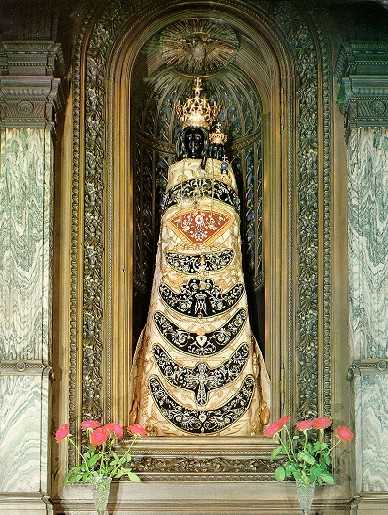
The litany of the Blessed Virgin Mary of Loreto.

In every era the Church has canonized new saints for the edification of the faithful. New devotions have been promulgated, such as devotion to the Sacred Heart of Jesus, devotion to the Holy Face, and more recently devotion to the Divine Mercy. The devotions are not "new" yet their form and cult have been adapted for the needs of the faithful at any given time, oftentimes by express command from the Lord himself. (Although always requiring the recognition and approval of the Church.)

Recently, two new titles of Our Lady have been added to the litany of Loreto. It is my understanding that this is not unprecedented, having occurred in the past as well; in fact, certain religious orders have been permitted to add titles, such as "Queen of the Friars Minor" for the Franciscans - who incidentally are the custos of the Shrine in Loreto, Ancona, Italy. (See "History of the Litany" for details.)

In reading some traditionalist blogs, as well as comments left, it seems the changes add to their suspicion of anything new promulgated by the Vatican. Comments such as, "Why did JPII feel the need to add his innovations to everything that has been a defined devotion for centuries?" Of course, many will not accept the "Mysteries of Light" he suggested, since it increased the traditional 15 mysteries of the rosary to 20 mysteries.

Certainly proponents of the rosary understand the history and development of the devotion. Many realize that a series of beads used to count one's aves and paters eventually became organized to become the original 150 aves emulating the 150 psalms. While the mysteries were categorically introduced later. One could always meditate upon other mysteries of our Lord's life. Upon examination, the mysteries comprise in detail, the essential points of the creed. If one is so attached to 150 aves, then let them pray 150 aves a day, using the traditional mysteries or adding the new mysteries - just don't exceed that magic number of 150. (Though praised by a succession of popes and saints, the rosary is not even a required devotion for Catholics.)

One website compared the more ancient text from the litany of Loreto with a supposed new litany they found in a missalette. It had been adapted and was obviously not the official litany. I found the official 'new' litany on the Holy See's website - it is the same as the ancient one, except for the new titles. See for yourself:

THE LORETO LITANY

Lord have mercy.
Christ have mercy.
Lord have mercy.
Christ hear us.
Christ graciously hear us.
God, the Father of heaven, have mercy on us.
God the Son, Redeemer of the world,
God the Holy Spirit, Holy Trinity, one God,
Holy Mary, pray for us.
Holy Mother of God,
Holy Virgin of virgins,
Mother of Christ,
Mother of the Church, (Officially added - although suggested by Paul VI after V.II)
Mother of divine grace,
Mother most pure,
Mother most chaste,
Mother inviolate,
Mother undefiled,
Mother most amiable,
Mother admirable,
Mother of good counsel,
Mother of our Creator,
Mother of our Saviour,
Mother of mercy,
Virgin most prudent,
Virgin most venerable,
Virgin most renowned,
Virgin most powerful,
Virgin most merciful,
Virgin most faithful,
Mirror of justice,
Seat of wisdom,
Cause of our joy,
Spiritual vessel,
Vessel of honour,
Singular vessel of devotion,
Mystical rose,
Tower of David,
Tower if ivory,
House of gold,
Ark of the covenant,
Gate of heaven,
Morning star,
Health of the sick,
Refuge of sinners,
Comfort of the afflicted,
Help of Christians,
Queen of Angels,
Queen of Patriarchs,
Queen of Prophets,
Queen of Apostles,
Queen of Martyrs,
Queen of Confessors,
Queen of Virgins,
Queen of all Saints,
Queen conceived without original sin,
Queen assumed into heaven,
Queen of the most holy Rosary,
Queen of families, (Officially added - do you have to wonder why in a time of the disintegration of the family?)
Queen of peace.

The Church and the Holy Father certainly have a right to add to the devotional life of the Church, certain elements requiring our attention. Why is the litany so sacrosanct that titles of the Blessed Virgin may not be added, or the rosary, that additional mysteries of our Lord's life may not be added? These are devotions after all, and become the means of catechises in their formulation. As far as the rosary goes, there are many forms; the Franciscan Crown, the Brigittine, along with a variety of chaplets. In one's private devotion, one may meditate upon any mystery of the Lord's life one wishes while praying the rosary; as with the litany, when privately prayed one may praise the Mother of God with varying titles according to one's devotion - so long as they conform to Church teaching and revealed truth.

Queen, Beauty of Carmel, pray for us. (A privilege given to the Carmelite order when they were custos of the shrine.)

Lamb of God, who takest away the sins of the world, spare us, O Lord.
Lamb of God, who takest away the sins of the world, graciously hear us, O Lord.
Lamb of God, who takest away the sins of the world, have mercy on us.

Pray for us, O holy Mother of God. That we may be made worthy of the promises of Christ.

Let us pray. Grant, we beseech thee, O Lord God, that we, your servants,may enjoy perpetual health of mind and body; and by the intercession of the Blessed Mary, ever Virgin, may be delivered from present sorrow, and obtain eternal joy. Through Christ our Lord. Amen.

Sunday, October 08, 2006

The inhabitants of Limbo...


"How low can you go?" - Remember that song and dance from Chubby Checker - it was called the "Limbo" since you had to dance forward under a stick, bending back until you were as if suspended in air. Limbo is like being suspended - as everyone knows.

Many blogs are covering the topic - the
definition of Limbo - well there won't be a definition as such, just a statement from the Commission's findings. It is so not going to be abolished, one can be sure of that.

Yet I thought it interesting that for centuries, millenia, the inhabitants of Limbo have been represented in art. They are called 'putti', which translates 'little boy', in Italian. The ancient Romans frequently painted them in frescoes and sculpted them on facades or objects. Since the Renaissance they are often seen in Roman Catholic religious art, frequently in the clouds surrounding the Madonna, along with little Cherubim. In his secular work, Michelangelo used them, as did most of the great painters of mythology.

It demonstrates how deeply embedded in the unconscious is man's concern for the innocent dead. It suggests the belief in Limbo is a major dimension of man's spirituality. Though it has never been formally defined by the Church, it is a comforting belief for those who have lost children. On the other hand, to say the departed are in a suburb of hell is not at all comforting. It reminds me of something St. Therese said to a sister in her monastery whose spirituality was focused upon the justice of God. Therese said something like this, "Well, if that is what you expect of God, then may you have it. We receive according to our hope. As for me I will continue in my confidence and hope in His merciful love." (A very free-base quote from memory.)

In art, the putti are usually shown joyfully playing, often exhibiting gifts of the fine arts, suggesting a superior talent and knowledge. Their Limbo is one of natural happiness and contentment. If the souls of the innocent, as it has long been believed, are deprived of the beatific vision, surely they may keep company with the saints and the Madonna - even Christ in His humanity, I suppose. How could that be? Well, the Blessed Virgin and the saints could visit them. If they are depicted in art as surrounding these personages, then one can hope it could be a reality. (Not that art is dogma, although some Orthodox iconographers would have you believe that.)

Ah! There is the key...hope. Limbo, while not a defined article of faith, is a place one may hope exists; furthermore, one may hope, that in God's merciful love, the unbaptized may be saved. I'll bet the conclusion by the Commission will be on those lines. No big deal, unless the SSPX's make it into one. OH! MY! GO.....! What if there are Jews there! :)

I missed my chance for Limbo - I always imagined it would be like being on Valium, running around naked in the sun, painting when I felt like it, bathing in the ocean - oh I'm sorry, that was one of my vacations.

The man was first.


Today's readings at Mass focus upon marriage - an old fashioned idea - yet one Hollywood celebrities seem to enjoy doing over and over.

I love the passage from Genesis, wherein the Father brought the animals to Adam for him to name - just like little kids get teddy bears and bow-wows to name and play with from their parents.

In His Providence, God recognized man needed a partner and created Eve from his side. So pay attention ladies - the man was first. Evolutionists ought to think about this as well.

Thinking about marriage however, one cannot help but recognize how it has disintegrated today in our society with the increase of divorce over the recent decades, along with the trend of couples more frequently cohabiting without benefit of marriage. Many of those who feel they do not need to be married to authenticate their union have done so after having endured a divorce or some other trauma in their own family. Many people in their desire for affirmation or self-preservation do not seem willing to admit the consequences of divorce upon their children. Granted, in some cases a marriage was bad from the beginning, perhaps there was abuse, or intolerable alcoholism, or some other mitigating circumstance, wherein there was no other alternative but divorce, or at best, annulment. That isn't my focus.

It's the kids. My own mother was divorced and remarried my father, I have an older sister and brother from her first marriage. There are negative effects in such a family. There had always been a sort of disconnect between my step siblings and myself. My brother really didn't like me, I'm certain he resented me. My mother resented my brother and sister, because every time she looked at them, she was reminded of her 1st husband, whom she despised. And my dad never adopted them. It wasn't a happy home. Nevertheless, this isn't about me.

It's about a woman I know. She has a little brother. Her parents were divorced when she was about four or five-years old I think, her brother was a baby. The mother was addicted to drugs and alcohol and rather promiscuous. As is often the case in divorce, the kids go with the mother. Though not homeless, my friend and her brother were pretty close to being so. Sometimes they would awaken in the morning not knowing where the mother was, only to find out a day or two later she had been in jail. An occasional ray of sunshine for them was when they would be placed in a foster home, although the niceties and kindness of the strange people who took them in baffled them. They didn't know how to act.

They moved a lot. The mother was drunk or doped up most of the time, the house was full of other types just like her mom, and of course, the kids were abused and neglected. Sometimes, when the mother was in jail, they scrounged in dumpsters for food. At school they were humiliated and rejected because they were dirty and poorly clothed. It was a horrible life.

One day when my friend was little, she was watching a cartoon on television and found herself identifying with a strong cartoon character who was a fierce animal. She was convinced she was watching herself - in other words, she adopted the beast as her interior identity. To this day she feels within her deepest self that this is her true identity - her true self. She is normal and functions ably in the workplace and society, nevertheless, interiorly she is always the outsider. Her self image had been shattered in her formative years and she found a means to cope and pull herself up and out of a near animal existence - by identifying with an animal.

It caused me to wonder, this concept of the "shattered image" many people have had to come to terms with in their life. It wasn't a great leap for me to view trans-gender or homosexual persons with the same compassion and understanding that I learned from my friend. Many of these people must have had some experience in their life that caused them to choose an identity contrary to their created being. What else could convince someone so fundamentally that they are indeed other than the norm of those around them, the person they were created to be?

It is not just divorce that shatters one's image of oneself, or one's identity, there are many dynamics at work. Yet, it seems to me, as the family disintegrates, and the stability of marriage is cast aside, society itself shatters, hence the children, the most vulnerable, have no compass.

My friend still lives with her brother, who has children from a broken marriage. They work and make a good living and home for their "family.' My friend is an uber-Catholic, if you will. She went through very much to get to the Church: aspects of the occult new age, fundamentalist Christianity, and so on. The abuse and dysfunction she discovered in the Catholic Church moved her to find greater stability in the strictures of the traditionalist movement. It demonstrates her need for moral absolutes, coming from a life wherein reality was what can only be called occult - that is, obscured and distorted. Thus in traditional Catholicism she has found the truth for which she had been yearning. My friend still has issues that she works on, but I see her growing and becoming whole. Grace builds upon nature, and God is allowing her to understand and find her true identity.

We must sometimes step out of our paradigm and try to understand one another - we never know what may have happened in the life of the person next to us. Prayer for one another is good. Pray for my friend who has helped me understand things a little better.