Saturday, July 29, 2006

St. Martha, patron saint of worriers...


Feast day for the very, very nervous.

"Jeepers Richard! I'm nervous!" Madelaine Kahn's character, Victoria Brisbane, from "High Anxiety."

Everyone always likes to use Mary and Martha as examples for the so-called active and contemplative life. I cannot dispute the Fathers and all the other saints, if time allowed I would write how Teresa of Avila praised the so-called active life and called attention to its own unique contemplative qualities. Teresa of Calcutta and her sisters are marvelous examples of this. Enough said on that.

When it comes to Martha complaining about Mary not helping out when the Lord was at her house, I wouldn't be surprised if she wasn't incited to do so by the men in Our Lord's company who may have thought it unseemly for Mary to be sitting at the Teacher's feet - after all, it was the men Jesus was speaking to, a woman's place was indeed servile. Martha's exasperation may have been with this attitude, plus having to leave her work to call Mary. Of course we don't know that.

What we do know is that Martha was agitated, a bit anxious and nervous. Don't we all get like that? Today I am. Everything seems overwhelming for me today, I'm worried about many things, I need St. Martha's intercession to help me realize that "Only one thing is necessary." (Hard to understand sometimes when you're in the throes of anxiety.) Nevertheless, I think I should get some medication for panic attacks, while asking Martha for her help.

Thursday, July 27, 2006

Neo-Nazi influences in radical Islam


Did you realize there is a connection?

Things are getting more serious by the day in the Middle East.

The Roman Summit failed yesterday, much to the Vatican's dissapointment.

Israel and Hezbollah continue duking it out.

Al Qaeda has thrown their hat in the ring calling for world wide holy war. (I thought that's what they have been doing however.) "It is a jihad (holy war) for the sake of God and will last until (our) religion prevails ... from Spain to Iraq," al-Zawahri said. "We will attack everywhere."

The neo Nazi President Mohamoud Ahmadinejad of Iran keeps up his threaats, while students in Iran are volunteering to go fight in Lebanon. " Iran is a sworn enemy of Israel and President Mahmoud Ahmadinejad has called for the Jewish state to be "wiped off the map". -While Israel accuses Iran of arming Hizbollah"

No wonder polls are saying that Americans are by and large pessimistic about the future. Over 50% of those polled feel The war in the Middle East will escalate to full scale war involving other nations.

It is an incredibly unstable time all around. I can't help but take it all very seriously. A person in my office commented how unusual it is for our country to be at war and yet nothing has changed in our daily lives. So much so, that if one does not watch the news and has no one they know in the armed forces, one's lifestyle is not at all affected. We are in big denial I think.

Naturally I have been pondering the Arab-Israeli hostilities and wondered what it all means. Did you ever read Roy Schoeman's "Salvation Is From The Jews"? It's a couple of years old now but still available and relevant of course. Mr. Schoeman is a convert to Catholicism from Judaism, although he sees his conversion more as coming into the fullness of faith, as do I.

He traces the history of Judaism very simply and intelligently, as well as it's fullfillment in the Roman Catholic Church. I misplaced my copy but I recalled many points of his connecting the current virulent anti-semitism of the Arab world and radical Islam to Nazi Germany. The above picture is from Roy's website of the Grand Mufti of Jerusalem meeting with Hitler. They were in each other's back pockets, as it were, when it came to anti-semitism. An irony of course because Arabs are also non-Aryan semites. Isn't it curious however that Islam and Naziism could find a common ground. Hitler wanted to use Islam to help exterminate the Jewish people. Schoeman believes that today, radical Islam has continued the Nazi legacy. He's not alone in this thought.

Chuck Morse has a splendid article on the connection of Islamic terrorism to Nazi Germany, covering much of the data written about in "Salvation Is From The Jews".

From David Greenberg I have this concise history which corresponds succinctly the association of Nazi influence and fascist Arab anti-semitism we are seeing today:

"Then came the Holocaust, which not only marked the pinnacle of European anti-Semitism but encouraged it in the Arab world as well. Because Arab leaders shared the Germans’ hostility to Britain and France—the dominant colonial powers in the Middle East—they were eager to make common cause with Hitler, despite Nazi belief that they, like the Jews, were inferior to Aryans. The mufti of Jerusalem, among others, actively spread propaganda about “Anglo-Saxon Jewish greed” while praising the Nazi war effort. Even years later, sympathy for Nazism could be easily found in Arab culture. When Israel apprehended Adolf Eichmann in 1960, a Saudi newspaper headline read, “Capture of Eichmann, Who Had the Honor of Killing Five Million Jews.”

If the Holocaust nurtured Arab anti-Semitism, it also helped to discredit such bigotry in the West. Indeed, it helped mobilize support for a Jewish state internationally. In 1948, Israel was finally granted independence. As if to welcome their new neighbor into the region, the Arab countries promptly invaded. Israel repulsed the attacks, and in the three Arab-Israeli wars that followed (1956, 1967, 1973), the Jewish state managed to survive and even to expand its territory. Most controversially, it took over the Gaza Strip from Egypt and the West Bank from Jordan, which were home to large numbers of Palestinian Arabs."
[snip]

Our Lady and Islam, the better connection.

I always go back to Our Lady of Fatima and her call for prayer, penance, and fidelity to the Commandments, as the means to acquire peace, that peace God has entrusted to her. I just can't help but think there is a connection of her apparitions in 1917 to the times we are now living, even if only by inference. We must pray, pray the prayers of the rosary for peace.

Wednesday, July 26, 2006

Secularism and the denial of the Truth


You have got to read this from Don Marco, my priest-monk friend from the Abbey of Santa Croce in Gerusalemme in Rome. (I'm not posting tomorrow so this is it! He is absolutely brilliant and ought to have either his own blog or write more books!)

"We live in the company of the saints. We are in communion with them, and communion implies communication. There is, at every moment, a mysterious exchange taking place between us and the saints who surround us. The Letter to the Hebrews says that we are "watched from above by such acloud of witnesses" (Heb 12:1).

I was shocked and saddened to read that a group of citizens are planning to bring a lawsuit against the city of Las Cruces, New Mexico to have the three crosses removed from the city's official seal. (The city is named after the three crosses of Mount Calvary.) Similar objections have been made against the symbolism associated with Sacramento, California and Corpus Christi, Texas, both named for the mystery of the Eucharist. California is dotted with cities and towns named after the patron saints of the missions around which they grew up, San Francisco being the most famous of these. Ignorance of the saints, or even indifference to them, is one thing: an ideology that seeks to erase their memory from the collective consciousness is quite another.

The names of saints are more and more rarely being given to Catholic babies. While there is a part of ignorance here, today's parents were the victims of the disastrous lack of catechesis that followed the Second Vatican Council, there is something more. The pressure to secularize every area of life is picking up momentum. Change what people say, and you will change what they think. The modification of vocabulary, and in this case the suppression of the glorious heritage of Catholic saints' names, will lead to a modification of values and, ultimately, of morality.

Monasteries have the splendid custom of attributing a saint's name or a biblical name to every room and place, from the cells to the workrooms to the storage rooms. The significance of this age­ old custom is as beautiful as it is profound: the monastery is inhabited not only by the visible people who live within its walls, but also by its invisible residents, the angels and the saints. The naming of a room for a saint is a confession of faith; it flies in the face of secularist ideologies that would have us believe that reality stops with what is visible.

The movement to secularize every thing and every place is as pernicious as it is aggressive. It is part of the "smoke of Satan" that Pope Paul VI saw penetrating the Church to foment confusion. It is important that we respond to the crisis with courage and with conviction. The invasion of the secular must be countered by a renewed acceptance of the sacred, and by re­claiming all things for Christ under the patronage of his saints and his mysteries: our cities, our towns, our homes, our institutions, our rooms, and, yes, our children.

The feast of Saints Joachim and Anna invites us to consider these things. Joachim and Anna arrived in North America with the first colonizers from France and Spain, those who named every new place for the saints of Christ. By this, they made it clear that the Kingdom of Heaven was also expanding and that all places and peoples were invited to live in communion and in communication with the saints.

In seventeenth century France devotion to the Holy Family became a mark of the renewal that, following the Council of Trent, blew through the Church like a refreshing breeze, a mystical invasion. The Holy Family was understood, at that time, to refer to the entire extended family of Jesus, including his grandparents, Joachim and Anne.

From France, Jesuit missionaries, Ursuline and Hospitaller nuns,and devout layfolk carried the devotion to the Holy Family to New France. A sanctuary dedicated to Saint Anne was built in 1658 between the Saint Laurence River and the Beaupré coast in Québec. Other smaller shrines to Saint Anne mark the "Catholic geography" of New England.

After the French Revolution, the Church knew an extraordinary burst of energy characterized by the foundations of hundreds of new religious communities of women; many of these nineteenth century foundations were dedicated to the Holy Family and, again, the grandparents of the Lord were not excluded. Some of these French communities came, in turn, to America where they taught generations of Catholics to reverence the human family of Christ and to live in communion with the saints.

Saint Anne and Saint Joachim have a special message for the grandparents among us. Grandmothers and grandfathers have a particular vocation in the order of grace. Grandparents are called to foster the supernatural life of their grandchildren, to pray for them, to pray with them, and to model holiness for them. Grandparents can reach places in a child's heart that no one else can reach. Grandparents can introduce their grandchildren to the joy of living with the saints.

We are the spiritual descendents of the saints. We profess our faith in the communion of the saints and acknowledge their presence in our homes and in our lives. We renounce the evil ideologies of secularization that, by suppressing the things that call to mind the saints, aim at erasingthe supernatural from daily life.

In the Eucharist, heaven descends to earth and earth is assumed into heaven. In the Eucharist there is infinitely more than what meets the eye. Saints Joachim and Anne are present to us; their most holy Daughter, the Virgin Mary, is present to us. Let us ask them to join their intercession to ours, imploring peace for the Middle East. This too is the communion of the saints: the Holy Sacrifice offered here can bring peace there. Live then, as if you were seeing the invisible! There is nothing more real than that."

The Holy Father and peace...

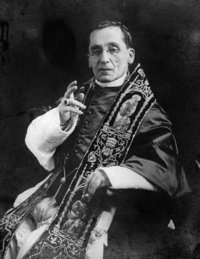
Pope Benedict XV

Pope Benedict XV had a peace plan in 1917, in accord with Emperor Charles' support (now Blessed Charles of Austria) which was subsequently ignored by other world leaders who were capable of preventing the 'Great War', World War I. Popes have often gone ignored in history, or defamed and lied about, such is the case with Pius XII, and more recently, Paul VI in his encyclical "Humanae Vitae". Now perhaps Benedict XVI is being ignored as one of the lone voices speaking out against the escalating conflict in the Middle East.

It is reported today that the Holy Father emerged from a chapel dedicated to the Holy Virgin saying, " 'It seems to me that in this moment, something is moving,' Benedict told reporters on his return from a visit to the Our Lady of Healing shrine where he prayed for peace." [snip - Guardian] He must believe something is happening that may lead to a peaceful settlement. He asked prayers for the meeting in Rome today of leaders seeking a peaceful solution to the war betwen Hezbollah and Israel. (Although it appears there has not been any firm resolution forthcoming from the Roman meeting as of this post.)

"Pray the prayers of the rosary for peace." Our Lady of Fatima from her peace plan of 1917.

Monday, July 17, 2006

The low spark of low rise pants...


(Title adapted from Steve Winwood and Traffic - "The low spark of high heeled boys." very cool '70's song.)

Guys and Chastity.

So, "how does a young man remain sinless" (Psalm 119) in the summertime? First of all he should pull his pants up and probably not shop at Abercrombie & Fitch - although they have the coolest clothes - that sometimes look like they came out of the dumpster - but they are cool.

This post is obviously only for guys interested in, or striving for chastity. A lot of young guys think it is impossible to remain chaste. Some think that they are chaste and celibate if they simply refrain from vaginal intercourse. We learned from the Clinton-Lewinski affair that many young people do not consider oral sex or masturbation "sex". These kids can't be Catholics however, can they? Yeah, I think there are Catholic kids with a messed up understanding of what sex is, and they probably do not see the need for confession either.

I could talk here about 'urban wear' and 'beach wear' or "club wear", and all sorts of suggestive and immodest fashions, but that's pretty obvious to everyone, right? Well, even if it isn't, I'm not going there. We all should know that minimal clothing is seductive. We know movies and TV and MTV is sexualized beyond belief. Music as well. Some of the rap and pop music pretty much glorify certain sex acts as well as promiscuous and lesbian behavior. (The homo stuff just isn't cool for guys - thank God.) Watch the Music Awards shows - it's pretty graphic choreography. So kids are surrounded by sex - you hear it in their language, and the age level is getting younger all of the time.

So how does any guy remain sinless? Especially in the age of Viagra? Confession, confession, confession - the Sacrament of Reconciliation - as often as needed. Frequenting the Sacrament with contrition - and a firm purpose of amendment of course - even if it seems like you 'can't' amend, or do not 'feel' like you can - try and understand that you 'will' it. Holiness is in the will.

Daily prayer, especially the rosary, and daily Mass when possible. Mental prayer or meditation is essential - where the daily examination of conscience is an obligatory component. Another good form of prayer is Lectio Divina - which is meditation/mental prayer and reading scripture all rolled into one. The other means is the practice of recollection outside the time of prayer; keeping one's self in the presence of God through short little prayers or aspirations, using the name of Jesus, and most especially, by frequent spiritual communions. Spiritual communion renews our awareness of Christ's presence in the Eucharist and renews our communion with him in "His silent loving action in the Eucharist" - at work in us through our explicit desire - thus His presence in us is "at work to accomplish infinitely more than we could ever ask or imagine." Then, try to spend some time each week or more in the presence of the Blessed Sacrament in adoration or simply enjoying to be in His presence. Cultivate devotion, confidence and love. Check out John Paul's book, "Theology of the Body" or other good commentaries on it, the book clears up many things concerning sex.

Some guys get themselves habituated to certain sins. All men, especially young men, have to be aware of their own bodies - not just to pump up, or how they are dressing themselves - but their biology and psychology. Our sexuality is a good thing and has one purpose, that of procreation. So many young people have problems with "delaying gratification" in a culture where everything is immediate. Men have built in release valves as it were. The temptation to masturbate goes away if you occupy yourself with something else - anything to take the focus off "it" - if you know what I mean. (Although, I don't see how that is possible with some kids who walk around the streets pulling at themselves all of the time - what a disgusting habit picked up from rap artists and other street trash. Don't ever do that!) Men's bodies have a natural release, it's politely referred to as 'nocturnal emissions'. Men do not have to masturbate. It won't 'fall off' or 'wither up' if you don't use it, as some proponents suggest in a round about way by saying it could lead to prostate cancer. Nonsense! The devil likes to suggest these things as well, it's ludicrous. (In the way of perfection, even natural responses from one's body ought not to be sought and one must remain detached from the pleasure, yet unperturbed when it occurs. And do not let your mind or the devil try to trick you into thinking the experience is a sin because you experienced pleasure - that is often a trick to keep you in that sexually charged moment and an invitation to commit a sin auto-erotically. )

As for other types of acting out sexually, these may have a compulsive dimension as well. One has to work at it. But never focus or dwell on the temptation or the act - it takes hold that way. Let impure thoughts go in one ear and out the other, don't focus. Sometimes they stick in the mind - don't focus on them, go on as if they are not there. (Don't get all uptight and try to repress them however, it makes them worse, be calm and let them blow away like "leaves on a windy day".) And if you feel like you've sinned by entertaining the thoughts - don't let your body or the devil convince you that you have already sinned gravely so you may as well go all the way. That is so much his best trick. The other really bad trick of his is, if you do fall, he suggests doing it again, since you've already sinned anyway. Every consent to his wicked suggestions forges another link in his chain - break it immediately through an act of contrition and go to confession as soon as you can. These acts of humility and repentance are your arms in battle, with trust in the Divine Mercy of course. That reminds me, pray the chaplet of Divine Mercy, even if you are steeped in sin, Jesus promised He would not fail to grant His grace and mercy to "even the most hardened sinner, even if he were to recite the chaplet only once." It is a very powerful prayer.

Maybe you've never heard of it, but there is a mortification referred to as custody of the eyes. It's when you keep from indulging your curiosity about things, the practice trains you to control your "wandering eyes". It can be exercized by not watching TV, or not listening to certain music at times, or not checking some one out on the street or at the beach. As you drive, ride or walk, or are just sitting there, you're going to see someone with a great body and perhaps little on it. You saw it, maybe you looked twice, it's not a sin - even though your body may have reacted. Take that reaction as a warning, divert your attention, move on, jump in the pool - do something. But do it without anxiety and without over reaction. Gradually one learns to not objectify and sexualize everybody and everything, especially if you do not make your body and other peoples body "an idol". There is a certain amount of idolotry in our culture that is directed toward the body. We live in a time wherein the most obvious sign of outward devotion may be properly called, "the cult of the body". We've got to stop our "sacrificing to idols" - a pagan custom revived in our day not unlike that which prospered in ancient Rome and Greece.

One more thing - never ever indulge in pornography - do not even have it near you. No magazines, no videos or DVDs, no nothing. The imprint upon the memory and imagination is powerful and diabolical. If you come across it you can't help the fact that you saw it, but do not let yourself get into it. Move along. Mortal sin is committed only when you willingly and deliberately entertain yourself with it, look at it or watch it indulgently, or act upon it. To see it accidently or even look with some curiosity, yet then to reject it - even though your body may have reacted - is not grave sin, don't get tricked into going further. But never have it around or buy it.

Be patient - but not too patient with yourself, remain calm, ask for help in prayer, keep going to confession and never give up. Chastity is possible - even in the summertime - and maybe even in Los Angeles.

Sunday, July 09, 2006

Compunction


"When in disgrace with fortune and men's eyes"

"When in disgrace with fortune and men's eyes,
I all alone beweep my outcast state,
And trouble deaf Heaven with my bootless cries,
And look upon myself, and curse my fate..."
-Shakespeare, Sonnet 29


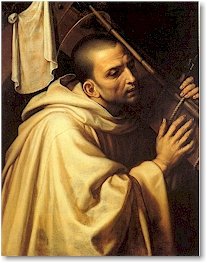
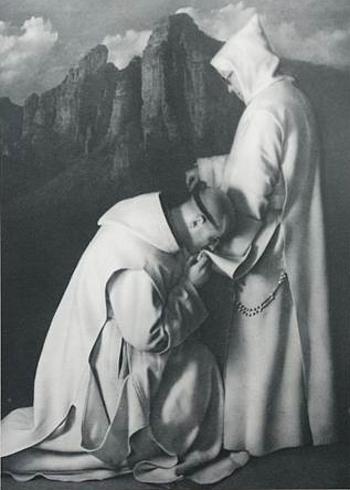
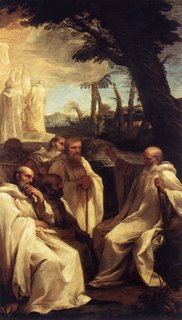
Yesterday's post brought me a great grace, it is called compunction. Compunction is not a word used very much anymore these days. My understanding of it is that it is like contrition, but it remains after the confession of one's sins. It's not depression nor is it "the sadness that leads to death" as St. Paul writes. It's a spiritually healthy condition, so desirable and consoling I wish I could be steeped in it every waking hour. It's very much linked to humility. One may imagine a saint, such as Bernard, pictured here, overtaken with compunction - "stung to his heart" by the sight of Jesus crucified and what Love has suffered in atonement for men's sins, and Bernard takes up Christ's cross and follows him. Still, feeling the sting in his heart, he understands his own sins have been the cause of so much grief, of so many wounds inflicted upon the Sacred Heart of Jesus. "Deep calls unto deep."


Papa John Paul I

I have searched my office at home, my art cabinets, and every book, as well as my office at work, for a marvelous quote I had from John Paul I - not JPII - but his predecessor. The Holy Father was speaking at the Wednesday audience, I have no documentation on hand, but it is authentic. The Holy Father said something to this effect, "Excuse me for saying this, others may fault me, but I think the Lord loves humility so much that He sometimes allows very good souls to fall into sin, even mortal sin. In fact He may permit them to fall repeatedly into a very grave sin, in order that the soul may become humble. Yes God so loves humility that He will allow Himself to be offended so that the sinner may come to repentance and become humble." I know I didn't do his statement justice but it is very close to what the Holy Father said.

In 1972 I had a profound conversion experience, my life changed completely. I entered monastic life because I was convinced I could not be saved in the world. It wasn't enough, so with Charles de Foucauld and Benedict Joseph Labre I left the enclosure to live a penitential life as a 'pilgrim'. But that was way too difficult - I believed I had to return to enclosed monastic life.
Returning from Europe I asked to be receivd once again, only to find out that my novice master had left, the Abbott had resigned and all the novices left as well, and they were not accepting anyone at the time. My superficial spiritual edifice suddenly and dramatically collapsed.

Living in Boston at the time, I was in the North End one Saturday, walking amidst the stalls at the market while a car had stopped at the intersection I was at, the stereo was blarring and it was Dianna Ross' song, "Love Hangover". (It was the height of disco and I was still pretty young - obviously.) I thought it was the coolest song ever. I walked back downtown, bought some hip clothes and went out to the bars that night - actually, just about every night for a few months. I returned to my old way of life, out of desperation, loneliness, isolation, (I was supposedly a hermit) and what is called 'acedia' - something many people today think is the 'dark night' - it's not.

Did you ever see "Looking For Mr. Goodbar", the movie with Dianne Keaton about a promiscuous school teacher who had a double life going out to all the clubs at night while teaching at a school by day? That was kind of me - the male version of course! I worked at a Church in Back Bay at the time and everyone thought I was a monk, but I went to all the clubs by night. My fall from grace was sudden, and my recovery was just about as sudden. This sinful period was only a matter of a few months. I left Boston to come home to the Twin Cities, realizing I was ruining my life in Boston. It was the most mortifying experience of my life, I hated it here. Gradaually I adjusted, regained my old job with better pay and a higher position. I returned to the practice of prayer and daily communion, balanced with a 'love of the world' - in this, to a lesser degree, I found some affinity with Teresa of Avila. Nevertheless, it was a knock down drag out fight to cut every tie with my sinful past. A series of fallings and risings at every step.

Through it all, I remained close to our Carmel and my 'spiritual sister' who is still there. Once in a letter she reassured me by writing, "Even if you have to go to confession every day, even twice a day, never fail to do so. Remember, a saint is a sinner who keeps trying." (I got to know a lot of priests in those days.) Only much later did I read the statement of John Paul I, about sin and the acquisition of humility. Only then did I really understand temptation and sin and God's inscrutable mercy.

I find comfort in this quote from St. Teresa Benedicta a'Cruce, "In aridity and emptiness the soul becomes humble. Former pride disappears when a man no longer finds in himself anything that might cause him to look down on others." - Science of the Cross . In my aridity and emptiness I fell back into sin, but never worry, it returns, only this time the soul understands God is with it, that faith and hope support it, that love sustains it. Edith Stein wrote elsewhere, "The soul ought to consider aridity and darkness as fortunate omens; as signs that God is beside it, freeing it from itself, taking the initiative out of its hand." My dreamsicle spiritual life, coddled by God in it's first fervor was too immature, too superficial, too unguided, too idiosynchratic for me to be on my own. It had to collapse, God had to take the initiative out of my hands, I had to become humble - God it is who inspires and perfects our faith. That is how I learned the meaning of these words, "I have more understanding than all who teach me because I do your will." Ps 119. Not that I go it alone now without counsel, but there is a freedom of spirit the Holy Spirit bestows in addition.

In the market, after Mass this morning, I heard the same music I listened to in Boston years ago, and all of these memories came flooding back vividly and poignantly, increasing the compunction I experienced at Mass. I did not have the same sins that Fr. Erickson had, but I have sinned too, all of us have. As I said yesterday, God's mercy is so inscrutable. We must have hope - confidence and love, as little Therese taught. And we must have humility and mercy in our hearts.

May the souls of the faithful departed rest in peace and may perpetual light shine upon them.

Monday, July 03, 2006

Islam and the Blessed Virgin Mary


Loreto and Islam.

The Translation of the Holy House of Loreto.

I happened upon an interesting note on the web of a Muslim man stating he believed that peace between Islam and Christianity could very well come about through Our Lady. He said Muslims and Christians have devotion to her. Here is the article:

ROME - 3 July 2006
Mary can bring religions together says Muslim writer. An Egyptian Muslim and deputy director of a prominent Italian newspaper has suggested that Mary could be the figure to bring Christians and Muslims together.

Mr Magdi Allam of Il Corriere della Sera has launched an appeal in the pages of the national daily newspaper to Muslims in Italy to visit Marian shrines. The journalist said that he is convinced that the Virgin Mary is a meeting point between Christians and Muslims. "Mary is a figure present in the Koran, which dedicates an entire chapter to her and mentions her some thirty times. In Muslim countries there are Marian shrines that are the object of veneration and pilgrimage by Christian and Muslim faithful," he said. "Therefore, I believe that if this happens in Muslim countries, why can't it happen in a Christian country, especially in this historical phase in which we need to define symbols, values and figures that unite religions, spiritualities and cultures?" he asked.

In Allam's opinion, "the Marian pilgrimage of Loreto - Italy's National Shrine - could represent a moment of meeting and spiritual gathering between Muslims and Catholics, around Mary, a religious figure that is venerated by both religions." -ICS

Interestingly enough, he may be correct. I have always considered Our Lady's apparitions at Fatima to have at least some inferrence to Islam, since the name Fatima was the name of Mohamed's favorite daughter. Bishop Sheen also had said some things in this regard.

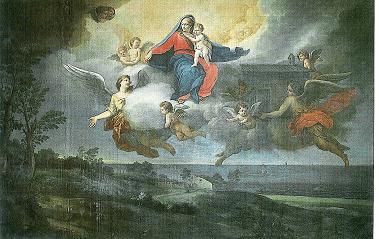
Along with the miraculous image of Our Lady of Good Counsel, the Holy House was once in Croatia and miraculously transported by angels to Italy. Many saints and popes have made the pilgrimage to Loreto, Bl. John XXIII went as a pilgrim to ask the Blessed Virgin's intercession for the Second Vatican Council. John Paul II had been there many times as well. It is a scientific marvel - the house, now enclosed in an edicule within the basilica, rests without foundations on the bare ground. (For further reading on the image of OL Good Counsel, see an earlier post on my other blog, Rome-ing Catholics.)

Both The Holy House and the image of Our Lady of Good Counsel were transported by angels away from Muslim invaders. The Sacred Image was carried from their onslaught of the Balkans. The Holy House was transported, first from the Holy Land to Croatia, and what seems now providential, to Italy. Some people dispute these stories as mere legends. I do not. I spent nearly a week at Loreto and never left the Holy House except when they closed the Basilica at night. I had been enraptured by it, literally.

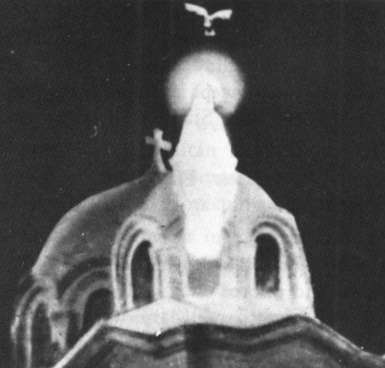
Photo of the Cairo apparition.


Finally, Our Lady appeared above a Coptic Church in Cairo, Egypt in the 1970's. Her apparitions were witnessed by thousands of people while the apparitions were even photographed. Our Lady said nothing however. Muslims and Christians both were witnesses to the Cairo apparitions that the Coptic Church later confirmed as being authentic. Our Lady promised at Fatima that in the end her Immaculate Heart would triumph, that Our Lord had entrusted the peace of the world to Her.

We need to pray our rosary I think.

Sunday, July 02, 2006

Devil in the details...


The title doesn't quite tell it.

"C'mon, it's just a fun movie!" That's what I tell people when they act surprised that I actually left the house to see a movie in a theatre and tell me my choice is wierd - for a guy. When I was just a boy I started out retail in fashion and went onto management for a large department store. A friend from all those years back stayed on and got a corporate position as Senior Designer. We sort of 'grew up' in a segment of the fashion business and had to know our stuff. I read Vogue, Women's Wear; I went to the markets, I knew who every designer was and who was wearing them, I also knew who all the top models were - by name. (Do you know who the first real super model was? Suzie Parker, a 1950's cover girl who did a stint in the movies.) Yeah, I knew too much, it was my job!

My friend and I both worked for a vice-president who was not unlike Meryl Streep's character in the film. He was a bitch too. Immensely talented and successful as well. Lucky for us, he liked us and we both learned a lot from him. His name was Andrew Markopolous, now deceased, yet his legacy lives on, with industry awards named after him, and people like my friend and I who will never forget him. Anyway, I digress, it's a fun film however, and it's entertaining for those who may have worked in fashion or retail, or for fashion magazines, or just anyone who follows fashion. It's a multi-billion dollar industry that employs a large segment of the population, so the film should do well. Having said that, I'll get to the point of this post.

Of course the devil doesn't wear Prada, he's a spirit and doesn't wear clothes, I think he just inspires their designs. Since the '6o's ready to wear designers have increasingly looked to the street for inspiration in their designs. Couture has followed suit. It's pretty obvious when most of the top designers feature barely clad models that look like hookers.


A Versace 'dress'.


Get back to the street, the supermarket, the office. The look is tight, and low. Even for men. Remember last year's Dolce and Gabbana's ad for men's jeans? It was hot, as the industry would say. Scandalously low rise jeans. Where'd they get that idea? The streets. Kids;
boyz and girlz wear their stuff so low you can almost see their stuff. It looks really bad on the fat ones. I don't know what they are supposed to wear, but don't dress like that, fat or anorexic. Little Blessed Jacinta of Fatima in 1918 repeated something Our Lady told her, "Many fashions will be introduced that will offend Our Lord very much - do not follow fashion." That was in 1918!

Years ago, early '70's to be exact, Carlo Carretto, a Little Brother of Jesus wrote a simple book titled, "The God Who Comes". It influenced me a great deal in the first stages of my conversion. In a chapter, "You'll all come to the same end unless you repent" where he discusses the need for repentance in our culture so steeped in hedonism - the pursuit of pleasure - not happiness. That was then! This is now! It was back then when you only saw women dressed as prostitutes who really were prostitutes. Or men dressed with revealing jeans that were usually always gay - but now the so-called "metrosexual" has evolved - non-gay men obsessed with fashion. In the chapter Caretto writes: "To begin with, we must go against the ideas of the day, for these are always opposed to the Gospel. We must resist 'the latest fashions and the spirit of the times,' which are almost always influenced by the evil one." That would be the devil.


Dolce and Gabbana ad.

Fashion is a clever manipulative game that makes tons of money for the purveyors. The cosmetic industry alone is a phenomenal money maker. If women really understood the mark up for the product and services they purchase - well, I think they do and it doesn't faze them. Age defying makeup, cosmetic surgeries. Shoes! Women love shoes. At major high-end retailers the mark-up on shoes is around 300%. A jacket from Christian LaCroix in the '90's was $20,000.00 - that was more than a modest car. I do not shop or read the trades any longer but I know for certain couture costs equally as much today. Why do women fall for this? And now men are doing likewise. Makeup for men? Manicures? Hair highlighting? I'd be embarrassed. It's a racket.

Fashion changes year to year, season to season, it takes people's money away, and distracts them from the essentials in life, it encourages people to become more vacuous and superficial, not to mention provocative and sensual - even an occasion of sin for others. The devil may not wear Prada, but he's in the details.

Friday, June 23, 2006

Solemnity of the Sacred Heart of Jesus


Behold this heart which has so loved men...

This is not the best reproduction of the image of the Sacred Heart but it is one that I like very much as it shows Our Lord offering us His heart, His love - presenting it to us freely, as He does in the Eucharist.

Don Marco sent me the hymn from the Office of Matins for the feast:

O Heart of God¹s Eternal Word,
Creation¹s origin and end:
How great the mystery of your love
To make of man, mere dust, your friend.
O Heart of flesh which has sustained
The wound we on ourselves inflict:
How great the mystery of your love
Outpoured on us the blind and sick.
O Heart of Jesus, strong and sure,
Obedient to the bitter end:
How great the mystery of your love
To suffer Golgotha¹s torment.
O Sacred Heart whose burning love
Craves to set all the world ablaze:
You yearn for us to share your life:
What can we offer but our praise?
O Heart of God the Father¹s joy,
O Heart of Christ, the Spirit¹s lyre,
What else have we in heaven but you,
Our morning praise is all desire. Amen.

Wednesday, June 21, 2006

Some thoughts on wearing the Scapular of Our Lady

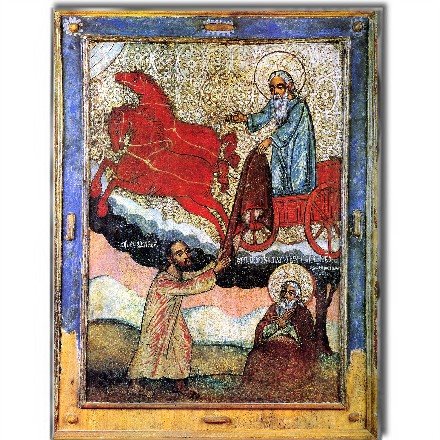
Todays first reading at Mass continues the cycle of the life and mission of Elijah culminating in what is referred to as the 'assumption' of the prophet and handing over to the prophet Elisha the prophetic charism. The icon pictured illustrates this well.


In the scripture Elisha prays "May I receive a double portion of your spirit." in response to Elijah's command to ask whatever legacy Elisha may have desired. Elijah replied, "If you see me taken up from you, your wish will be granted, otherwise not." The scripture states that a fiery chariot came between the prophet and his disciple and took Elijah up to heaven in a whirlwind, while the prophetic mantle fell at the feet of Elisha. Elisha tore his garments in mourning over the loss of his spiritual father and took up the mantle, rolling it up and striking the water of the river Jordan, causing it to divide, thus allowing him dry passage across the river bed. How many layers of spiritual significance to this story! Nevertheless, I have only one simple reflection, and that is regarding the Order of Carmel.


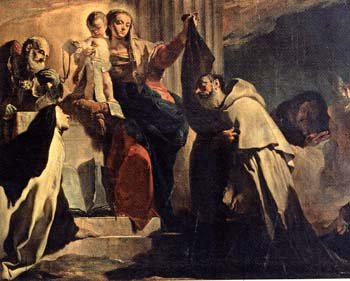
Pictured: St. Simon Stock receiving the scapular of Mt. Carmel.

First of all, the Order of Carmel has always seen the prophets Elijah and Elisha as the 'proto-founders' of the order. In the passage from Kings wherein Elijah sees the "little cloud rising from the sea" from his perch atop the summit of Mt. Carmel many have written that this little cloud prefigures the Virgin who would bear the Savior. Archeological evidence tells us hermit followers of Elijah inhabited Mt. Carmel even in Old Testament times, and of course Christian hermits lived there later, in the spirit of Elijah, hence the origins of the Order of Mt. Carmel.

Perhaps it is a stretch on my part but I have always seen the Scapular of Mt. Carmel somehow prefigured as it were, in this episode in the Book of Kings when Elijah passes on the mantel to Elisha. It seems to me when Our Lady gave the scapular to St. Simon there was a similar significance. To be sure it is a sign of her favor and protection, first to Carmel and then to the lay person who wears her 'livery' as the medieval word refers to it. Ponder the idea and consider it's meaning.

Without doubt there is a prophetic charism imbedded in the Order of Carmel, signified by Our Lady herself. The scapular of Mt. Carmel provides numerous benefits and graces for those who wear it, and it is a garment that the Church has highly praised and given many indulgences to. One may either wear the cloth scapular, which one must be enrolled in to enjoy all of the indulgences, or one may simply have it blessed by a priest and still enjoy the protection of the Mother God. A Scapular medal may also be worn in place of the cloth one, but the wearer must have been enrolled in the cloth scapular first in order to gain the same privledges. It all sounds so complicated, but it is not. Some people like to nit pick about how big it should be, or if the medal may substitute, but that makes it more of a fetish or talisman than a revered sacramental of the Church. (The Carmelite order has come out with revised conditions regarding the Scapular devotion.)

There are many other scapulars of various orders in the Church, as well as those that have cropped up from private revelations. If one's devotion moves one to wear these, that is fine, but sometimes I see the occasional person wearing all of them at once, as well as numerous medals and crucifixes - that's a bit off. Sometimes people use sacramentals to make themselves feel holy or appear holy, sometimes they use them superstitiously, all of that should be discouraged. In today's Gospel Our Lord cautions against "performing our religious deeds in order that people may see them."

For the laity however, the scapular is normally worn beneath one's outer garments, the devotion is a matter of the heart, it signifies our consecration to God, and the entrustment of ourselves to the Immaculate Heart of Mary, as well as a guarantee of Our Lady's protection and guidance.

The affiliation to the Order of Carmel (indeed simply being a baptized and confirmed Roman Catholic) gives our lives a prophetic character, that of witnessing to our faith, albeit sometimes silently and hidden, much as the Scapular we discreetly yet devoutly wear next to our heart.
.
Icon: The Assumption of the prophet Elijah.

Tuesday, June 20, 2006

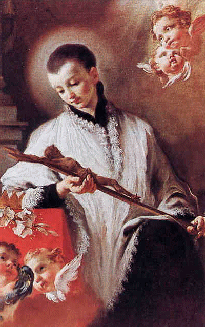
June 21, St. Aloysius (Louis) Gonzaga


St. Aloyisius Gonzaga

The young Jesuit cleric was born to a princely familyof Castiglione in Lombardy, Italy in 1568. He renounced his inheritance and legally turned it over to his brother, after which he then entered the Society of Jesus. Known for his angelic purity and perfect observance of the rule, he died after contracting the plague while ministering to those afflicted.

He is an attractive saint for youth as well as young novices in religious life. St. Aloysius pray for us who have not followed your innocence that we might at least follow the example of your penance and charity towards the poor. Amen.

Sunday, June 18, 2006

The secret to prayer; Lectio Divina (For the feast of St. Romuald, June 19)


Pictured; The Vision of St. Romuald.

St. Romuald saw in a vision, like the prophet Jacob, his monks ascending a ladder to heaven. It brings to mind the classic practice of prayer, known as Lectio Divina; the monastic way of prayer our Holy Father Pope Benedict XVI hopes will have something of a renaissance in our time. It is perfectly compatible with the Teresian method of 'mental prayer' - when St. Teresa of Avila writes that she went to prayer with a book, I feel certain she understood this manner of prayer.

The Ladder of Monks, Guigo the Carthusian
On Lectio Divina:

ONE DAY while I was occupied with manual labor
Cum die quadam corporali manuum labore occupatus
I began to reflect on man’s spiritual work,
de spiritali hominis exercitio cogitare coepissem,
and suddenly four steps for the soul came into my reflection:
quatuor spiritales gradus animo cogitanti se subito obtulerunt
reading,
meditation,
prayer,
[and] contemplation
lectio
scilicet meditatio,
oratio
contemplatio

THIS is a ladder for monks
by means of which they are raised up from earth to heaven
qua de terra in coelum sublevantur,

It has [only a] few separate rungs, yet its length is immense and incredible:
gradibus quidem distincta paucis, immensae tamen et incredibilis magnitudinis,

for its lower part stands on the earth,
cujus extrema pars terrae innixa est,

while its higher [part] pierces the clouds and touches the secrets of heaven.
superior vero nubes penetrat et coelorum secreta rimatur


JUST as its rungs have various names and numbers,
Hi gradus sicut nominibus et numero sunt diversi

so also so they differ in order and merit;
ita ordine et merito sunt distincti;

and if one diligently searches out their properties and functions
quorum proprietates et officia,

- what each [rung] does in relation to us, how they differ from one another and how they are ranked-
quid singuli circa nos efficiant, quomodo inter se differant et praeemineant, si quis diligenter inspiciat,

he will regard whatever labor and study he expends as brief and simple compared with the great usefulness and sweetness [he gains].
quidquid laboris et studii impenderit in eis breve reputabit et facile prae utilitatis et dulcedinis magnitudine.

Reading is careful study of [Sacred] Scripture,
Est autem lectio sedula scriptuaru

with the soul’s [whole] attention:
cum animi intentione inspectio.

Meditation is the studious action of the mind
Meditatio est studiosa mentis actio,

to investigate hidden truth, led by one’s own reason.
occultae veritatis notitiam ductu propriae rationis investigans.

Prayer is the heart’s devoted attending to God,
Oratio est devota cordis in Deum intentio

so that evil may be removed
pro malis removendis

and good may be obtained.
vel bonis adipiscendis.

Contemplation is the mind suspended -somehow elevated above itself - in God
Contemplatio est mentis in Deum suspensae quaedam supra se elevatio

so that it tastes the joys of everlasting sweetness.
eternae dulcedinis gaudia degustans

HAVING assgned descriptions to each of the four rungs,
Assignatus ergo quatuor graduum descriptionibus,

we must see what their functions are in relation to us.
restat ut eorum circa nos officia videamus.


III THE FUNCTIONS of THESE AFOREMENTIONED RUNGS
III QUAE SUNT OFFICIA PRAEDICTORUM GRADUUM
FOR the sweetness of a blessed life:
Beatae vitae dulcedinem

Reading seeks;
lectio inquirit,

meditation finds;
meditatio invenit,

prayer asks;
oratio postulat,

contemplation tastes.
contemplatio degustat


Reading, so to speak, puts food solid in the mouth,
Lectio quasi solidum cibum ori apponit,

meditation chews and breaks it,
meditatio masticat et frangit

prayer attains its savor,
oratio saporem acquirit,

contemplation is itself the sweetness that rejoices and refreshes.
contemplatio est ipsa dulcedo quae jocundat et reficit.


Reading concerns the surface,
Lectio in cortice,

meditation concerns the depth
meditatio in adipe,

prayer concerns request for what is desired,
oratio in desiderii postulatione,

contemplation concerns delight in discovered sweetness.
contemplatio in adeptae dulcedinis delectatione. ( taken from "The Ladder of Monks")

June 19: Feast of St. Romuald


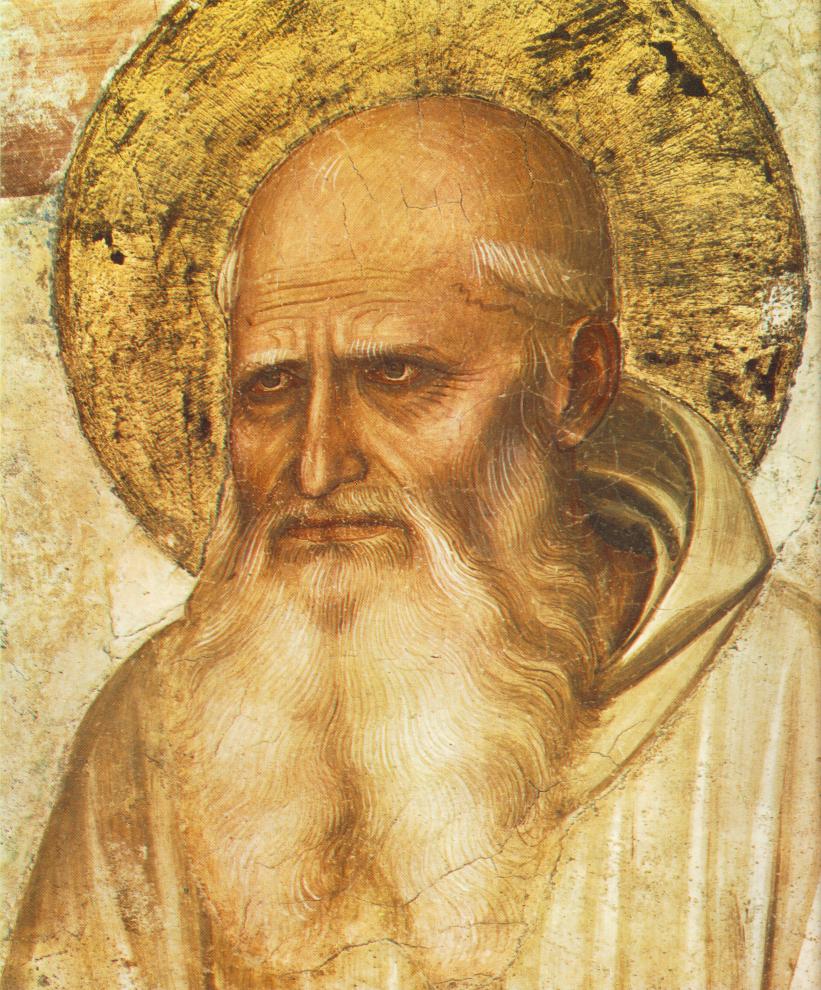
Pictured, St. Romuald, in the white habit of the Camaldolese, by Fra Angelico.

St. Romuald (952-1027) entered the Benedictines in atonement for his father's sin of murder - he killed a relative. Seeking to live a more solitary life as a hermit, he left the cenobitic life of the Benedictine abbey to search for an appropriate refuge. He eventually founded monastic communities throughout northern and southern Italy. He reformed the monastic life of his time, which had become rather decadent. St. Romuald's most famous hermitage is in Camaldoli, near Arezzo in Italy. In the United States we have two Camaldolese foundations, both different congregations with different expressions of the eremetic life. One is in Big Sur, California, the other in Bloomingdale, Ohio.

Shortly after my conversion and return to the Church (thirty some years ago now) I wanted to leave everything and enter the strictest monastery possible. I really believe it was much more than first fervor driving me, but I quit my job and took to the road, never realizing that this was the begining of my pilgrimage of prayer in life. I found myself at Steubenville and moved on to Holy Family Hermitage, the more strictly enclosed and eremetical of the two Congregations of Camaldolese in the U.S. - at least they were then.


St. Conrad of Parzham


The Prior sent a lay brother to the gate to send me away. (The Prior evidently was having some psychological problems as well as being frustrated that 'charismatic' students were just showing up unanounced at the hermitage, hoping to pray with the hermits.) The lay brother was older and looked a little bit like St. Conrad of Parzham. He was so kind to me and did his best to explain why the Prior refused to see me. He took me on a secret tour of the enclosure and prayed with me in the chapel, but in the end he had to send me on my way. He gave me the bread he was to eat that day to take with me. I often wonder if he continued to pray for me. Because of his age, I expect that he is now dead, I hope he still remembers me in heaven.

Feast of Corpus Christi


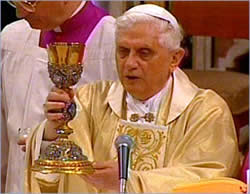
Holy Father Pope Benedict XVI at the elevation during the Consecration of the Mass.


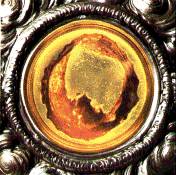
The remaining sign of the Eucharistic Miracle of Lanciano. The Eucharistic species remains intact, Therefore it can be considered something of an ongoing miracle.


Eucharistic Miracle
Lanciano, Italy 8th Century A.D.

(Taken from "The Real Presence" website.)

Ancient Anxanum, the city of the Frentanese, has contained for over twelve centuries the first and greatest Eucharistic Miracle of the Catholic Church. This wondrous Event took place in the 8th century A.D. in the little Church of St. Legontian, as a divine response to a Basilian monk's doubt about Jesus' Real Presence in the Eucharist.

During Holy Mass, after the two-fold consecration, the host was changed into live Flesh and the wine was changed into live Blood, which coagulated into five globules, irregular and differing in shape and size.

The Host-Flesh, as can be very distinctly observed today, has the same dimensions as the large host used today in the Latin church; it is light brown and appears rose-colored when lighted from the back. The Blood is coagulated and has an earthy color resembling the yellow of ochre.

Various ecclesiastical investigation ("Recognitions") were conducted since 1574.
In 1970-'71 and taken up again partly in 1981 there took place a scientific investigation by the most illustrious scientist Prof. Odoardo Linoli, eminent Professor in Anatomy and Pathological Histology and in Chemistry and Clinical Microscopy. He was assisted by Prof. Ruggero Bertelli of the University of Siena.

The analyses were conducted with absolute and unquestionable scientific precision and they were documented with a series of microscopic photographs.These analyses sustained the following conclusions:

The Flesh is real Flesh. The Blood is real Blood.
The Flesh and the Blood belong to the human species.
The Flesh consists of the muscular tissue of the heart.
In the Flesh we see present in section: the myocardium, the endocardium, the vagus nerve and also the left ventricle of the heart for the large thickness of the myocardium.
The Flesh is a "HEART" complete in its essential structure.
The Flesh and the Blood have the same blood-type: AB (Blood-type identical to that which Prof. Baima Bollone uncovered in the Holy Shroud of Turin).
In the Blood there were found proteins in the same normal proportions (percentage-wise) as are found in the sero-proteic make-up of the fresh normal blood.
In the Blood there were also found these minerals: chlorides, phosphorus, magnesium, potassium, sodium and calcium.
The preservation of the Flesh and of the Blood, which were left in their natural state for twelve centuries and exposed to the action of atmospheric and biological agents, remains an extraordinary phenomenon.

Another miracle contributing to the feast of Corpus Christi.

Bolsena-Orvieta, Italy
A priest had difficulties believing in the Real Presence, and blood began seeping out of the Host upon consecration. Because of this miracle, Pope Urban IV commissioned the feast of Corpus Christi, which is still celebrated today. ("The Real Presence")

Friday, June 16, 2006

Mother Teresa's rule: No fund raising.

Missionaries of Charity of Blessed Mother Teresa of Calcutta.

I had an incident one day a month or so ago in the Store I work in. It made me do a lot of thinking. The Missionaries of Charity came in to see me. Every time they visit the Store I feel like I'm seeing Mother. Sometimes I even lapse and call them Mother instead of Sister. No offense to any other religious order but these nuns are exceptional examples of the religious life; they remain just as faithful to radical poverty and their original charism as when they were founded. They are women of prayer as evidenced by the rosary they carry in their hands and are actively praying as you meet them - their rosaries do not just hang on their belts.

When you encounter the sisters you cannot help but tangibly feel their charity. I love them. They had to talk to me about a mistake we made in our catalog. It concerns one of those latex wrist bands, a JPII memorial item, a piece of "I could care less merchandise" that is over-priced as well as a post-peak trend item. A seemingly insignificant item. In our catalog copy, that we took from the vendor we bought it from - I must hasten to say - it states that "a percentage of the proceeds from sales of this item go to the Missionaries of Charity." Mother Marcella, the provincial in the U.S. contacted me a few months ago that this was in error. I was totally unaware of the copy and promotion. I assured her I would look into it. I explained I had no knowledge of the connection and told her I knew very well that the Missionaries and Mother have always had a prohibition against fund raising. I knew that! I assumed everyone did. I told management and explained how important the matter is, they seemed to understand. And guess what happened? Another re-mail catalog had already gone to press and was subsequently mailed out. You can imagine the embarrassment for me and the Company when Sister came in and talked to me about the same mistake that had not been taken care of. I explained as best I could, I said I would take care of it for them and I apologized. I went immediately to the Owner of the Company and explained to him the problem. I called the Company we buy the items from and explained the situation. He explained that he had bought the business from another fellow and he was the one who promoted the item that way and he simply continued it. As I spoke to him on the phone he removed the line from his web site. I knew it was going to be taken care of. (And it was - immediately.)

The entire episode gave me pause however. The Missionaries themselves always remind me of the parable of the goats and sheep being judged at the end of time, because they are so hidden and humble and also because Mother often referenced this parable. (I shuddered because of what scripture says in regard to merchants and how they will be judged!) What struck me about this Gospel however is how the people to the right hand of our Lord, those who have done well, question Jesus saying, "When did we see you hungry and give you food? Naked and we clothed you?" and so on. They honestly did not know until Jesus told them that when they did this to the least among them that they did it to Him. The blessed were totally unaware of their good works - they were simply acting from the goodness of their hearts. They neither measured nor tallied their good works - they simply were acting and doing what was right, the right hand not knowing what the left was doing‌.

It is human nature to take an account of possessions, money, honors, etc. We deduct our charitable contributions from our taxes. (In our Store we even sell "Sacrifice Beads" a pious custom adopted from the life of Therese of Lisieux, you're supposed to count your sacrifices throughout the day by moving a bead every time you do a good work. Unless you are about five years old, as Therese was when she used it, I'd strongly recommend not using such a device. (It's for training kids - not for adults.)

We often carry this accounting practice into our spiritual lives. Many who practice prayer like to figure out what stage of prayer they are at. In my Store we carry a book called "The Stages of Prayer" written by an former Discalced Carmelite nun, it more or less 'retarded' my own progress in prayer since it focused so much on stages and levels of prayer - it isn't the best study on the practice of prayer. Teresa of Avila's famous book, "The Interior Castle"‌ documents the various stages of prayer as well. This is great for directors or to inspire a person to strive for the higher gifts, but it's a waste of time, in my opinion, to use it to try and figure out where you are at in the spiritual life. You're just measuring again. You're keeping score of your virtue - similar to what an overly solicitous parent does in regard to their kids sports activities or academic life. Jesus said not to let your right hand know what your left hand is doing and to keep your works of mercy secret. In other words forget your self and mortify your self seeking. Love and act out of love, "Love and do what you will" as St. Augustine wrote. We should neither count the cost nor the accomplishments of our charity - or prayer for that matter. We might take it a step further, maybe we should not use other people's charitable mission or accomplishments to raise funds or make a sale. If we are going to do an act of charity, we ought to do it in the name of Jesus, for Jesus, and let Him alone know we are doing it. Don't try to make a profit off the backs of the poor.

Remember the Pharisee and the Publican, the one guy recounted to God all of his merits and good deeds, he tithed, gave to the poor, he did a lot of good. (What if he was one of those who traipsed by that other guy laying on the side of the road that the Samaritan helped?) But the one who was justified was the Publican - who had nothing but his sins. At the end of her life St. Therese proclaimed she went to God "empty handed“ not unlike the Publican.

I think that is how the Missionaries of Charity think of themselves as well. Yeah, they never take account of what they do, they simply follow Jesus.

(We eventually got rid of the phrase in our catalog. The Missionaries were happy and hopefully we learned a good lesson.)

Saturday, June 03, 2006

How GLBT people are welcome in the Church...


Just repent!

People with same sex attraction or homosexual tendencies, even those who consider themselves gay are indeed welcome in the Roman Catholic Church. The Church proclaims Christ's message in the Gospel to all persons; "The kingdom of Heaven is at hand. Repent! And believe in the Gospel!" The Church calls all to repentance and reconciliation. People with homosexual orientation are called to repentance as are all members of the Church. Communion is given to all of those who have converted and returned to Christ through the Sacrament of Penance. Christ calls us to deny our very selves, take up our cross and follow Him. He calls us to change, to reform our lives - we may not and can not demand that He change or that the Church change or that Church teaching should change. Truth is immutable.

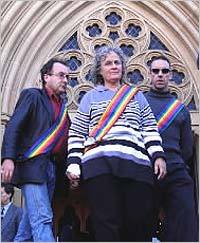
For those who are unfamiliar with the "Sashers" - presented here is their statement on their 'core values' taken from the Dignity website: [http://www.dignitytwincities.org/}

Mission statement of the Rainbow Sash movement:

"Our Core Statement -

1)In wearing the Rainbow Sash we proclaim that we are lesbian, gay, bisexual, and transgender people who embrace and celebrate our sexuality as a sacred gift.
2)In wearing the Rainbow Sash we call the Roman Catholic Church:
to honor our wisdom and experience;
to enter into public dialogue with us;
to work with us for justice and understanding.
Together, let us seek a new appreciation of human sexuality in all of its diversity and beauty.

Our Core Action
The movement's core action, or ritual expression, involves the symbol of the Rainbow Sash. The sash is a strip of rainbow colored fabric which we wear over our left shoulders when we attend the celebration of the Eucharist. Carrying this symbol, we publicly claim our place at Christ's table, sacramentally expressing the truth of our lives, and calling the Church to embrace a new day of integrity and freedom.

The movement began on Pentecost Sunday, 1998, at St. Patrick's Cathedral in Melbourne, Australia, when a group of seventy people attended Mass wearing the Rainbow Sash. Hence, Pentecost Sunday each year is the primary day when members of the movement don the Rainbow Sash and present themselves in their local cathedrals to celebrate the Eucharist with their fellow Catholics. Their presence at the cathedral is preceded by a letter to the local bishop explaining what the sash means, and informing the bishop of when and where they will be present."

It should be noted that it is not God's gift to a person to either be gay, lesbian, bi-sexual, or trans-gender. The mystics have certainly seen suffering as a grace or gift from God in so far as it contributes to the sanctification of the person. Therefore the mortification inherent in suffering from an "objective disorder" could indeed be redemptive in proportion to the person's efforts to overcome these tendencies by grace, personal effort, and with the help of prayer and the sacramental life of the Church. In this respect one may consider it a "gift" on the pre-condition that the person has repented of any sin committed in acting out sexually. If one reflects upon the verse from the Easter "Exultet!"; "O happy fault, O necessary sin of Adam, that gained for us a Savior!" Then one may understand that God draws good, even from sin as it were - after our repentance.

Thursday, June 01, 2006

The Smoke of Satan?


New Accusations Against Other Legionary Priests?

What a mystery this entire matter of Fr. Marciel and his order. The Legionaries of Christ is one of the finest new orders in the Church, a sort of later day Jesuit-style militia, with fierce loyalty to the Pope and the Magisterium.

I have known a couple of men who have left the order, one was under psychiatric counselling for a while, the other also had some negative things to say about the Legion's formation program, but neither ever implied any type of sexual abuse had gone on. I know I seem to like this word, but at most it sounded more like a 'cult' than anything else, that is how they described their experiences to me at least. However, I dismissed it as information coming from two disgruntled former members. Nothing more.

Fr. Marcial Maciel Dellogado, pictured above receiving a blessing from Pope John Paul II. Everything I had heard or read about him left me with the impression that he was a very holy man. In fact, I was certain he had to be to have such a prolific order of priests in addition to his considerable following of (more often than not) affluent laity. I cannot remember if it is Garrigou-Lagrange or St. John of the Cross who wrote that God normally bestows great graces and mysticl gifts to the founders of religious orders as a sort of paternal legacy for the order to partake in for generations afterwards. If all of this is true about Fr. Marcial, would it follow that a certain amount of disorder or at least dysfunction could be his legacy?

Read on:

"One of Father Maciel's original accusers, Paul Lennon, M.A., dropped the following bombshell in what may be yet another nuclear bomb for the Legion of Christ and its Regnum Christi apostolates in this exclusive interview with The Wanderer: Since the May 19 statement on Father Maciel from the Holy See, more alleged victims have come forward claiming sexual abuse, not only by Father Maciel, but from other priests of the Legion of Christ. He said that due to the stigma attached particularly to male sexual abuse, the new accusers wish to remain anonymous at this time. Lennon was with the first class of Legionary priests ordained from Ireland back in 1969.What Does It All Mean?"Among canon lawyers, there is an expression, where there is smoke, there is fire," said Pete Vere, J.C.L. "As more and more allegations come forward, it is very difficult to believe that something may not have happened," he said.However, Vere added that while he personally believes that based upon the actions of the Holy See with Father Maciel, "many of the allegations have been substantiated," he was quick to caution that that he "did not have access to the evidence.""Inviting Fr. Maciel to live the remainder of his days as a penitent, without the public exercise of his ministry has a twofold effect: it affirms that the Church takes the charges seriously, considers them to be credible and punishable; secondly, it attempts to affect the ultimate salvation of Fr. Maciel by urging him to repentance," said Timothy Ferguson, J.C.L., a 38-year-old canonist from Clair Shoals, Michigan."It is more than a mere slap on the wrists," he said, "as it affects the one thing most people hold very dear, his reputation.""Since this is referred to as an 'invitation' rather than an 'imposition,' it doesn't fall under canon 1342.2, which forbids the declaration of perpetual penalties without a judicial process," Ferguson said. As an invitation, there would seem to be no means for recourse or appeal against it," he said.In other words, if Father Maciel had refused the Holy See's invitation to serve the rest of his life suspended from public ministry in penitence and prayer, Ferguson said he believed it "would necessitate the initiation of a penal process.""I think what we're seeing with Benedict XVI's papacy, he is standing for what is not popular, but what is right," said canonist Vere. "With someone like Fr. Maciel and his stature, it is going to be cleared through the Pope, and this is just another example of him showing he will do the right thing even when it is very painful," he said." (See Seattle Catholic for the original article.)

Standing at Mass


Just a thought...

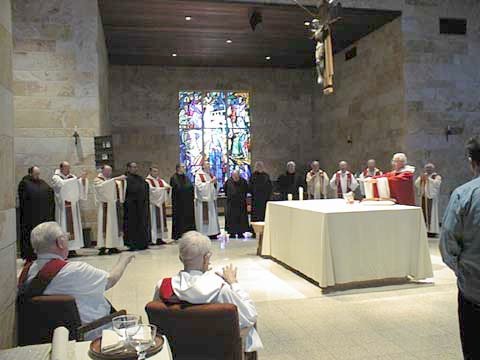
I think I figured out where this comes from - standing at Mass that is. Dah! I knew this before yet obviously never gave it much thought. The whole concept developed in the monasteries. It stems from the monastic communal Mass. The priests circle the altar for concelebration, since they are monks and the non-ordained brothers are also monks, the community stands together. Some monasteries invite the retreatants up around the altar with the community. The retreatants (priests, laymen, liturgists) obviously went back to their parishes and diocese with these innovations. I was in a Trappist monastery for a while, when I left I could always recognize who had been on retreat at an abbey by the way they bowed to reverence the Blessed Sacrament instead of genuflecting. (Benedictine custom is a profound bow instead of genuflecting.) Lay people think monastic practices are more holy I guess. They like the novelty - hence the assimilation into their parish practice. So maybe some liturgical abuses really started out with good intentions, but then took on a life of their own. I think St. Teresa of Avila said, "the road to hell is paved with good intentions." I really prefer kneeling and genuflecting, if I was in a monastery, I would conform to the custom of the place.

Sunday, May 28, 2006

The Little Pope...


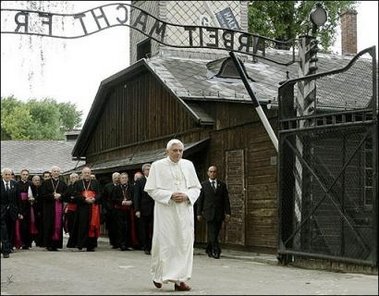
Benedict XVI at Auschwitz.

He insisted upon walking in alone, unescorted.


The German Pope.

What are these days we live in?

Viva il Papa! Vicar of Christ!


(I wish I had a better photo.)

Saturday, May 27, 2006

Papa Benedetto


Pope Benedict XVI in Poland. In every photo he looks absolutely delighted and very much at ease with being the Pope.

The Holy Father is enjoying a tremendous welcome in Poland, the German Pope speaking to the Poles in their native language - does that not seem to assuage, somewhat, the crimes of Nazi Germany on a spiritual level perhaps?

Speaking to the crowds he expressed his hope of beatifying his "beloved Predecessor" and called upon the faithful to pray for this to happen soon. Many hoped and half expected that he would beatify John Paul II on this trip to Poland, but it doesn't look as if that happened.

Viva il Papa!