Saturday, October 14, 2006

Identity and Conversion


I was thinking of the first reading from today's Mass as it regards identity. Paul states;

'There is neither Jew nor Greek,
slave nor freeman,
there is not male and female,
for you are all one in Christ Jesus." Galatians 3

I thought of my friend who is struggling with the issue of identity. As well as others who may have been abused or degraded at some point in their life, who struggle with low self-esteem and a shattered self-image. Even women not unlike the Samaritan woman who perhaps have been married several times in some unconscious effort to find validation in the love of a man. Or the promiscuous whose identity is and emotional life is affirmed and assuaged by meaningless sexual encounters.

From what I understand, recently in this Archdiocese there had been a 'coming out' prayer service for so-called gay people at one of the Catholic churches in town. That is just unfortunate. Again, I think it is based in an identity problem. (If it had been a healing service, that would be all together appropriate, yet a prayer service, a coming out service, is a rebellious act.) Gay culture wants people to come out as a political act - it is not so much a liberation of self. Certainly there is a camaraderie and a modicum of acceptance amongst peers, but it is in the end a political act. The more self-proclaimed gays coming out, the more clout for the gay agenda - whose battle cry is that the gay life-style is normative. Hence, not only their demand for recognition and acceptance, but validation by Church and society.

The person who experiences same-sex attraction should understand this as an aspect of personality, not as their core identity. Their identity is as Genesis states, "Male, female, God created them." Each person's identity is that of being a human being created and loved by God, and now, as a baptized Christian, his true identity is in Christ, that he has become a co-heir with Christ. That is the starting point in conversion, the beginning of self-knowledge and discovery of identity. At least, that is what I always think of when I hear St. Paul's letter to the Galatians. Let me change some of Paul's words;

"There is neither black nor white,
addicted nor free person,
there is not male or female,
gay or lesbian,
therian or animal person;
for you are all one in Christ Jesus.
You are a new creation."

We have been created in the image and likeness of God - Christ came to restore that image. He has subjected all creation to Himself, and therefore to us. To mistake our true identity for something else is a form of idolatry on some level. We are placing the creature above God as it were. Christ, the Church calls men to conversion, to turn from what is false, to turn from their idols, and to be converted. There is indeed a wave of diabolical illusion sweeping the world, distorting the truth, while ensnaring many souls.

Elsewhere, Paul speaks about those of us who engaged in all sorts of sin and he tells us emphatically "you must put all that aside now." (Colossians 3) I do believe, however, there is good reason in the "school of self-knowledge" to accept the distorted image of one's self in an effort to understand and deal with it - not to fear it, since oftentimes the adoption of the identity was a result of fear, thereby becoming a coping mechanism in one's life. To accept one's 'therianism' (therian - derived from theriomorphic- is a person who believes his core identity is that of an animal, or an animal's spirit I believe. It seems to be associated with African or Native America animism.) or to accept one's homosexuality, is a first step in understanding the self. After all, same-sex attraction can be a rather neutral thing, if not acted upon. While the idea that one is a bear remains neutral, unless one begins to live like a bear. (Acceptance does not mean acting from it.)

The key would be in understanding what these experiences mean for the individual. What need is being satisfied, what does it do for the person? When did you first encounter it? Get to the bottom of the issue; where did it originate? Gradually one will unlock the secret and lessen it's power. It requires faith, courage, and perseverance. To understand the why and wherefore, is to begin the process of healing and conversion. Prayer, the sacraments, a good confessor is a necessary component in the process - because everything is a grace.

"Do not surrender your confidence; it will have great reward. You need patience to do God's will and receive what He has promised." Hebrews 10: 35-36

(Just some thoughts for "you" and you know who you are. :)

Friday, October 13, 2006

The desert...


"If I had the wings of a dove, I would fly away and be at rest." from the Office of St. Bruno.

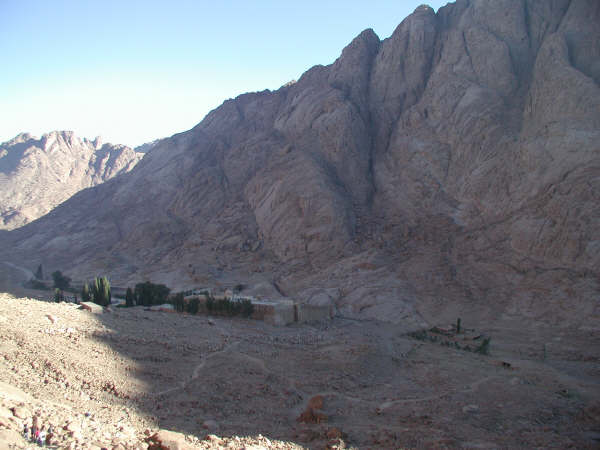
Pictured, St. Catherine's Monastery in the Sinai.

I love the desert fathers. If they only had showers. My VP at Dayton's (eventually Marshall-Fields, now Macy's.) was Greek and once in a conversation I spoke glowingly of the monks on Mt. Athos - hoping as an Orthodox Catholic he'd have some great tales about the holy mountain. He sneered - "I hate those monks - they never bathe!" He was very "The Devil Wears Prada." yet, for all his high and mightiness, he enjoyed conversing with me.

When testing my vocation in monastic life, very few monasteries appeared to me to be observant enough for my ideals. Few seemed poor enough, or if I found a community that was poor, there seemed to be a lack of stability. While some 'new' orders seemed a tad pretentious and ambitious as well as lacking any spiritual maturity. Of course I found, in my opinion, the Carthusians to be the best, but I wasn't suited to their life.

My experiences in good monasteries left me with a prejudice regarding other forms of religious life, and an imperious attitude towards new communities as well as hermits, not to mention neo-gyrovagues. Gradually, I learned never to judge whether a person or community was living a fervent life or not, that there are many instances in the spiritual life of persons seeking the will of God that do not conform to our prejudices.

There is a story from the desert fathers wherein a monk went to see another, renowned for his wisdom and holiness. The monk was scandalized that the father lived in relative luxury compared to what he had been used to in his scete. The father drank wine, slept on a bed of straw, bathed, and ate rather well, although he fasted and was faithful to the rule of psalmody and other exercises peculiar to the eremitical state.

The young monk left the father to return to his skete. The father knowing he had been scandalized called him back and questioned him as to his life. It turned out the monk had been a shepherd, sleeping in the fields and eating a very meager diet, without any comforts, no bathing, except in the river, and so on. In the skete, he had regular meals, a mat to sleep upon, in a hut for shelter.

The father then told him of his past. He had lived like a prince in Rome, with many attendants and great luxury, dining sumptuosly every day. Upon his conversion he renounced all of that and went into the desert to live the ascetic life as the young monk could see.

Filled with compunction, the young monk recognised his presumption and asked the father's forgiveness, often returning to him for spiritual instruction.

The story taught me as well. If a sister lives in an apartment and drives a car, she may no longer have had a convent to live in. If a friar lives in a nice friary, or a monk has a beautiful monastery to live in wherein every need is met, that does not mean he is not a fervent religious.

If a lay person dresses well, lives in a nice house, watches TV, or listens to rock music, or does anything else worldly, while striving to live a devout life, albeit hidden - that does not mean that person is living in sin. No more than two men or two women sharing the same house, or a man and a woman sharing the same house, are living in sin.

"Judge not and you will not be judged." I think Jesus said that.

A 'desert father-like' story.


About Bishop Carlson

I heard a story about him that when he was instructing a young couple who were preparing for marriage, he told them that it was inappropriate for them to live together before the wedding.

They had been living together for some time and their two incomes were necessary to keep their residence. Bishop Carlson said the young man was welcome to live at the Bishop's house with him, free of charge. He meant it.

The couple eventually found a way to live apart until marriage and kept the residence.

That's a good Abba, don't you think?

Wisdom from the Thebaid


Remaining sick today, after returning to work yesterday, I'm reading the sayings of the desert fathers.

A few of the sayings refer to that temptation which has been mentioned so frequently in our time. It made me think of the scandals in the Church that might have been avoided if there had been a greater vigilance on the part of the elders.

"Isaac from the Thebaid said to his brothers, 'Do not bring boys here. Boys are the reason why four monasteries in Scetis were deserted.'"

"A hermit said, 'Do not give or receive anything from worldly people. Take no notice of women. Do not remain long in the company of a boy.'"

To be honest, I found the warnings against boys or young men strange. Then Gustav Aschenbach, obsessed in his pathetic infatuation with Tadzio, came to mind. ("Death In Venice") In another place I again read that monks should avoid spending a long time in the company of the junior monks and never to steady one's gaze upon young men. I can't remember if it was from Dostoyevsky or Archbishop Brianchaninov - but I believe it was from the Russian Thebaid. It would be prudent to say these cautions would easily be applied to looking at young women as well.

Then for those who may pass judgement upon others, suspecting everyone as gay, there is this story.

"A brother, being tempted by a demon, went to a hermit and said, 'Those two monks over there who live together, live sinfully.' But the hermit knew that a demon was deceiving him. So he called the brothers to him. In the evening he put out a mat for them, and covered them with a single blanket and said, 'They are sons of God and holy persons.' But he said to his disciple, 'Shut this slandering brother away in a cell by himself; he is suffering from the passion of which he accuses them.'"

The desert fathers were hermits of course, yet their teachings are profitable for all, informing us of all sorts of temptations the demon uses. Discretion and vigilance are good sentries for any state of life.

Thursday, October 12, 2006

October 13, the Miracle of the Sun at Fatima


"A woman clothed with the sun." - Book of Revelations

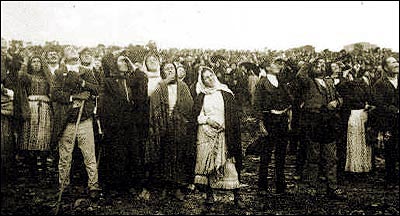
Newspaper photo of pilgrims experiencing the Miracle of the Sun at Fatima in 1917.

The Miracle of the Sun:

"The proclamation of a public miracle caused the most intense speculation throughout Portugal. People from all parts of the country descended, in their tens of thousands, on the Cova, despite the terrible storm that lashed the mountain country around Fatima, on the eve of October 13.

A page from Ilustracao Portugueza, October 29, 1917, showing the crowd.

The children reached the place around noon, and then saw the flash of light as Mary appeared before them. For the last time, Lucia asked what she wanted: "I want to tell you that a chapel is to be built here in my honour. I am the Lady of the Rosary. Continue always to pray the Rosary every day. The war is going to end, and the soldiers will soon return to their homes.

"Then rising into the air and opening her hands towards the sun, growing more brilliant as she did, she disappeared, being replaced by various visions seen only by the children.At the same time the vast crowd of approximately 70.000 people experienced a visible miracle.

The black clouds parted, and the sun became visible, looking like a dull grey disc that could be looked at directly quite easily.

A journalist, Avelino de Almeida, described the event as follows: "...one could see the immense multitude turn towards the sun, which appeared free from clouds and at its zenith. It looked like a plaque of dull silver and it was possible to look at it without the least discomfort. It might have been an eclipse which was taking place. But at that moment a great shout went up and one could hear the spectators nearest at hand shouting: "A miracle! A miracle!" Before the astonished eyes of the crowd, whose aspect was Biblical as they stood bareheaded, eagerly searching the sky, the sun trembled, made sudden incredible movements outside all cosmic laws - the sun "danced" according to the typical expression of the people..."

"People then began to ask each other what they had seen. The great majority admitted to having seen the trembling and dancing of the sun; others affirmed that they saw the face of the Blessed Virgin; others, again, swore that the sun whirled on itself like a giant Catherine wheel and that it lowered itself to the earth as if to burn it with its rays. Some said they saw it change colors successively..."

The crowd experiencing the Miracle of the Sun.

Many other witnesses testified to the terrifying nature of the solar miracle: "It turned everything different colours, yellow, blue, white, and it shook and trembled; it seemed like a wheel of fire which was going to fall on the people. They cried out: 'We shall all be killed, we shall all be killed!' ... At last the sun stopped moving and we all breathed a sigh of relief. We were still alive and the miracle which the children had foretold had taken place.

"Other people witnessed the solar miracle from a distance thus ruling out the possibility of any type of collective hallucination. A final intriguing, and important, point was that the heat of the sun, as it descended on the people, also had the effect of drying their clothes and the ground, so that they went from being completely soaked to being dry in about ten minutes." - Courtesy, "Living Miracles" website.

The New York Times also reported upon the event.

Wednesday, October 11, 2006

"Que muero porque no muero."


"That I die because I do not die." - John of the Cross.

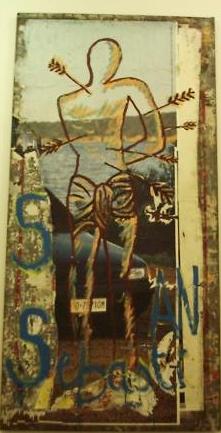
Pictured, "St. Sebastian" by Mimmo Rotella

I have often painted St. Sebastian, who had been shot with arrows, left to die, only to be revived and submit himself for martyrdom again. In a sense, for me, he became an allegory for what happens to a person who has been sexually abused in childhood. The image shown here by Rotella, is particularly poignant since the saint is visible only as an outline, his body simply a shell, his identity obscured.

Speaking to a friend who had been abused and degraded as a child, we discussed the issue of identity, self image, and dissociative experience. Oftentimes, at the moment of violence, the victim removes herself mentally from the actions being performed upon her. This can result in a dissociative personality disorder that endures throughout one's life. Or, it can be simply a coping mechanism that does not become pathological. Then again, the person may so identify with the personality they either invented or embraced, they become conditioned to accept it as being their true identity. In such a case, this new, safe identity helps them to navigate through life, unknown to outsiders.

My friend is going through great passages of self-knowledge and acceptance, experiencing a wonderful freedom of spirit. At times however, the wounds reopen and she goes through difficult times dealing with the hurt, the pain, and the anger - as well as the lonely sense of isolation that is the result of having one's self-image disfigured by abuse. I mentioned my concept of St. Sebastian, having died in a sense, only to be revived, yet the stigmata of his wounds remaining. However it is a long, difficult process of healing that one must go through. Something someone cannot just "get over".

I compared it to the mystery of the saints who actually had the stigmata, which would open and bleed on Fridays and feasts of the passion. In similar fashion, I believe the person who has been abused, while on the road of recovery, perhaps all of their lives, will periodically relive the event with all it's pain and suffering - only now, like the stigmatist, the person may have a better awareness of who they are and what happened to them and what the pain means. In a sense, the suffering becomes redemptive and healing. (This is best accomplished if the person prays and frequents the sacraments, as my friend does.) Nevertheless, no outsider can ever understand the person's interior martyrdom of spirit. They die because they do not die.

Abuse is a terrible crime against a child, it kills the spirit in a manner, it devastates the identity. The person's resurrection from this death is difficult, although often taking a lifetime, it is not impossible. Oftentimes we mistake others behavior, even their sinful life, as a willful moral failing. To be sure, sin is sin, yet I have met prostitutes and promiscuous people, as well as homosexuals, whom I believe are living in such a way as to assuage their pain. Often victims of sexual abuse or some other trauma, they adopt an identity or way of acting that alleviates their misery, or in the worst case scenario, they are living out the personality they adopted after the degrading assault or trauma they experienced. They self-fullfil the prophecy that seemingly damned them to make such a choice, albeit, not a choice made in complete freedom. Many alcoholics do the same thing. It's not a satisfactory remedy however.

Remember to pray for the living dead.

The Divine Maternity of the Blessed Virgin Mary


The Mother of God "Salus Populi Romano"

[snip] In the year 1931 a jubilee marking the fifteenth centenary of the Council of Ephesus was celebrated to the great joy of the whole Catholic world. The fathers at that Council, under the guidance of Pope Celestine, formally condemned the errors of Nestorius and declared as Catholic faith the doctrine that the Blessed Virgin Mary, who gave birth to Jesus, was truly the Mother of God. Prompted by holy zeal, Pope Pius XI determined that the memory of so important an event should continue alive in the Church. Accordingly he ordered the renovation of Rome's famous memorial to the Council of Ephesus, namely, the triumphal arch and transept in the Basilica of St. Mary Major on the Esquiline. His predecessor Pope St. Sixtus III (432-440) had embellished that arch with a beautiful mosaic, but time had done it damage.

In an encyclical Pius XI, moreover, underscored the principal teachings of the General Council at Ephesus, developing in detail and with loving affection the singular privilege of divine Motherhood granted to the Blessed Virgin Mary. He believed that so sublime a mystery should ever become more firmly anchored in the hearts of the faithful. At the same time the Pope singled out Mary, the Mother of God and the one blessed among women together with the holy Family of Nazareth as the foremost model for the dignity and sanctity of chaste married life and for the religious education of youth. [snip] - The Church's Year of Grace, Pius Parsch.

Pray for us O holy Mother of God, that we may be made worthy of the promises of Christ.

Tuesday, October 10, 2006

Blessed John XXIII


October 11 is the feast of Blessed John XXIII, as well as the feast of the Maternity of the Blessed Virgin Mary, the day chosen to convene the historic Second Vatican Council in 1962. The first image of the Holy Father I present is one I painted for the occasion of his beatification by John Paul II, it is now in the possession of the Cathedral of Santa Fe, New Mexico. The second photograph captures the wonderful kindly spirit that was his.

I wrote to him when I was little and received a beautiful picture of His Holiness, with a little note, that unfortunately has been lost. (My mother hid it for safe keeping and I never knew what became of it after that.) He was universally loved, and is now venerated among the saints of God.

Pray for us Blessed John XXIII.

[snip] Before the reform of the General Roman Calendar today was the feast of the Motherhood of the Blessed Virgin Mary. The theological controversies regarding the divinity of Christ which disturbed the Church during the fourth and fifth centuries led to a denial of the divine maternity of Mary. The heretics refused to honor Mary as Mother of God. The Council of Ephesus in 431 declared that the Blessed Virgin "brought forth according to the flesh the Word of God made flesh" and that in consequence she is the Mother of God. Thus she is rightly given the title of divine maternity. In 1931, on the fifteenth centenary of this great Council, Pius XI instituted today's feast. By this act the pope wished to emphasize not only Mary's divine maternity, but also her motherhood of all the members of Christ's Mystical Body. [snip] Go to Catholic Culture for further reading.

(And do not neglect to visit tonight - and tomorrow for his homily - Don Marco's "Vultus Christi" a superb blog, for his posts concerning Bl. John XXIII.)

Adaptation and the needs of the faithful.


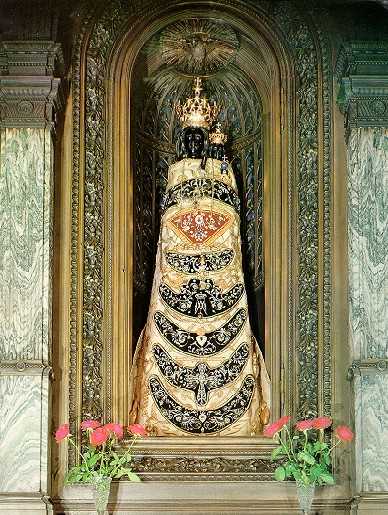
The litany of the Blessed Virgin Mary of Loreto.

In every era the Church has canonized new saints for the edification of the faithful. New devotions have been promulgated, such as devotion to the Sacred Heart of Jesus, devotion to the Holy Face, and more recently devotion to the Divine Mercy. The devotions are not "new" yet their form and cult have been adapted for the needs of the faithful at any given time, oftentimes by express command from the Lord himself. (Although always requiring the recognition and approval of the Church.)

Recently, two new titles of Our Lady have been added to the litany of Loreto. It is my understanding that this is not unprecedented, having occurred in the past as well; in fact, certain religious orders have been permitted to add titles, such as "Queen of the Friars Minor" for the Franciscans - who incidentally are the custos of the Shrine in Loreto, Ancona, Italy. (See "History of the Litany" for details.)

In reading some traditionalist blogs, as well as comments left, it seems the changes add to their suspicion of anything new promulgated by the Vatican. Comments such as, "Why did JPII feel the need to add his innovations to everything that has been a defined devotion for centuries?" Of course, many will not accept the "Mysteries of Light" he suggested, since it increased the traditional 15 mysteries of the rosary to 20 mysteries.

Certainly proponents of the rosary understand the history and development of the devotion. Many realize that a series of beads used to count one's aves and paters eventually became organized to become the original 150 aves emulating the 150 psalms. While the mysteries were categorically introduced later. One could always meditate upon other mysteries of our Lord's life. Upon examination, the mysteries comprise in detail, the essential points of the creed. If one is so attached to 150 aves, then let them pray 150 aves a day, using the traditional mysteries or adding the new mysteries - just don't exceed that magic number of 150. (Though praised by a succession of popes and saints, the rosary is not even a required devotion for Catholics.)

One website compared the more ancient text from the litany of Loreto with a supposed new litany they found in a missalette. It had been adapted and was obviously not the official litany. I found the official 'new' litany on the Holy See's website - it is the same as the ancient one, except for the new titles. See for yourself:

THE LORETO LITANY

Lord have mercy.
Christ have mercy.
Lord have mercy.
Christ hear us.
Christ graciously hear us.
God, the Father of heaven, have mercy on us.
God the Son, Redeemer of the world,
God the Holy Spirit, Holy Trinity, one God,
Holy Mary, pray for us.
Holy Mother of God,
Holy Virgin of virgins,
Mother of Christ,
Mother of the Church, (Officially added - although suggested by Paul VI after V.II)
Mother of divine grace,
Mother most pure,
Mother most chaste,
Mother inviolate,
Mother undefiled,
Mother most amiable,
Mother admirable,
Mother of good counsel,
Mother of our Creator,
Mother of our Saviour,
Mother of mercy,
Virgin most prudent,
Virgin most venerable,
Virgin most renowned,
Virgin most powerful,
Virgin most merciful,
Virgin most faithful,
Mirror of justice,
Seat of wisdom,
Cause of our joy,
Spiritual vessel,
Vessel of honour,
Singular vessel of devotion,
Mystical rose,
Tower of David,
Tower if ivory,
House of gold,
Ark of the covenant,
Gate of heaven,
Morning star,
Health of the sick,
Refuge of sinners,
Comfort of the afflicted,
Help of Christians,
Queen of Angels,
Queen of Patriarchs,
Queen of Prophets,
Queen of Apostles,
Queen of Martyrs,
Queen of Confessors,
Queen of Virgins,
Queen of all Saints,
Queen conceived without original sin,
Queen assumed into heaven,
Queen of the most holy Rosary,
Queen of families, (Officially added - do you have to wonder why in a time of the disintegration of the family?)
Queen of peace.

The Church and the Holy Father certainly have a right to add to the devotional life of the Church, certain elements requiring our attention. Why is the litany so sacrosanct that titles of the Blessed Virgin may not be added, or the rosary, that additional mysteries of our Lord's life may not be added? These are devotions after all, and become the means of catechises in their formulation. As far as the rosary goes, there are many forms; the Franciscan Crown, the Brigittine, along with a variety of chaplets. In one's private devotion, one may meditate upon any mystery of the Lord's life one wishes while praying the rosary; as with the litany, when privately prayed one may praise the Mother of God with varying titles according to one's devotion - so long as they conform to Church teaching and revealed truth.

Queen, Beauty of Carmel, pray for us. (A privilege given to the Carmelite order when they were custos of the shrine.)

Lamb of God, who takest away the sins of the world, spare us, O Lord.
Lamb of God, who takest away the sins of the world, graciously hear us, O Lord.
Lamb of God, who takest away the sins of the world, have mercy on us.

Pray for us, O holy Mother of God. That we may be made worthy of the promises of Christ.

Let us pray. Grant, we beseech thee, O Lord God, that we, your servants,may enjoy perpetual health of mind and body; and by the intercession of the Blessed Mary, ever Virgin, may be delivered from present sorrow, and obtain eternal joy. Through Christ our Lord. Amen.

Sunday, October 08, 2006

The inhabitants of Limbo...


"How low can you go?" - Remember that song and dance from Chubby Checker - it was called the "Limbo" since you had to dance forward under a stick, bending back until you were as if suspended in air. Limbo is like being suspended - as everyone knows.

Many blogs are covering the topic - the
definition of Limbo - well there won't be a definition as such, just a statement from the Commission's findings. It is so not going to be abolished, one can be sure of that.

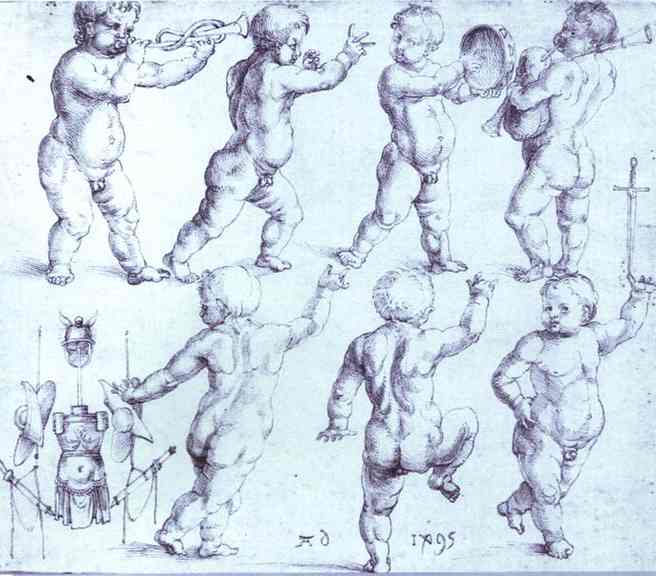
Yet I thought it interesting that for centuries, millenia, the inhabitants of Limbo have been represented in art. They are called 'putti', which translates 'little boy', in Italian. The ancient Romans frequently painted them in frescoes and sculpted them on facades or objects. Since the Renaissance they are often seen in Roman Catholic religious art, frequently in the clouds surrounding the Madonna, along with little Cherubim. In his secular work, Michelangelo used them, as did most of the great painters of mythology.

It demonstrates how deeply embedded in the unconscious is man's concern for the innocent dead. It suggests the belief in Limbo is a major dimension of man's spirituality. Though it has never been formally defined by the Church, it is a comforting belief for those who have lost children. On the other hand, to say the departed are in a suburb of hell is not at all comforting. It reminds me of something St. Therese said to a sister in her monastery whose spirituality was focused upon the justice of God. Therese said something like this, "Well, if that is what you expect of God, then may you have it. We receive according to our hope. As for me I will continue in my confidence and hope in His merciful love." (A very free-base quote from memory.)

In art, the putti are usually shown joyfully playing, often exhibiting gifts of the fine arts, suggesting a superior talent and knowledge. Their Limbo is one of natural happiness and contentment. If the souls of the innocent, as it has long been believed, are deprived of the beatific vision, surely they may keep company with the saints and the Madonna - even Christ in His humanity, I suppose. How could that be? Well, the Blessed Virgin and the saints could visit them. If they are depicted in art as surrounding these personages, then one can hope it could be a reality. (Not that art is dogma, although some Orthodox iconographers would have you believe that.)

Ah! There is the key...hope. Limbo, while not a defined article of faith, is a place one may hope exists; furthermore, one may hope, that in God's merciful love, the unbaptized may be saved. I'll bet the conclusion by the Commission will be on those lines. No big deal, unless the SSPX's make it into one. OH! MY! GO.....! What if there are Jews there! :)

I missed my chance for Limbo - I always imagined it would be like being on Valium, running around naked in the sun, painting when I felt like it, bathing in the ocean - oh I'm sorry, that was one of my vacations.

The man was first.


Today's readings at Mass focus upon marriage - an old fashioned idea - yet one Hollywood celebrities seem to enjoy doing over and over.

I love the passage from Genesis, wherein the Father brought the animals to Adam for him to name - just like little kids get teddy bears and bow-wows to name and play with from their parents.

In His Providence, God recognized man needed a partner and created Eve from his side. So pay attention ladies - the man was first. Evolutionists ought to think about this as well.

Thinking about marriage however, one cannot help but recognize how it has disintegrated today in our society with the increase of divorce over the recent decades, along with the trend of couples more frequently cohabiting without benefit of marriage. Many of those who feel they do not need to be married to authenticate their union have done so after having endured a divorce or some other trauma in their own family. Many people in their desire for affirmation or self-preservation do not seem willing to admit the consequences of divorce upon their children. Granted, in some cases a marriage was bad from the beginning, perhaps there was abuse, or intolerable alcoholism, or some other mitigating circumstance, wherein there was no other alternative but divorce, or at best, annulment. That isn't my focus.

It's the kids. My own mother was divorced and remarried my father, I have an older sister and brother from her first marriage. There are negative effects in such a family. There had always been a sort of disconnect between my step siblings and myself. My brother really didn't like me, I'm certain he resented me. My mother resented my brother and sister, because every time she looked at them, she was reminded of her 1st husband, whom she despised. And my dad never adopted them. It wasn't a happy home. Nevertheless, this isn't about me.

It's about a woman I know. She has a little brother. Her parents were divorced when she was about four or five-years old I think, her brother was a baby. The mother was addicted to drugs and alcohol and rather promiscuous. As is often the case in divorce, the kids go with the mother. Though not homeless, my friend and her brother were pretty close to being so. Sometimes they would awaken in the morning not knowing where the mother was, only to find out a day or two later she had been in jail. An occasional ray of sunshine for them was when they would be placed in a foster home, although the niceties and kindness of the strange people who took them in baffled them. They didn't know how to act.

They moved a lot. The mother was drunk or doped up most of the time, the house was full of other types just like her mom, and of course, the kids were abused and neglected. Sometimes, when the mother was in jail, they scrounged in dumpsters for food. At school they were humiliated and rejected because they were dirty and poorly clothed. It was a horrible life.

One day when my friend was little, she was watching a cartoon on television and found herself identifying with a strong cartoon character who was a fierce animal. She was convinced she was watching herself - in other words, she adopted the beast as her interior identity. To this day she feels within her deepest self that this is her true identity - her true self. She is normal and functions ably in the workplace and society, nevertheless, interiorly she is always the outsider. Her self image had been shattered in her formative years and she found a means to cope and pull herself up and out of a near animal existence - by identifying with an animal.

It caused me to wonder, this concept of the "shattered image" many people have had to come to terms with in their life. It wasn't a great leap for me to view trans-gender or homosexual persons with the same compassion and understanding that I learned from my friend. Many of these people must have had some experience in their life that caused them to choose an identity contrary to their created being. What else could convince someone so fundamentally that they are indeed other than the norm of those around them, the person they were created to be?

It is not just divorce that shatters one's image of oneself, or one's identity, there are many dynamics at work. Yet, it seems to me, as the family disintegrates, and the stability of marriage is cast aside, society itself shatters, hence the children, the most vulnerable, have no compass.

My friend still lives with her brother, who has children from a broken marriage. They work and make a good living and home for their "family.' My friend is an uber-Catholic, if you will. She went through very much to get to the Church: aspects of the occult new age, fundamentalist Christianity, and so on. The abuse and dysfunction she discovered in the Catholic Church moved her to find greater stability in the strictures of the traditionalist movement. It demonstrates her need for moral absolutes, coming from a life wherein reality was what can only be called occult - that is, obscured and distorted. Thus in traditional Catholicism she has found the truth for which she had been yearning. My friend still has issues that she works on, but I see her growing and becoming whole. Grace builds upon nature, and God is allowing her to understand and find her true identity.

We must sometimes step out of our paradigm and try to understand one another - we never know what may have happened in the life of the person next to us. Prayer for one another is good. Pray for my friend who has helped me understand things a little better.

Saturday, October 07, 2006

A season of wonder...


Second only to Christmas in retail.

It's Halloween. Having worked late tonight, I drove home in the dark, the wind blowing autumn leaves around in little tornadoes. I noticed houses all alight with orange jack-o-lanterns and tomb stones decorating their front yards, with bed-sheet ghosts suspended from trees. People go all out to be spooky. If it is done well, it's kind of fun - but talk about kitsch!

I'm not as opposed to Halloween as other Christians seem to be. I do think it is fun, although, being without children, I've never really celebrated it - except when I was little. The history goes way back of course - after all, it's a celebration of All-Hallows Eve - the vigil of All Saints day. What's scary about that?

Of course it's a big occult holiday for witches as well, so I understand the opposition of Christians. Parental guidance and faith is needed for children. Adults and teens seem to be the ones who go over to the dark side. So watch your pets and your kids. (And remember, you can't burn witches any longer.)
It is amazing however, that it has become such a big holiday across the country - truly, second only to Christmas in retail, what with cards, decorations, costmes, parties, etc. It may possibly indicate a rampant re-emergence of neo-paganism, while being a somewhat arrogant rebellion against death on some level.

Merchandising Advent wreaths at the store reminded me that the wreath was once a pagan symbol as well, albeit Christianized now. I never got into that either.

I like the lights though - when it is so dark and spooky outside...

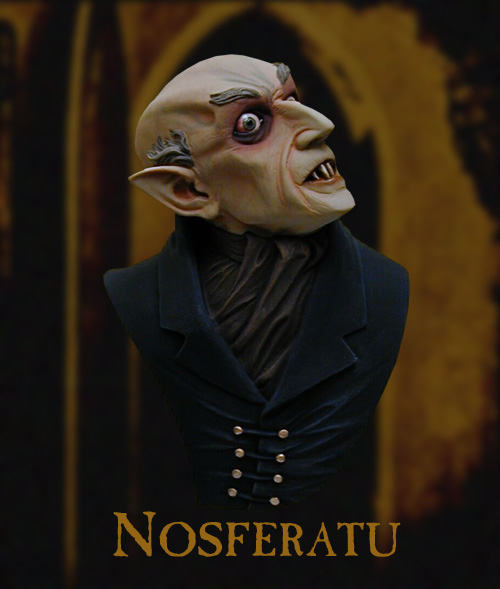
(Note: "Nosferatu" was the scariest vampire movie in the history of cinema, and every original still that I tried to grab, from a variety of sites, would not print on this blog - just the puppet image would post...I'm so scared! Somebody quick - call Michael Brown at "Spirit Daily"!)

Friday, October 06, 2006

The Question of Limbo...


Is there such a place?


News today is that the Holy Father has made no pronouncement of any new understanding of limbo, the place, or state, unbaptised infants go to. Here is the traditional teaching on it:

"Persons, such as infants, who have not committed actual sin and who, through no fault of theirs, die without baptism, cannot enter heaven; but it is the common belief they will go to some place similar to Limbo, where they will be free from suffering, though deprived of the happiness of heaven." - Baltimore Catechism

The Catholic Church's official catechism, issued in 1992 after decades of work, dropped the concept of limbo and says: "As regards children who have died without Baptism, the Church can only entrust them to the mercy of God … " CCC

It has never been a defined dogma of the Church, albeit the traditional belief. The concept of limbo was one I was taught in school. Some saints held that it is actually a place on the "outskirts" of hell, while others have described it as a paradise separate from the beatific vision. An uber-Catholic I work with seems to prefer the place in hell concept, which fits in well with his fire and brimstone spirituality.

In the part of the creed wherein we profess "He descended into hell" it is commonly believed that it refers to Christ's descent into limbo to free our first parents and the saints of the old testament. Some theologians, such as Hans Urs Von Balthazar believe Christ really did descend into actual hell - I can't remember in which of his writings wherein he discusses that. I believe many Orthodox Catholics accept the same belief, as did the early Christians - although I could be mistaken. Nevertheless, it remains a matter of speculation to some degree.

Press reports claim that the Commission studying the subject, as well as the Holy Father will abolish the belief. I doubt that. You just don't undo tradition to assuage the modern human sentiment that everyone must be saved, do you? Then what does, "He descended into hell" really mean? Of course some Orthodox legends have it that in the end, the Blessed Virgin will obtain the release of all the souls in hell as well, such mystical fantasies have never been taught in the Latin Church and are contrary to the faith.

As Cardinal Ratzinger, the Pope has said he believed the concept of limbo could possibly be set aside because it is "only a theological concept" and "never a defined truth of faith." Nevertheless, this is a vastly different statement than saying it does not exist.

One ought not to depend upon the media for papal teachings.

Update: Gerald has a post from Asia News on the same subject.

Queen of the Holy Rosary


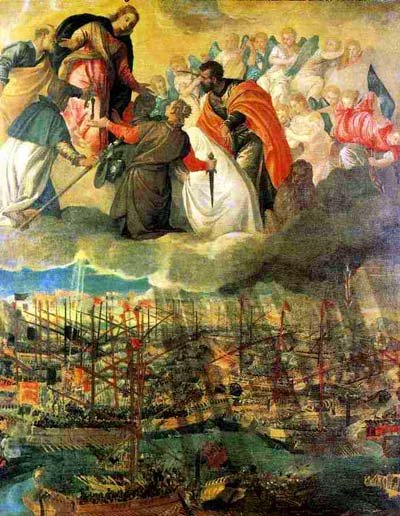
What do you think when it comes to this feast? That it occurs in the "Month of the Holy Rosary" and that is why October is dedicated as such? It is a feast in thanksgiving for the victory of Christianity against the Turks at the Battle of Lepanto.

I have always found it significant that the last apparition at Fatima happened in October with the great miracle of the sun. The name 'Fatima' being the same as Mohammed's daughter, hearkens back to the days when a large part of the Iberian peninsula was under the control of the Moors. I cannot help but think the purpose of Heaven has been to alert us to what is happening in our own day, with the conflict between Islam and the Christian West. It may be good to muse about these things and give the prayers of the Rosary greater place in our spiritual lives.

Presented here is an excellent homily for today's feast from an English priest:

[snip] "On 7 October 1571 the forces of Christendom, under the command of Don Juan, defeated the Turks at Lepanto. The famous sea victory was attributed to the intercession of the Blessed Virgin because the Rosary had been recited both by the soldiers before battle and by many of the faithful in Rome. St Pius V instituted the Feast of Our Lady of Victories and, shortly afterwards, Gregory XIII changed this to Our Lady of the Rosary. In the early eighteenth century, following some further victories against the Turks, the Feast was extended throughout the Church. And so October became known as the month of the Holy Rosary." [snip] -Roman Miscellany

"Pray the Rosary every day." - Our Lady of the Rosary of Fatima

Joanna Bogle's response...

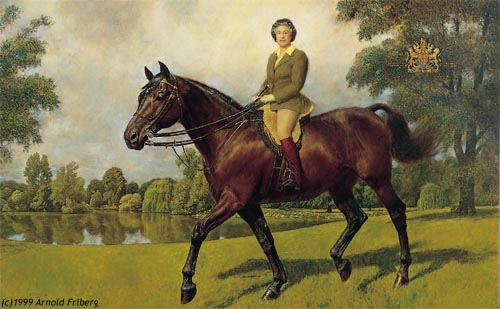
Painting, "Elizabeth II"

A few days ago I commented on Mrs. Bogle's blog, with sincere questions, hoping to get a response in answer to my questions. (She could have told me to read a book on history.) Without ever insulting my intelligence, she very graciously and succinctly explained why the monarchy is valued in Britain. Thank you Mrs. Bogle! I copied and pasted her friendly response:

Joanna Bogle said...
Well, here goes....I'm terribly sorry that you were offended that I didn't publish your comments or reply to you....but the system of comments on my blog doesn't provide for my being able to send you a direct personal reply. I had to track down your blog via Google, so here I am!!

I have made clear on my blog that I honestly can't get involved in lengthy discussions except on specific issues largely related to Catholicism.....The blog's essentially a diary with Catholicism as its chief ideolgical component rather than any political issues. I like to steer the thing along those lines, and don't want to get side-tracked into debates with Americans - however delightful and friendly! - who quite obviously will have a different approach on Monarchy and our Royal Family.

However, for what it's worth, my comment goes like this:

America is a great and splendid nation, and one which has proved a blessing to many. It's a joyful place to visit, too - there is a sense of purpose and of welcome which lifts the heart. But it certainly has its own version of an hereditary tradition within its political system: please don't try to say that the Bushes and the Kennedys and so on don't have hereditary power! The difference is just that: there is real power wielded by great families, rather as Britain had in its days of imperial authority. George Washington imposed his family's coat of arms as the nation's flag - no harm in that, and the flag has stood for prosperity and a decent way of life for millions, including those who arrived poor and hungry fleeing from real oppression and injustice.

In Britain, we have found - not without some travail, including a bitter civil war between monarchists and their opponents - that a Monarchy and Parliamentary democracy work extremely well. We have adapted to massive social change without the struggles that this entailed in America (the "civil rights" movement, etc) and the sense of community and family that is engendered by our monarchy and its associated heritage has served us admirably. We look with pity on those European nations - France as perhaps the supreme example, currently in its 5th Republic with probably more to follow - that lack the blessings of stability bestowed on us.

We don't specially expect Americans to value our monarchy as we do, and we recognise the value of their own tradition: there are many among us who despise and reject the crude anti-Americanism that frequently sweeps Europe, and we are not unmindful of the poignant graves of young American soldiers and airmen who lie with honour in our Cambridgeshire countryside, and of the sacrifice of life they gave with generous hearts in a war that preserved our freedom.

When we speak our Queen, we don't, actually, mostly think in soap-opera terms - which is why we have been distressed by Royal events of recent years - but of the ideal of nationhood embodied in an anointed monarch consecrated to public service in a tradition stretching back through millenia. It's not an absurd idea, and we think it carries a quiet resonance at least as noble as anything that a larger republic can offer. What is likely to destroy it, tragically, is the loss of our nation's Christian identity: we admire Americans for their stalwart adherence to a Faith that many in Britain now denounce or deny.

God Bless America!
And, in this small island with a large history: God save the Queen!
With warmest good wishes
Joanna Bogle

I'm such a brat, having coerced a response from this wonderful woman. Yet I'm delighted and impressed to have heard from her...and just a tad embarrassed that I betrayed my lack of intelligence regarding Monarchy.

From now on, when you may disagree with me, maybe take a lesson from Joanna Bogle on civility when commenting.

I like the Bogle's!

Thursday, October 05, 2006

St.Bruno


Holy Father St. Bruno...

Speaking about the Charterhouse:

"Many wish to come into this port, and many make great efforts to do so, yet do not achieve it. Indeed many, after reaching it, have been thrust out, since it was not granted to them from above.

Therefore, my brothers, you should consider it certain and well established that whoever partakes of this desirable good, should he in any way lose it, will grieve to his death, if he has any concern for the salvation of his soul." -Letters of St. Bruno. Office of Readings.

Each year I read this, what I know by heart, recalling it many times throughout the year.

Pray for us St. Bruno, now and at the hour of our death. Amen.

St. Bruno's eve...


The feast of St. Bruno always makes me rather nostalgic. The Carthusians was the one order I finally found that I thought was meant for me - the only order I considered to be authentic.

The Prior of the Charterhouse I spent a month at, Fr. Raphael Diamond, a somewhat famous Jewish convert and friend of Von Hildebrand, as well as a psychiatrist, determined that I would be better suited for another form of monasticism or mendicant religious life - albeit, at that time, there wasn't much to offer by way of faithful religious life. I was absolutely crushed. I went to Europe as a pilgrim, emulating St. Benedict Joseph Labre after that.

My experience at the Charterhouse was very intense and sublimely spiritual. It was the most real experience of my life. Nevertheless, I left with a greater freedom of spirit, and after two decades, knew and understood what Fr. Raphael, now deceased, meant. (In monastic life, one is Fr. "By the first name" as opposed to the somewhat imperious Fr. "By the last name" in secular priesthood. I frequently "get caught" in that mistake. It often goes along with Professor "By the last name". One learns their place.)

This rather odd photo of a Carthusian, somewhat "Harry Potter" looking and kind of spooky - is not too far off. The Carthusians, being hermits, are a bit idiosyncratic, some I met were nothing short of eccentric. If anyone has been to the American Charterhouse in Vermont, and stayed awhile, they would know what I mean. (One Father wore sunglasses over his regular glasses, all of the time, he was kind of different.) Although, I expect if one had the occasion to visit the desert fathers, one would meet with similar experiences.

In the Charterhouse, one may encounter the most authentic form of eremetical/monastic life in existence, not unlike the early desert fathers, far superior to Mt. Athos - in my opinion. It's a wonderful life, and I am always full of repentance and compunction when I consider that I was not permitted to stay. I consider my experience a "remorse" akin to purgatory; it is the feeling, that I must wait for heaven, not yet able to enter.

I have confessed to two hermits in my life, one at the Charterhouse, another elsewhere, both were so taken aback and scandalized, I had to explain the psychological dimension of my sins in order to almost console them, as it were. The experience in my confession at the Charterhouse was the cause of my speaking to the Prior, which determined my being sent away. It is a source of sorrow to this day, yet it is the consequence of sin. My confessor in Boston scolded me for being so candid - they were old sins I brought up - Fr. Gregory thought I should have been admitted. Oh well, I still get in trouble for my candor. (One thing everyone has always said about me, secular or religious, I am always sincere and honest.)

Tomorrow I have to speak with my boss. I may be emulating Joseph Labre again.

Wednesday, October 04, 2006

Blessed Bartolo Longo


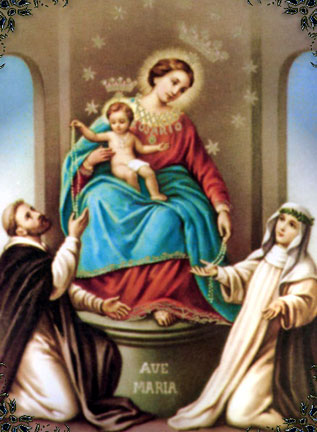
And Our Lady of Pompeii

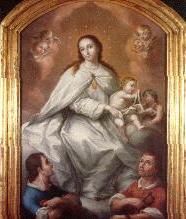
Thanks to Don Marco I remembered it is Bl. Bartolo's feast day! He established the shrine of Our Lady of the Rosary of Pompeii. The image is a Spanish Colonial retablo he found, poorly painted, and had it re-touched and installed as the central image of the shrine, the centerpiece of devotion. Many miracles are attributed to it, or rather through the devotion of the Holy Rosary the image inspired. It remains my favorite image of the Queen of the Holy Rosary.

Check out Don Marco for more details.

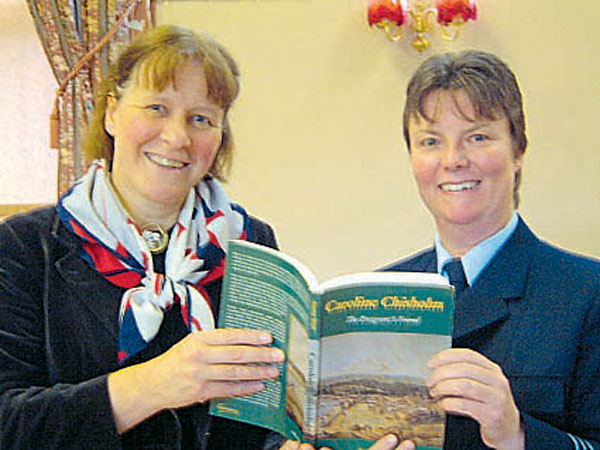
Joanna Bogle


Mrs. Bogle is on the left in this photo.

I've only known of her because she and her husband James have a show on EWTN, which I find charming and informative. Now Mrs. Bogle has a blog, that I find charming, homely, and somewhat informative. I like her very much, finding her much more engaging than her husband. (He tends to be a bit Trandemish for my taste...) However, I'm pleased to link to her blog.

Disappointed however that a comment I left was never answered - she has "comment moderation" operative. Here is a section of one of her posts I commented upon:

"In the evening, went to see the new film "The Queen" about events at Balmoral surrounding the death of Princes Diana. It shows the Queen in a sympathetic light, and altho' it presents Tony Blair as something of the hero of the hour, the message is also in the end a fairly positive one about monarchy and continuity. But I wondered where people like me fit in: I was not there among the weepers and mass-grief-and-floral-tributes crowd and thought it all absurd and frightening. But I am certainly not Royal and wasn't at Balmoral, nor am I a politician involved with making events happen. Where do ordinary patriots of a once-mainstream kind, with a love of British history and a sense of the continuity of things, fit in to a country which sees Royalty as soap-opera and which talks in psycho-babble or slogans?"

I asked her, as an American who cannot understand the British Monarchy, why they exist. The Monarch has no power and the lives of the Royals seem so shallow. I then asked why the phenomena of the great outpouring of sympathy for the Princess Diana was "absurd and frightening" in her opinion. I found it curious. Nevertheless, she did not post my comment, nor did she respond.

I work with people who are "monarchists" and several traditional Catholics seem to be as well. I don't get it at all. There is absolutely no remaining absolute monarchy remaining in the western world. What on earth is the attraction? Is it even plausible to hope that a monarchical system could be re-established?

I wish Mrs. Bogle would have responded to my comment. It's not very cordial for a Brit not to have done so. Of course the Queen often doesn't acknowledge anyone either. (Nobility has its privilege.) Which brings up another point - as far as the Church is concerned, or let's say, the faith, has there been a legitimate monarch since Henry VIII? After all, the rest have been schismatics and heretics - well except for maybe one or two Catholic monarchs. But is a pretend monarchy sufficient for continuity? Continuity of what?

During WWII, Elizabeth's parents, indeed the entire family, were certainly morale boosters. Elizabeth II has maintained herself well all of her life and presented a very dignified and respectful presence, yet she does not rule Britania. The monarchy is nothing but a figure head - they do not rule. I don't get it - what's the point? In my estimation, the British seem to be a collection of eccentrics - intelligent and cultured perhaps - yet sometimes rather eccentric.

John Paul strikes back!

[Follow up on an earlier post.]
I've never liked Gaultier - his designs are tacky - but his response to the too thin controversy is fun. Actually, this model was the ideal in another century. (They say the French are getting more like fat Americans - because they are eating fast food such as MacDonalds more often.)

"Fashion designer Jean Paul Gaultier found his own way to comment on the 'size zero' debate - by putting a larger model down the catwalk to show off his clothes.
Dressed in a daring black corsetry, the plus-sized model dwarfed her fellow waif-like catwalk queens.
Clearly more of a size 20 than the controversial model Size 0, this voluptuous woman proved big is beautiful as she strutted down the runway at Gaultier's 30th anniversary show yesterday during fashion week in Paris."


What if this becomes the norm? Then all the models will look like Russian matushkas! (Does anyone remember the '80's Wendy's ads depicting a Russian fashion show? It was hilarious - Moscow was insulted and Wendy's had to take down the ads.)

Tuesday, October 03, 2006

The authentic St. Francis...


His Holiness Pope Benedict XVI had this to say recently about St. Francis:

“He was not merely an environmentalist or a pacifist. He was, above all, a converted man. I have read with great pleasure that the bishop of Assisi, Sorrentino, precisely in order to remedy this ‘abuse’ of the figure of Saint Francis, wants to proclaim the eighth centenary of his conversion as a ‘Year of conversion,’ in order to [...] demonstrate what conversion is by connecting us with the figure of Saint Francis, in order to widen the horizon of life. At first, Francis was a sort of playboy. Then he realized that this was not enough. He heard the voice of the Lord: ‘Rebuild my house.’ And little by little, he understood what it meant to ‘rebuild the house of the Lord’.” The entire article on; http://www.chiesa.espressonline.it/dettaglio.jsp?id=82705&eng=y.

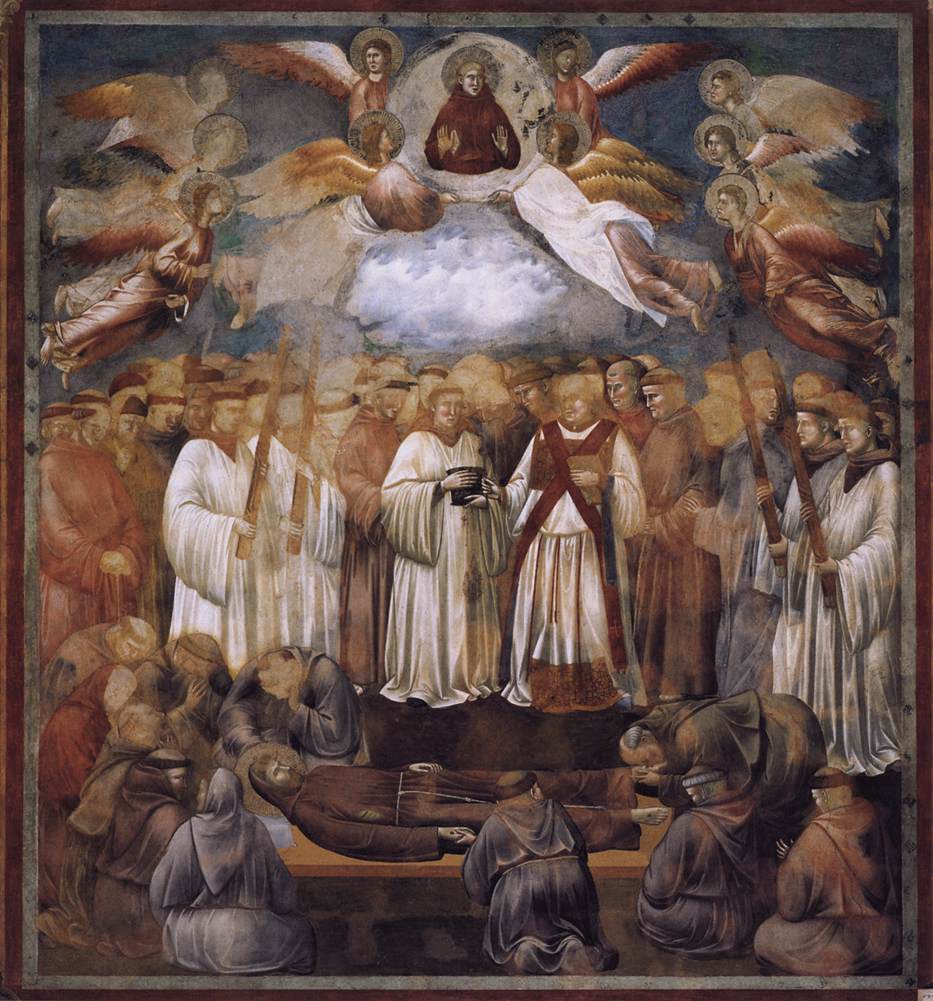
The Transitus of Our Holy Father Francis


This evening one may solemnly commemorate the death of St. Francis of Assisi. The vigil of his feast day may also be a day of prayer and fasting.

The son of a wealthy merchant, many like to think of him as something of a playboy and romanticized knight. I suppose we can think of his youth in that way, yet it would be incorrect to compare his frivolity to how contemporary rich kids play...I doubt if he was as decadent as Paris Hilton's boyfriends. I think it is safe to assume Francis always remained a virgin. He liked to have fun and hung out with the guys, if you will.

His conversion after taking ill on his way to battle, allowed him to understand the vanity and brevity of life. He fell in love with Jesus. The vehemence of this love caused him to put aside everything and follow the Lord after the primitive example of the first disciples. Like Mother Teresa in our own day, he quickly gathered numerous followers.

Francis was a little saint. That is why I loved him and St. Therese so much in my youth. He was so simple and transparent he would weep at hearing a passage of the Passion read to him. His soul burned with seraphic love to such an extent he was conformed to his Crucified lover.

His III Order today still attracts the simple ones. Sinners seeking to amend their lives through penance and prayer. The 'official' III Order is now called "Secular Franciscans" and there is a tendency to focus primarily on peace and justice issues, while conducting a more academic approach to the life of St. Francis and the intellectualizing of the Franciscan charism. His doctrine has been more or less institutionalized, while his spirit seems to have been dissipated into something more "new age" than authentic Catholic asceticism.

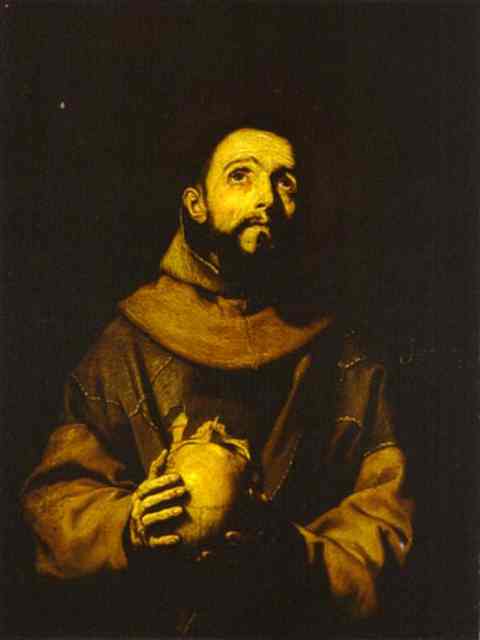
Sometimes I think that is why, many folks, even some of the Friars, delight in the romantic aspect of the Saint's life. Surrounding themselves with bird baths and fountains of the saint with birds flocking all over the otherwise dreadful piece of sculpture representing him. Then there are those Brother Sun and Sister Moon ecological seminars many host in his honor. Yet Francis, in his most authentic image, is an icon of Jesus Crucified. He is in a tattered habit, his side and limbs wounded with the stigmata, his body like gnarled roots, barefoot, trampling the globe representing the world underfoot. He holds a cross, and perhaps a skull, representing the brevity of life and our final end. The authentic image of St. Francis calls us to penance, while urging us to love - to love love, and make love loved.

Yet I digress. This evening commemorates his transitus or death. In imitation of his Crucified Love. On this night, he rose from his death bed, removed his clothes and lay down upon the bare earth to die, covered only with a small cloth. The passion was read to him one last time before he died.

St. Francis of Assisi, father of the poor, example of penitents, pray for us now and at the hour of our death. Amen.

Monday, October 02, 2006

Guardian Angels


What does your Angel look like?

Wouldn't it be wonderful to see and converse with him? St. Gemma Galgani did. So did Frances of Rome. Didn't Padre Pio do so as well? St. Catherine Labore had her angel appear as a little child to wake her and escort her to visit with Our Lady in the chapel at Rue de Bac.

Perhaps, if we were able to see him, we would try to hold onto him, maybe make "three tents" - well one or two - like Peter at the Transfiguration. We would want to simply "be" with him while neglecting our duties and responsibilities. We might fail in our exercise of charity, seeking our consolation in a friendship that we cannot penetrate or adequately embrace...such a thing is for the soul and God alone.

We must be content with the invisible.

"It is only with the heart that one can see rightly; what is essential is invisible to the eye." - Saint-Exupery, "The Little Prince"

(Check out "The Penitent Blogger" for a fine commentary from St. Bernard on today's memorial.)

Saturday, September 30, 2006

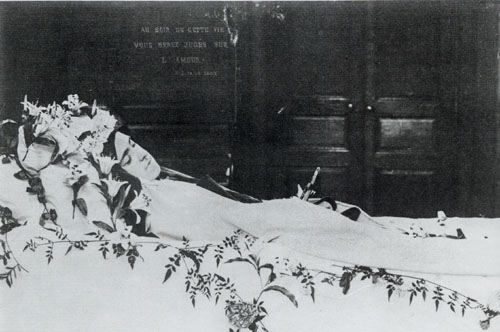
Transitus...


Shortly after 7PM little Therese died this very same evening in 1897. I was working tonight and forgot.

She died much like Our Lord, suffocating in great agony; the weeks and days leading up to her death, St. Therese suffered an ineffable darkness, "the trial of Faith". Neither her own words, nor those of any other living person, can describe what it was like to share so intimately her Beloved's death. Not even her sisters could comprehend it.

Therese is little, and yet great. Nevertheless she is always little...very, very little. I sometimes lament she has been declared a Doctor of the Church, resulting in many academics, intellectuals, and masters of theology and spirituality making a science of her "little way." Many times they miss. They miss her "littleness" - her insignificance...

The only great theologian or mystic that I know of who best writes of her life is St. John of the Cross, the writer whose works Therese's spirituality most perfectly embodies. John of the Cross was a little soul as well.

And the person who most closely lived Little Therese's "little way" was even more little and insignificant that herself - Blessed Teresa of Calcutta.

Happy feast day little God-Mother!

Wednesday, September 27, 2006

In Memoriam


September 28

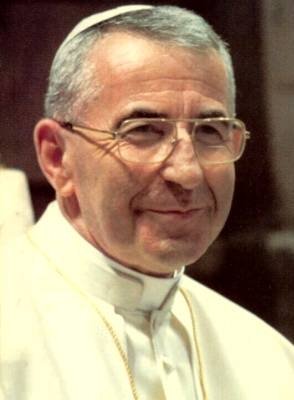
Albino Luciani 1912-1978

The Servant of God, Pope John Paul I


Holy Father, pray for us, now and at the hour of our death. Amen

Tuesday, September 26, 2006

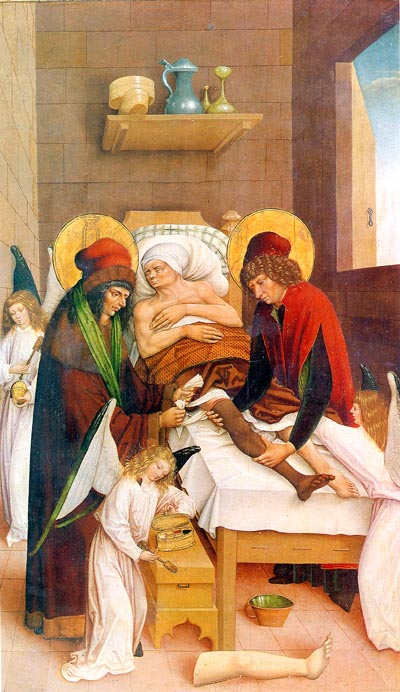
St's Cosmas and Damien


The Holy Helpers.

The two physician saints are depicted here in one of their most famous posthumous miracles. They replaced the diseased leg of a man with the leg of another man who had died. It was obviously from a man of color. Hence, the worlds first leg transplant...probably not so astonishing for self-sufficient moderns, who have become accustomed to transplant surgeries. If you are going in for a transplant, I think I would pray to these two saints if I were you. If you're waiting for a transplant, all the more reason to invoke their assistance.

Go to Don Marco's site, "Vultus Christi" for everything you want to know about these two saints.

Monday, September 25, 2006

The blessed Pope, John Paul I


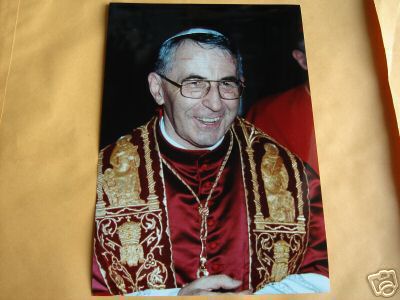
I read with joy that the Holy Father's cause is progressing well. He was like a shooting star, having reigned for only a month. He humbly combined his predecessor's names to become the first pope in history with a double name. By this act he demonstrated to the world and the Church that the Vatican Council was indeed an authentic council and the papacy would continue the reforms initiated there. John Paul II proved likewise.

Such a short reign, marked by extraordinary humility and charity - you see this in his face. Pray for us John Paul I as we prepare for the anniversary of your death, pray for unity within the Church. (JPI's anniversary of death is September 28 - he died in 1978.)

Here is the article:

"Rome, Sep. 25 (CWNews.com) - The diocesan investigation into the cause for beatification of Pope John Paul I is nearing its conclusion, 28 years after the death of "the smiling Pope."

Thursday, September 28 will mark the anniversary of the sudden death of Pope John Paul I, who had succeeded Pope Paul VI just 33 days earlier. According to an official responsible for the cause, the diocesan inquiry will come to an end within a few more weeks.

Ordinarily, the local investigation of a cause for beatification begins in the diocese where the candidate died. But in this case, for a variety of reasons-- including the fact that Pope John Paul I had spent so little time as Bishop of Rome-- the inquiry was begun in the Belluno diocese, where Albino Luciani was born in 1912. According to Msgr. Giorgio Lise, a vice-postulator for the cause, the diocesan inquiry is likely to conclude by the feast of St. Martin, the patron of the Belluno diocese, on November 11." [snip] continued

St. Sergius of Radonezh


Monk and mystic - friend of animals.


My favorite saint from the Russian calendar. He founded, if my memory serves me, the famous Monastery of the Holy Trinity near Moscow, along with a couple of others as well. He had frequent apparitions of the Mother of God, lived the ascetic life most perfectly, and had the animals of the forest, including bears, eating out of his hands. He is like the St. Francis of the Russian Orthodox Church. September 25 is his feast day. He died in 1392.


Viit here for details on his life.

Sunday, September 24, 2006

Dr. Seuss


He invented the word 'nerd'. I never knew that. I didn't like Dr. Seuss as a kid because I early on developed a taste for fine art, therefore cartoons held no fascination for me. I always read the stories of saints and rarely anything else - well maybe Greek mythology and Grimm's Fairy Tales - but that is about it.

Now as an adult I like Dr. Seuss and the Simpson's.

So he invented 'nerd'. What is the origin of the word 'dork'? I'll look that up. What if it says, 'Terry Nelson'?

Our Lady of Ransom


Or, Our Lady of Mercy.

Today's feast of Our Lady is primarily celebrated in South American countries and in Spain. It is the titular feast of the order of friars known as the Mercedarians, founded by St. Peter Nolasco. St. Raymond Nonnatus was also a member of this order, founded to ransom Catholic slaves held captive by Muslims.

Unlike today, when there is no bargaining with terrorists, in those days ransom would be paid to free those held captive. St. Raymond exchanged himself for such and was enslaved for a time. The Saracens pierced his lips with a padlock to prevent him from speaking about the Catholic faith. He himself was later ransomed by his fellow Mercedarians.

Things do not seem to have changed much with Muslim-Christian relations have they? The Holy Father meets with Muslim leaders tomorrow. Let's pray Our Lady to guide this meeting.

During the English persecutions under the reign of Henry VIII and Elizabeth I, devotion to Our Lady of Ransom took on greater fervor in the hopes of bringing the Church of England back into "Our Lady's Dowry".

In our day, aside from the continued threats of terrorism, our culture is faced with many other moral afflictions, such as addictions to vice and various obsessive-compulsive disorders. Our Lady of Ransom would seem to be the title one could implore Our Lady to obtain freedom from those sins that ensnare us.

Saturday, September 23, 2006

St. Pio


The priest with the stigmata.

I painted this icon of Padre Pio several years ago, before he had been beatified. It now resides in the exquisite "Winter Chapel" attached to the Church of St. Louis, King of France in St. Paul, Minnesota. It hangs across from the confessional. It is a chapel filled with fine art and architectural detail, so I am honored that it was chosen for the space.

I painted it one day after a vivid dream the night before, a dream that seemed more like a vision. In the dream, I was in Moscow's Red Square and entered the cathedral of St. Basil. When I looked up, the dome exploded off, and there was Padre, in the sky in this pose, blessing the world, the sky behind him all aflame, red and golden.

I never expected him to be canonized in my lifetime. It seemed only very traditional and pious Catholics continued to pay any attention to him after his death. I more or less hid my devotion lest I be considered one of these people. Priests and monks I knew were suspicious of Padre Pio, his charismata, his seemingly pre-Vatican II spirituality, as well as his chapel veiled followers. I never told anyone when I went to his tomb to venerate his relics, which was a great grace for me. Since my early childhood I had always hoped to visit him, but it was only after his death that I was able.

Then John Paul II declared this man a saint, the man other popes were suspicious of and who preferred silenced and out of the way, which his bishop and superiors did for a time. As a saint, held forth for the entire Church to venerate, he has become a figure open for all Christians to revere, with the example and witness of his life to instruct and guide the faithful in the way of holiness. He was something of a prophet, holding on to the solid traditions of the Roman Catholic faith, the very same sacred traditions being renewed in our day.

Pray for us St. Pio, that we may be made worthy of the promises of Christ. Amen.

[Prints of the icon may be obtained from Bridge Building Images.]

Friday, September 22, 2006

Andrew Warhola


Photo edited/censored
for nudity.

Did anyone but me watch the PBS documentary by Ken Burns on Andy? What a trip...down memory lane.

I have always liked his art. From the illustrations of shoes for ads, to the silk screened images of celebrities, to the films. Once in a conversation, Fr. Welzbacher told me he felt Picasso was diabolical. I never asked him about Warhol.

Watching the piece on PBS I was struck how diabolical Andy's life was. The decadence of the factory, his odd, voyeuristic sexuality, and the strange assortment of low-life personalities he gathered around him. To think I invited him to one of my parties - what does that say about me? (He told me on the phone that he couldn't make it, but would send someone if I paid their expenses.)

So what did I like about him? In the late '60's and early '70's he was iconic. He influenced marketing, art, and the 'revolution'. I have always appreciated his innovation. I also often thought he was putting everyone on - playing with society and watching everyone make a fool of themselves. He was an observer. He was a documentarian. While seeming to be the antithesis of culture and high society, he craved to be a part of it, the superstar of it all - and of course he achieved that. In fact, he invented the term superstar.

Although he never did drugs, and remained pretty much asexual, the pop star sub-culture he created was steeped in it. He documented that - hence the attraction and strange validation his admirers and fans experienced. Looking back with this documentary I was impressed with how very sad and decadent the life of Andy was. I felt 'dirty' watching it.

Yet his work (and he was a hard and prodigious worker) holds a legitimate place in the history of art. He created - and through his creations, changed a culture - or at least, contributed to it's change. He broke through barriers with an anarchist's fervor. He documented our decline into depravity and amoral behavior. He reflected the narcissism and consumerism of the culture in his art. His art did nothing to elevate the human spirit, rather it denigrated it, or more precisely, brought the superficiality and decay of our society to our attention. In the end, he achieved what he set out to do, he became famous - not for 5 or 15 minutes, but forever - or as long as art exists. His work, in my opinion, is and remains art. I still like him for what was authentic in him and his work.

Did you realize he kept his mother in a house next door to his and attended Mass on an almost daily basis? He was very complex - a trait he exploited in himself and others.

Tuesday, September 19, 2006

Roger of Taize


Convert?

Brother Roger of Taize was murdered by an insane woman not long after Pope John Paul II's death. A mild controversy arose at the Pope's funeral when Brother Roger received Holy Communion at the funeral Mass from none other than Cardinal Ratzinger, now Benedict XVI. Though a public action, I assumed there must have been some understanding or dispensation to allow a Protestant monk to communicate. It later turned out, after Roger's death, that he had, quite awhile back, come into union with the Roman Catholic Church.

That news was not surprising to me since the religious of Taize, though Protestant, seem to be very close to the Catholic Church, which is apparent by their embrace of monastic life. Brother Roger was undoubtedly a man of deep prayer and spirituality. After his death Pope Benedict spoke of him as being in heaven.

Catholic News has an article clarifying the nature of his entering into communion with the Catholic Church. His confreres at Taize insist it was not a conversion, but an entering into union with the Church, therefore he had no need of repudiating his Protestant heritage. Here is a portion of that article:

"The ecumenical Community of Taize issued a statement last week denying its founder, the late Brother Roger Schutz, underwent a “conversion” to the Catholic faith, saying instead he entered “progressively into a full communion with the faith of the Catholic Church without a ‘conversion’ that would imply a break with his origins.”

The statement denies a story in the French newspaper “Le Monde,” which the Taize Community said was based on a rumor spread “by Catholic traditionalist circles” and that “misrepresents his true intentions and defames his memory.”

The Taize leaders point out that the Bishop Emeritus of Autun, Raymond Seguy, has clarified his statements to Le Monde, telling France Presse: "I did not say that Brother Roger abjured Protestantism, but he showed that he subscribed fully to the Catholic faith."

“From a Protestant background, Brother Roger undertook a step that was without precedent since the Reformation: entering progressively into a full communion with the faith of the Catholic Church without a ‘conversion’ that would imply a break with his origins,” the statement notes.

It goes on to explain that in 1972, “the bishop of Autun at the time, Armand Le Bourgeois, simply gave him Communion for the first time, without requiring any other profession of faith from him besides the creed recited during the Eucharist, which is held in common by all Christians. Several witnesses were present and can attest to this.” [snip] "Taize leaders deny “conversion” of Brother Roger to Catholic faith" CNA

This news in itself will renew the controversy surrounding Roger, yet it explains why the monk of Taize was able to receive Communion at the Holy Father's funeral. His union with Rome may have been kept quiet for pastoral reasons, known only to those involved. It is my understanding that dispensations and special circumstances allow for many things in the Church, hence the union of Br. Roger of Taize with Rome may have been considered private. Despite the fact one's profession of faith is a public witness. It's another difficulty to understand, isn't it? Then again, it could be his brothers at Taize were not pleased with Roger's choice and seek to downplay the union with Rome thing. Perhaps it is better left to heaven to figure out.

Monday, September 18, 2006

Also on September 19 - The Feast of Our Lady of La Salette


An approved apparition with spurious secrets...

There are supposedly secrets from this apparition that foretell incredible and apocalyptic scenarios of doom - that many conspiracy theorists believe to be true and currently developing in our times. None of these can be authenticated. Conspiracy theorists and apocalypse enthusiasts promulgate the unauthenticated secrets. The seers themselves have a morbid atmosphere surrounding their lives. There is little to attract me to these strange events.

Websites such as Michael Brown's "Spirit Daily" often quote from the unofficial secrets. The entire event is obscured nowadays by unsubstantiated purported revelations concerning the original apparitions. The apparitions seemed to concern France in a particular manner, with an extension to the entire world.

Nevertheless the events at La Salette have been surrounded by controversy since, especially because of questions concerning the veracity and stability of one of the seers, Melanie. (It should be noted that a secret was given to Pius IX but it was never revealed to the public, although a secret has been retrieved from the Vatican archives in the past decade. That said, the older sensational version of the secret, reported as being the same one given to the Pope, carries no verifiable credence. Go here for an excerpt from that secret, it has been around for so many decades, many think it is official.)

Church approval of the apparitions has nonetheless been granted, as well as devotion to the Virgin of La Salette.

Go here and here for a factual account of the apparitions. Then go here for what seem to be official statements refuting the veracity of the later secret. Finally, go here for the text of the secret released by the Vatican archives and published by Rene Laurentin, once again it differs from the others in circulation. It is all very confusing to say the least.

Sunday, September 17, 2006

18 September; St. Joseph of Cupertino


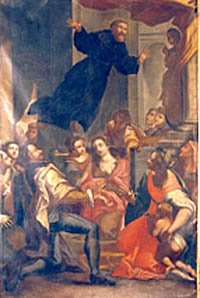
Today is the feast day of one of my favorite saints, Joseph of Cupertino, Franciscan priest and mystic.

When I lived in Assisi I was permitted to make an 8 day retreat in the solitude of his newly renovated apartments at the Sacred Convent. It was in these apartments that St. Joseph had been 'imprisoned' because of the extraordinary mystical phenomena that surrounded him. He was kept in solitude to keep him away from the curious who flocked to him because of the gift of levitation, for which he is best known. I had a friar who acted as my 'Martha" in the solitude of my retreat, bringing me food and drink and celebrating Mass for me in the saint's oratory. It was a memorable experience for my life. Immediately afterwards, on the feast of the Stigmata, I was professed in the third order of St. Francis at the tomb of our Holy Father in the crypt of the Basilica.

Presented is a brief biography of St. Joseph:

"St. Joseph of Cupertino in prayer, he was called "the Flying Friar" because of his frequent levitations St. Joseph of Cupertino (1603-1668) was an Italian mystic whose life is a wonderful combination of a complete lack of natural capacity and an extraordinary supernatural efficiency.

He lacked every natural gift. He was incapable of passing a test, maintaining a conversation, taking care of a house, or even touching a dish without breaking it. He was called Brother Ass by his companions in the monastery.

He was born on June 17, 1603 into a family of poor artisans. Because of his father?s debts, he was born in a shed behind the house, which was in the hands of bailiffs. He was sickly and often at death?s door during his childhood, and at age seven he developed a gangrenous ulcer which was later cured by a religious man. He was always despised by his companions who called him a fool. Even his mother wearied of him and repudiated him for his lack of any human value. Later, when he entered the religious life, he faced worse difficulties. The Capuchins received him as a lay brother but his ineptitude and abstraction made him unbearable for the other religious. Often he was taken in ecstasy and, oblivious of what he was doing, he would drop the food or break the dishes and trays. As a penance, bits of broken plates were fastened to his habit as a humiliation and reminder not to do the same again. But he could not change. He could not even be trusted with serving the bread because he would forget the difference between the white and brown breads. Finally, considering that he was good for nothing, the religious took his habit and expelled him from the monastery.

Later, he declared that having the habit taken from him was the greatest suffering of his life and that it was as if his skin had been torn from his body. When he left the monastery he had lost part of his lay clothes. He was without a hat, boots, or stockings, and his coat was moth-eaten and worn. He presented such a sorry sight that when he passed a stable down the lane, dogs rushed out on him and tore his apparel to worse tatters. He escaped and continued along the road, but soon came upon some shepherds, who thought he was a miscreant and were about to give him a beating, when one of their number had pity on him and persuaded them to let him go free." [snip] Read the conclusion here.

St. Joseph of Cupertino pray for me for the grace of conversion; and pray for us now and at the hour of our death. Amen.

Thursday, August 31, 2006

Tolerating racism - on Oprah.


That would be reverse racism.

(Photograph of Paul Robeson as Othello and Peggy Ashcroft as Desdemona from the 1930 London production of Shakespeare's Othello.)

The gospel according to Oprah evidently tolerates reverse racism. Coming in from doing yard work I smoked a cigarette and turned on TV to watch the news. I was too early and caught a bit from the Oprah show with the stars of some new movie dealing with interracial couples. Instead of turning the channel, I watched as she had a group of black men discussing the growing trend of black women dating white men. (It's okay with them for the black men to date outside of their race, but not so much for the women.) They made statements such as , "They're just after money or status." when they date white men. And in response to black women stating that they can't find good black men, they respond, "here we are". All of that is fine with me - I don't care about interracial dating, but I started to think about what had been said. If these were white guys talking about the same subject, stating the same opinions, there would be outrage expressed over obvious racist statements. And it would not end on the Oprah show. Maybe I missed something, but it sure sounded like reverse racism to me.

Funny conspiracy theories.

Now new ones...

Even involving Sr. Lucia of the Immaculate Heart, the visionary of Fatima, shown here at her funeral. (But this isn't the first time they have involved her.)

Conspiracy theories can be entertaining on some level, just the sheer nonsense of many along with the intriguing thought, "what if it's true?" thrill. Not a few believe the bogus "Protocols of Zion" are true. There are Catholics who think that there is more to the third secret of Fatima than what the Vatican revealed, while Sr. Lucia as well as Cardinal Ratzinger, including his new Secretary of State, Cardinal Bertone insisted the entire secret has been revealed. Cardinal Bertone recently stated so in an interview, when answering this question;

"Q: You closely followed the publication of the secret of Fatima: are there [further] catastrophic revelations regarding the future or has everything been revealed and accomplished?

A: I met sister Lucia many times and had in my hands the declaration written by her on the matter. There are no further revelations of Fatima and the so-called Third Secret has been completely revealed. As for the catastrophisms, some said that sister Lucia did not close her eyes at night since she was so terrified of the imminent disasters. She answered me, "But if I did not sleep at night, how would I be able to pray all day long?" Sister Lucia recommended that credit should not be given to these announcements of misfortunes."
[snip] Rorate Coeli.

How much more do people have to have to be convinced of the fact that the Fatima secrets have been revealed? Maybe they have not come to pass entirely and the message of prayer and penance is still imperative for us today, but we have the full message. We have what we need to know. We need to trust the Pope when he says so. Before all the secrets were revealed, we already had the essential aspects of the message to amend our lives by, what more needs to be done? Some Fatima devotees think that the consecration of Russia was never performed correctly and therefore must be done in accord with what Our Lady requested. This, despite the fact that Sr. Lucia has said "Heaven has accepted" the consecration of John Paul II in 1984, soon after which, the Berlin wall came miraculously tumbling down and Communism seemed to be dying out. (Not that the world is any more secure or better for it.)

Today I received in the mail a copy of the notorious "Fatima Crusader" magazine, operated by Fr. Nicholas Gruener. Fr. Gruener's group are the chief architects of this conspiracy theory against the Vatican as well as the post Vatican II Church. In one of their books on the subject by John Vennari entitled "The Devil's Final Battle" which insults many in the hierarchy and claims a conspiracy to hide the true contents of the third secret, the author is convinced the secret dealt with the ongoing crises in the Church. He indicates the prohibition of the Latin Mass and the loss of vocations, etc. was initiated by Masons and Communists (some of whom were Cardinals) bent on the destruction of the Church. (A local priest, said to be silenced, has also talked about these things as being true, although he is not as extreme as this bunch; however, such views can get someone silenced. Gruener is supposed to have been.) At times the tone and tenor of Vennari's book is downright hateful, and does it's best to sow seeds of doubt and discord in the most casual reader.

In an article in the current "Crusader" Venarri continues to reach - claiming a new book with heretofore unpublished writings of Sr. Lucia, issued with permission from the Vatican as well as her Carmel in Coimbra, cannot be the authentic writings of Sr. Lucia. He writes, "It is the rhetoric of post-conciliar ecumenism, not that of Sr. Lucia's own words." He is writing regarding Sr. Lucia's words about World War II and the persecution of the Jews, while going on to claim the Jewish religion of today is not the same religion of Jesus' time. (Something a few others say as well.) He cites passages from the Talmud to support that claim. This may or may not be true, I have never read the Talmud, but it simply does not accord with what the Church currently understands when the Jews are referred to as "our elder brother in the faith."

The silliest part of the article is where Venarri addresses the ultimate conspiracy theory that Sr. Lucia may have either died or was killed in the late 1950's, only to be replaced by an impostor. (In the '70's there was a similar conspiracy theory by "out there" Marian devotees saying Paul VI was also put "out of the way" and replaced by an impostor.) Gratefully, he finds it hard to believe but states, "My own opinion is that I would prefer the case to be studied by reputable forensic experts." Thus leaving open the absurd possibility of it all.

He ends the article with this statement; "Hence, Catholics would do well to treat any posthumous writings of Sr. Lucia with extreme caution, especially when they contradict her previous lifelong testimony, and contradict bedrock truths of the Catholic Faith."

I think Catholics would do well to avoid any writings endorsed by "The Fatima Crusader". No wonder people think Fatima is for the crazies and ignore its message and relevance to our own times, when people like this incite such division and mistrust in the authentic teaching Magisterium of the Church.

Wednesday, August 30, 2006

How we may know chastisement is coming.


Burning Man (Painting by Andre Durand. I did not use the real title.)

We can know that a chastisement is being prepared for us without divine revelations or apparitions of the Virgin Mary. (Although we must be grateful to so good a Mother that she would help us discern the will of God.) Her apparitions have been occurring since the 1830's beginning with St. Catherine Labore, with warnings of chastisements. Since we seem to have recovered from every war and revolution we become more and more skeptical that any real chastisement could befall us. We become ever more complacent, permissive, as well as licentious. It seems to me there has been established a new world religion - not so much the "liberalism" Ann Coulter writes about - that is it's cult, or praxis - instead it is relativism that is the idol of this religion. Materialism, pleasure, leisure and convenience seem to be its "graces".

John of the Cross writes, [Chastisements] "can also be known in their causes, since the divine providence responds most certainly and justly to what the good or bad causes arising from the sons of men demand. One can know naturally that a particular person or city, or some other factor, will reach such a point that God in His providence and justice must respond in conformity with the punishment or reward that cause warrants." (Ascent II, 21;9)

What is so wrong in the world that it should merit a general chastisement? I don't know? Maybe read the news and not watch the censored and sanitized version of it on television. One simply has to just look around. Not just the wars and the rumors of wars - those are chastisements.

Abortion. I know everyone gets tired of hearing about it, and soon they won't be with the not-so-new "morning after pill", that guarantees even more promiscuity. Everyone takes contraception so for granted they fail to realize just how much of an affront it is to God. By it we attempt to make ourselves masters of our own creation, while misusing the gift of sexuality for our own pleasure. It cannot be a coincidence that homosexuality has gained such acceptance in a contraceptive culture. Sex without consequence legitimizes just about every other sexual expression. Just as abortion, legitimizes every other type of life choice, such as infanticide or euthanasia.

In our very well educated minds we convince ourselves there is no such thing as revealed truth that governs our lives. Everyone claims we worship the same God and that there is no religion any better than another, pagan goddess worship included. Everyone is equal. Hence, even the Catholic church may host pan-religious prayer meetings at Assisi praying for peace. We now believe every person can decide for himself what is moral or immoral. Thus man falls for the original lie and thinks himself equal to God, and this essentially is idolatry.


This is what happened in ancient Israel, when the people turned from idolatry and corrupted the temple worship. Turning to other gods is never pleasing to the One True God. It is never pleasing for him to see us engage in abominable behavior, such as infanticide, sacrificing children to idols for a life of convenience, whether by a pill, or a knife. We may not mock his creation by abusing his gift of sexuality through masturbation, homosexuality or transgender operations. It seems to me we have lost our sense of sin because we have forsaken true worship of God and authentic spirituality - thereby abandoning even the natural law.

So you see, we can know by natural reason a chastisement is coming. The question is, when?