Showing posts sorted by relevance for query simon stock. Sort by date Show all posts

Sunday, July 15, 2012

Cassian and the monastic malfor or scapular.

St. John Cassian


The scapular as a garment dates back further than St. Simon Stock - or even Benedict...

The scapular originally was thought to be part of the work habit amongst monastics, and was prescribed in the Rule of St. Benedict.  Yet as I mentioned earlier, Eastern monasticism traces it back to the 4th century and St. Pachomius and the 'Angelic habit'.  John Cassian likewise records the habits of the Egyptian desert fathers, which includes the malfor, or scapular.  That text here:
Chapter VI.
Of their Capes.
Next they cover their necks and shoulders with a narrow cape, aiming at modesty of dress as well as cheapness and economy; and this is called in our language as well as theirs mafors; and so they avoid both the expense and the display of cloaks and great coats. - Cassian, Bk. I: The Dress of Monks

Just thinking out loud here.  Wouldn't the Carmelites already have worn a scapular before the apparition of Our Lady to St. Simon?  Probably.  So, perhaps Our Lady singled out the scapular to be more than a work habit for the hermits turned friars?  Gracing the humble garment with a deeper meaning regarding discipleship, taking on the yoke of Christ, as it were?  Indeed, making it a sign and seal of her protection and patronage... reminding those who wear it, to guard their heart - which the scapular covers. 

Anyway, the Blessed Virgin's scapular is a habit, a garment of grace - not just for monks and nuns, but for all the faithful.

St. Simon Stock

Saturday, May 16, 2015

A Weekend of Saints


Today, May 16, and tomorrow, May 17 is adorned with holy men and women.

Today is the feast of St. Margaret of Cortona, penitent.  Our Lord called her the Magdalene of the Franciscan order.  She could be a patron for single mothers who were sinners.  It would be better to rely on Margaret's merits than their own however - since Margaret was quite extreme in her penance and probably not the best mother for her poor son - who later was entrusted to the Franciscans - which had to be a better life for him.  Margaret suffered all her life from gossips who never forgot her sinful past and accused her of continuing indiscretions even after so many years of penance.  Perhaps she could be a patron for gay people as well - who once gay, always gay - in the eyes of so many of us.

St. Margaret, pray for us!


St. Simon Stock is also commemorated today.  Modern hagiographers tend to discredit the traditional stories about this Carmelite saint, yet he has always been venerated as the one to whom the Blessed Virgin gave the scapular of Mt. Carmel.  Scapulars had been around since the first monks - Pachomius was given a version of it by an angel - yet the gift of the Brown Scapular to Simon Stock was indeed special and set apart, and became a sign of consecration even for lay people.  I accept the traditional story of St. Simon who is so named because he began his eremetical life living in the hollow of a tree.  I like that.


Today is also the memorial of St. John Nepomucene.  He is the patron of Czechoslovakia, and of confessors.  He was martyred because he refused to divulge the content of the Queen's confessions to the King, who promised him honors if he did so.  He didn't and was thrown off a bridge in Prague.  His image and story was used by missionaries to the New World to catechize aboriginal people on the Seal of the Confessional.

Ah! Tomorrow, May 17 is especially illustrious!

First, it is the memorial of St. Paschal Baylon.  The humble Franciscan lay brother so devoted to the Blessed Sacrament.  I love him so much - I pray he grants me an increase of devotion to the Blessed Sacrament - a deep union ...

On this day, May 17, 1925, the Blessed Therese of the Child Jesus and the Holy Face was canonized by Pius XI.

Ninety years later, the Blessed Mary of Jesus Crucified, also know as Mariam Buoardy, the Little Arab, will be canonized by Pope Francis, along with fellow Palestinian Bl. Marie-Alphonsine Ghattas.

Bl. Mary of Jesus Crucified will be celebrated throughout the Church, in Catholic news and on Catholic blogs, so I don't need to say much.  The Little Arab is a modern thaumaturge - her life is filled with miracles and wonders, much like the early saints, whose legends have been more or less discredited by contemporary hagiographers who no longer believe in miracles.  The wondrous life of Bl. Mary has been documented by contemporaries and studied by mystical theologians.

So.  This weekend is filled with saints, revealed in and through the glorious splendor of the Ascension of the Lord.

Saturday, May 16, 2009

St. Simon Stock

May 16 is also the feast of St. Simon Stock, to whom Our Lady gave the Holy Scapular of Mt. Carmel. It is believed by some that children born on this day have a particular devotion to the Blessed Virgin Mary of Mt. Carmel and her Holy Habit. To learn more about St. Simon, click here.
.
(BTW - If any of my readers know where I may obtain a large cord of St. Francis - as the friars and nuns wear, please let me know. Thanks. As a III Order Franciscan, I hope to be buried in one.)

Wednesday, June 21, 2006

Some thoughts on wearing the Scapular of Our Lady

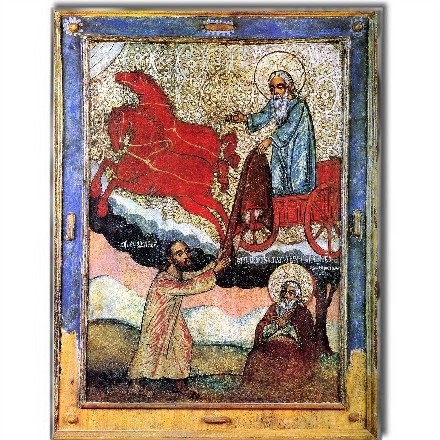
Todays first reading at Mass continues the cycle of the life and mission of Elijah culminating in what is referred to as the 'assumption' of the prophet and handing over to the prophet Elisha the prophetic charism. The icon pictured illustrates this well.


In the scripture Elisha prays "May I receive a double portion of your spirit." in response to Elijah's command to ask whatever legacy Elisha may have desired. Elijah replied, "If you see me taken up from you, your wish will be granted, otherwise not." The scripture states that a fiery chariot came between the prophet and his disciple and took Elijah up to heaven in a whirlwind, while the prophetic mantle fell at the feet of Elisha. Elisha tore his garments in mourning over the loss of his spiritual father and took up the mantle, rolling it up and striking the water of the river Jordan, causing it to divide, thus allowing him dry passage across the river bed. How many layers of spiritual significance to this story! Nevertheless, I have only one simple reflection, and that is regarding the Order of Carmel.


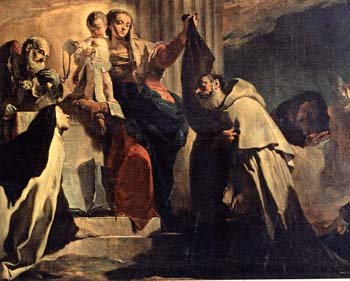
Pictured: St. Simon Stock receiving the scapular of Mt. Carmel.

First of all, the Order of Carmel has always seen the prophets Elijah and Elisha as the 'proto-founders' of the order. In the passage from Kings wherein Elijah sees the "little cloud rising from the sea" from his perch atop the summit of Mt. Carmel many have written that this little cloud prefigures the Virgin who would bear the Savior. Archeological evidence tells us hermit followers of Elijah inhabited Mt. Carmel even in Old Testament times, and of course Christian hermits lived there later, in the spirit of Elijah, hence the origins of the Order of Mt. Carmel.

Perhaps it is a stretch on my part but I have always seen the Scapular of Mt. Carmel somehow prefigured as it were, in this episode in the Book of Kings when Elijah passes on the mantel to Elisha. It seems to me when Our Lady gave the scapular to St. Simon there was a similar significance. To be sure it is a sign of her favor and protection, first to Carmel and then to the lay person who wears her 'livery' as the medieval word refers to it. Ponder the idea and consider it's meaning.

Without doubt there is a prophetic charism imbedded in the Order of Carmel, signified by Our Lady herself. The scapular of Mt. Carmel provides numerous benefits and graces for those who wear it, and it is a garment that the Church has highly praised and given many indulgences to. One may either wear the cloth scapular, which one must be enrolled in to enjoy all of the indulgences, or one may simply have it blessed by a priest and still enjoy the protection of the Mother God. A Scapular medal may also be worn in place of the cloth one, but the wearer must have been enrolled in the cloth scapular first in order to gain the same privledges. It all sounds so complicated, but it is not. Some people like to nit pick about how big it should be, or if the medal may substitute, but that makes it more of a fetish or talisman than a revered sacramental of the Church. (The Carmelite order has come out with revised conditions regarding the Scapular devotion.)

There are many other scapulars of various orders in the Church, as well as those that have cropped up from private revelations. If one's devotion moves one to wear these, that is fine, but sometimes I see the occasional person wearing all of them at once, as well as numerous medals and crucifixes - that's a bit off. Sometimes people use sacramentals to make themselves feel holy or appear holy, sometimes they use them superstitiously, all of that should be discouraged. In today's Gospel Our Lord cautions against "performing our religious deeds in order that people may see them."

For the laity however, the scapular is normally worn beneath one's outer garments, the devotion is a matter of the heart, it signifies our consecration to God, and the entrustment of ourselves to the Immaculate Heart of Mary, as well as a guarantee of Our Lady's protection and guidance.

The affiliation to the Order of Carmel (indeed simply being a baptized and confirmed Roman Catholic) gives our lives a prophetic character, that of witnessing to our faith, albeit sometimes silently and hidden, much as the Scapular we discreetly yet devoutly wear next to our heart.
.
Icon: The Assumption of the prophet Elijah.

Tuesday, July 16, 2013

Feast of Our Lady of Mt. Carmel


This feast of Our Lady is not just for Carmelites - it is for the Universal Church.
Over time this rich Marian heritage of Carmel has become, through the spread of the Holy Scapular devotion, a treasure for the whole Church. By its simplicity, its anthropological value and its relationship to Mary's role in regard to the Church and humanity, this devotion was so deeply and widely accepted by the People of God that it came to be expressed in the memorial of 16 July on the liturgical calendar of the universal Church. - Blessed John Paul II
One can remain a lay person and belong to the family of Carmel through devotion to the Scapular of Our Lady of Mt. Carmel.  Membership in the Secular Carmelites is a special vocation, but enrollment into the Scapular Confraternity is open to all laity, priests and religious alike.  Otherwise, anyone may devoutly wear the Scapular as a sign of devotion to the Blessed Virgin.

John Paul II as a layman,
secular Carmelite,
wearing scapular


"The sign of the Scapular points to an effective synthesis of Marian spirituality, which nourishes the devotion of believers and makes them sensitive to the Virgin Mother's loving presence in their lives." - JPII
Who may invest people with the Brown Scapular of Our Lady of Mount Carmel? 
According to the Rite for the Blessing and Enrollment in the Scapular of the Blessed Virgin Mary of Mount Carmel, approved by the Holy See in 1996, any priest or deacon has the faculties for blessing the scapular.  A person given authority to act in the name of the order may receive people into the confraternity of the scapular.  The official ritual provided by the Holy See makes no provision for someone other than a priest or deacon to bless the scapular. - Catechesis
Triptych Madonna of the Scapular,
side panels, Prophet Elijah and St. Elisha,
and St. Simon Stock receiving the scapular.
 
 
Personal speculations regarding the scapular.
 
It's an article of clothing, as the Holy Father noted in the address cited above, it is essentially a habit.  Scapulars go back a long time.  The scapular became a sign of taking upon oneself, the yoke of Christ.  Religious Jews wear a similar garment, somewhat analogous with the Roman Catholic habit of wearing the Scapular:
The tallit katan (Yiddish/Ashkenazic Hebrew tallis koton; "small tallit") is a fringed garment traditionally worn either under or over one’s clothing by Jewish males. It is a poncho-like garment with a hole for the head and special twined and knotted fringes known as tzitzit attached to its four corners. The requirements regarding the fabric and fringes of a tallit katan are the same as that of a tallit gadol. Generally a tallit katan is made of wool or cotton. - History here.
 
The scapular as an article of Christian religious clothing goes further back than medieval times - it was part of the monastic habit - in one form or another - going back at least to St. Pachomius (4th century), who was believed to have received it from an angel, as part of the monastic 'schema' - still worn by Orthodox monks.


The scapular originally was thought to be part of the work habit amongst monastics, and was prescribed in the Rule of St. Benedict.  Yet as I mentioned earlier, Eastern monasticism traces it back to the 4th century and St. Pachomius and the 'Angelic habit'.  John Cassian likewise records the habits of the Egyptian desert fathers, which includes the malfor, or scapular.  That text here:
Chapter VI.
Of their Capes.
Next they cover their necks and shoulders with a narrow cape, aiming at modesty of dress as well as cheapness and economy; and this is called in our language as well as theirs mafors; and so they avoid both the expense and the display of cloaks and great coats. - Cassian, Bk. I: The Dress of Monks


A 'prophetic garment' - an 'evangelical garment'.

Perhaps it is a stretch on my part but I have always seen the Scapular of Mt. Carmel somehow prefigured as it were, in this episode in the Book of Kings when Elijah passes on the mantel to Elisha. It seems to me when Our Lady gave the scapular to St. Simon there was a similar significance. To be sure it is a sign of her favor and protection, first to Carmel and then to the lay person who wears her 'livery' as the medieval word refers to it. Ponder the idea and consider it's meaning.

Elijah passes on the mantel to Elisha.


The Order of Carmel has always seen the prophets Elijah and Elisha as the 'proto-founders' of the order. In the passage from Kings wherein Elijah sees the "little cloud rising from the sea" from his perch atop the summit of Mt. Carmel many have written that this little cloud prefigures the Virgin who would bear the Savior. Archaeological evidence tells us hermit followers of Elijah inhabited Mt. Carmel even in Old Testament times, and of course Christian hermits lived there later, in the spirit of Elijah, hence the origins of the Order of Mt. Carmel.

The affiliation to the Order of Carmel (indeed, simply being a baptized and confirmed Roman Catholic) gives our lives a prophetic character, that of witnessing to our faith, albeit sometimes silently and hidden, much as the Scapular we discreetly yet devoutly wear next to our heart.


Bl. Isidore Bakanja

Friday, July 08, 2016

Novena to Our Lady of Mt. Carmel


Most Holy Mary, Our Mother, 
in your great love for us you gave us the Holy Scapular of Mount Carmel, 
having heard the prayers of your chosen son Saint Simon Stock. 
Help us now to wear it faithfully and with devotion. 
May it be a sign to us of our total consecration to you,
of our desire to grow in holiness according to your intentions for us,
 as well as a sign of your protection and motherly care.
Amen.

Tuesday, May 06, 2008

More "lost" art.


Bad photos!
.
Two Carmelite images:
.
Top: Triptych Madonna of the Scapular, side panels, Prophet Elijah and St. Eliseus, and St. Simon Stock receiving the scapular.
.
Bottom: Prophet Elijah, "Behold a little cloud rising from the sea."
.
Images now belong to two Carmelite communities (the lower image being one of two of the same image).

Saturday, July 15, 2017

Stella Maris, Our Lady of Mt. Carmel

Haifa, Israel
(OL of Arabia is also modeled after this statue.)


While in choir at the Charterhouse in Vermont I imagined seeing Our Lady as she appears in this photo - it seemed to me to be a consolation and assurance of her protection after I was told I didn't have a vocation.  Just Christian.  Once I accepted that, I began to understand myself.

The toties quoties originally began at noon on the 15th of July, extending until Midnight on the actual Feast of Mt. Carmel.  I'm not sure if that remains in effect.  For certain, a plenary indulgence may be gained on July 16 by visiting a Carmelite chapel, and praying the usual prayers for the Holy Father, as well as the Creed, an Our Father, and the Hail Mary. Devotion to Our Lady of Mt. Carmel is ancient and very much connected to the Prophet Elijah. In later times, the Scapular of Mt. Carmel was given to St. Simon Stock. It is one of the most richly indulgenced sacramentals in the Church and is considered the sign of one's consecration to the Blessed Virgin.

At Fatima Our Lady showed herself as Our Lady of Mt. Carmel during the miracle of the sun.  There are intriguing parallels on that account to the Prophet Elijah in his confrontation with the pagan priests on Carmel, and calling down fire from heaven.  Because of that, it lends an apocalyptic nuance to the final vision of Fatima.