Friday, June 16, 2006

Mother Teresa's rule: No fund raising.

Missionaries of Charity of Blessed Mother Teresa of Calcutta.

I had an incident one day a month or so ago in the Store I work in. It made me do a lot of thinking. The Missionaries of Charity came in to see me. Every time they visit the Store I feel like I'm seeing Mother. Sometimes I even lapse and call them Mother instead of Sister. No offense to any other religious order but these nuns are exceptional examples of the religious life; they remain just as faithful to radical poverty and their original charism as when they were founded. They are women of prayer as evidenced by the rosary they carry in their hands and are actively praying as you meet them - their rosaries do not just hang on their belts.

When you encounter the sisters you cannot help but tangibly feel their charity. I love them. They had to talk to me about a mistake we made in our catalog. It concerns one of those latex wrist bands, a JPII memorial item, a piece of "I could care less merchandise" that is over-priced as well as a post-peak trend item. A seemingly insignificant item. In our catalog copy, that we took from the vendor we bought it from - I must hasten to say - it states that "a percentage of the proceeds from sales of this item go to the Missionaries of Charity." Mother Marcella, the provincial in the U.S. contacted me a few months ago that this was in error. I was totally unaware of the copy and promotion. I assured her I would look into it. I explained I had no knowledge of the connection and told her I knew very well that the Missionaries and Mother have always had a prohibition against fund raising. I knew that! I assumed everyone did. I told management and explained how important the matter is, they seemed to understand. And guess what happened? Another re-mail catalog had already gone to press and was subsequently mailed out. You can imagine the embarrassment for me and the Company when Sister came in and talked to me about the same mistake that had not been taken care of. I explained as best I could, I said I would take care of it for them and I apologized. I went immediately to the Owner of the Company and explained to him the problem. I called the Company we buy the items from and explained the situation. He explained that he had bought the business from another fellow and he was the one who promoted the item that way and he simply continued it. As I spoke to him on the phone he removed the line from his web site. I knew it was going to be taken care of. (And it was - immediately.)

The entire episode gave me pause however. The Missionaries themselves always remind me of the parable of the goats and sheep being judged at the end of time, because they are so hidden and humble and also because Mother often referenced this parable. (I shuddered because of what scripture says in regard to merchants and how they will be judged!) What struck me about this Gospel however is how the people to the right hand of our Lord, those who have done well, question Jesus saying, "When did we see you hungry and give you food? Naked and we clothed you?" and so on. They honestly did not know until Jesus told them that when they did this to the least among them that they did it to Him. The blessed were totally unaware of their good works - they were simply acting from the goodness of their hearts. They neither measured nor tallied their good works - they simply were acting and doing what was right, the right hand not knowing what the left was doing‌.

It is human nature to take an account of possessions, money, honors, etc. We deduct our charitable contributions from our taxes. (In our Store we even sell "Sacrifice Beads" a pious custom adopted from the life of Therese of Lisieux, you're supposed to count your sacrifices throughout the day by moving a bead every time you do a good work. Unless you are about five years old, as Therese was when she used it, I'd strongly recommend not using such a device. (It's for training kids - not for adults.)

We often carry this accounting practice into our spiritual lives. Many who practice prayer like to figure out what stage of prayer they are at. In my Store we carry a book called "The Stages of Prayer" written by an former Discalced Carmelite nun, it more or less 'retarded' my own progress in prayer since it focused so much on stages and levels of prayer - it isn't the best study on the practice of prayer. Teresa of Avila's famous book, "The Interior Castle"‌ documents the various stages of prayer as well. This is great for directors or to inspire a person to strive for the higher gifts, but it's a waste of time, in my opinion, to use it to try and figure out where you are at in the spiritual life. You're just measuring again. You're keeping score of your virtue - similar to what an overly solicitous parent does in regard to their kids sports activities or academic life. Jesus said not to let your right hand know what your left hand is doing and to keep your works of mercy secret. In other words forget your self and mortify your self seeking. Love and act out of love, "Love and do what you will" as St. Augustine wrote. We should neither count the cost nor the accomplishments of our charity - or prayer for that matter. We might take it a step further, maybe we should not use other people's charitable mission or accomplishments to raise funds or make a sale. If we are going to do an act of charity, we ought to do it in the name of Jesus, for Jesus, and let Him alone know we are doing it. Don't try to make a profit off the backs of the poor.

Remember the Pharisee and the Publican, the one guy recounted to God all of his merits and good deeds, he tithed, gave to the poor, he did a lot of good. (What if he was one of those who traipsed by that other guy laying on the side of the road that the Samaritan helped?) But the one who was justified was the Publican - who had nothing but his sins. At the end of her life St. Therese proclaimed she went to God "empty handed“ not unlike the Publican.

I think that is how the Missionaries of Charity think of themselves as well. Yeah, they never take account of what they do, they simply follow Jesus.

(We eventually got rid of the phrase in our catalog. The Missionaries were happy and hopefully we learned a good lesson.)

Saturday, June 03, 2006

How GLBT people are welcome in the Church...


Just repent!

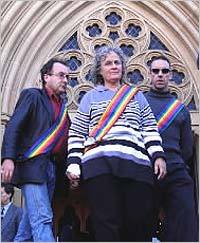
People with same sex attraction or homosexual tendencies, even those who consider themselves gay are indeed welcome in the Roman Catholic Church. The Church proclaims Christ's message in the Gospel to all persons; "The kingdom of Heaven is at hand. Repent! And believe in the Gospel!" The Church calls all to repentance and reconciliation. People with homosexual orientation are called to repentance as are all members of the Church. Communion is given to all of those who have converted and returned to Christ through the Sacrament of Penance. Christ calls us to deny our very selves, take up our cross and follow Him. He calls us to change, to reform our lives - we may not and can not demand that He change or that the Church change or that Church teaching should change. Truth is immutable.

For those who are unfamiliar with the "Sashers" - presented here is their statement on their 'core values' taken from the Dignity website: [http://www.dignitytwincities.org/}

Mission statement of the Rainbow Sash movement:

"Our Core Statement -

1)In wearing the Rainbow Sash we proclaim that we are lesbian, gay, bisexual, and transgender people who embrace and celebrate our sexuality as a sacred gift.
2)In wearing the Rainbow Sash we call the Roman Catholic Church:
to honor our wisdom and experience;
to enter into public dialogue with us;
to work with us for justice and understanding.
Together, let us seek a new appreciation of human sexuality in all of its diversity and beauty.

Our Core Action
The movement's core action, or ritual expression, involves the symbol of the Rainbow Sash. The sash is a strip of rainbow colored fabric which we wear over our left shoulders when we attend the celebration of the Eucharist. Carrying this symbol, we publicly claim our place at Christ's table, sacramentally expressing the truth of our lives, and calling the Church to embrace a new day of integrity and freedom.

The movement began on Pentecost Sunday, 1998, at St. Patrick's Cathedral in Melbourne, Australia, when a group of seventy people attended Mass wearing the Rainbow Sash. Hence, Pentecost Sunday each year is the primary day when members of the movement don the Rainbow Sash and present themselves in their local cathedrals to celebrate the Eucharist with their fellow Catholics. Their presence at the cathedral is preceded by a letter to the local bishop explaining what the sash means, and informing the bishop of when and where they will be present."

It should be noted that it is not God's gift to a person to either be gay, lesbian, bi-sexual, or trans-gender. The mystics have certainly seen suffering as a grace or gift from God in so far as it contributes to the sanctification of the person. Therefore the mortification inherent in suffering from an "objective disorder" could indeed be redemptive in proportion to the person's efforts to overcome these tendencies by grace, personal effort, and with the help of prayer and the sacramental life of the Church. In this respect one may consider it a "gift" on the pre-condition that the person has repented of any sin committed in acting out sexually. If one reflects upon the verse from the Easter "Exultet!"; "O happy fault, O necessary sin of Adam, that gained for us a Savior!" Then one may understand that God draws good, even from sin as it were - after our repentance.

Thursday, June 01, 2006

The Smoke of Satan?


New Accusations Against Other Legionary Priests?

What a mystery this entire matter of Fr. Marciel and his order. The Legionaries of Christ is one of the finest new orders in the Church, a sort of later day Jesuit-style militia, with fierce loyalty to the Pope and the Magisterium.

I have known a couple of men who have left the order, one was under psychiatric counselling for a while, the other also had some negative things to say about the Legion's formation program, but neither ever implied any type of sexual abuse had gone on. I know I seem to like this word, but at most it sounded more like a 'cult' than anything else, that is how they described their experiences to me at least. However, I dismissed it as information coming from two disgruntled former members. Nothing more.

Fr. Marcial Maciel Dellogado, pictured above receiving a blessing from Pope John Paul II. Everything I had heard or read about him left me with the impression that he was a very holy man. In fact, I was certain he had to be to have such a prolific order of priests in addition to his considerable following of (more often than not) affluent laity. I cannot remember if it is Garrigou-Lagrange or St. John of the Cross who wrote that God normally bestows great graces and mysticl gifts to the founders of religious orders as a sort of paternal legacy for the order to partake in for generations afterwards. If all of this is true about Fr. Marcial, would it follow that a certain amount of disorder or at least dysfunction could be his legacy?

Read on:

"One of Father Maciel's original accusers, Paul Lennon, M.A., dropped the following bombshell in what may be yet another nuclear bomb for the Legion of Christ and its Regnum Christi apostolates in this exclusive interview with The Wanderer: Since the May 19 statement on Father Maciel from the Holy See, more alleged victims have come forward claiming sexual abuse, not only by Father Maciel, but from other priests of the Legion of Christ. He said that due to the stigma attached particularly to male sexual abuse, the new accusers wish to remain anonymous at this time. Lennon was with the first class of Legionary priests ordained from Ireland back in 1969.What Does It All Mean?"Among canon lawyers, there is an expression, where there is smoke, there is fire," said Pete Vere, J.C.L. "As more and more allegations come forward, it is very difficult to believe that something may not have happened," he said.However, Vere added that while he personally believes that based upon the actions of the Holy See with Father Maciel, "many of the allegations have been substantiated," he was quick to caution that that he "did not have access to the evidence.""Inviting Fr. Maciel to live the remainder of his days as a penitent, without the public exercise of his ministry has a twofold effect: it affirms that the Church takes the charges seriously, considers them to be credible and punishable; secondly, it attempts to affect the ultimate salvation of Fr. Maciel by urging him to repentance," said Timothy Ferguson, J.C.L., a 38-year-old canonist from Clair Shoals, Michigan."It is more than a mere slap on the wrists," he said, "as it affects the one thing most people hold very dear, his reputation.""Since this is referred to as an 'invitation' rather than an 'imposition,' it doesn't fall under canon 1342.2, which forbids the declaration of perpetual penalties without a judicial process," Ferguson said. As an invitation, there would seem to be no means for recourse or appeal against it," he said.In other words, if Father Maciel had refused the Holy See's invitation to serve the rest of his life suspended from public ministry in penitence and prayer, Ferguson said he believed it "would necessitate the initiation of a penal process.""I think what we're seeing with Benedict XVI's papacy, he is standing for what is not popular, but what is right," said canonist Vere. "With someone like Fr. Maciel and his stature, it is going to be cleared through the Pope, and this is just another example of him showing he will do the right thing even when it is very painful," he said." (See Seattle Catholic for the original article.)

Standing at Mass


Just a thought...

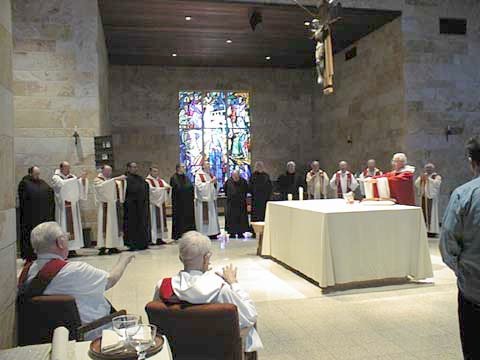
I think I figured out where this comes from - standing at Mass that is. Dah! I knew this before yet obviously never gave it much thought. The whole concept developed in the monasteries. It stems from the monastic communal Mass. The priests circle the altar for concelebration, since they are monks and the non-ordained brothers are also monks, the community stands together. Some monasteries invite the retreatants up around the altar with the community. The retreatants (priests, laymen, liturgists) obviously went back to their parishes and diocese with these innovations. I was in a Trappist monastery for a while, when I left I could always recognize who had been on retreat at an abbey by the way they bowed to reverence the Blessed Sacrament instead of genuflecting. (Benedictine custom is a profound bow instead of genuflecting.) Lay people think monastic practices are more holy I guess. They like the novelty - hence the assimilation into their parish practice. So maybe some liturgical abuses really started out with good intentions, but then took on a life of their own. I think St. Teresa of Avila said, "the road to hell is paved with good intentions." I really prefer kneeling and genuflecting, if I was in a monastery, I would conform to the custom of the place.

Sunday, May 28, 2006

The Little Pope...


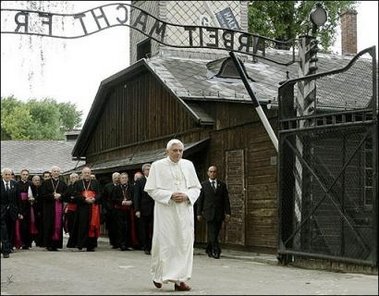
Benedict XVI at Auschwitz.

He insisted upon walking in alone, unescorted.


The German Pope.

What are these days we live in?

Viva il Papa! Vicar of Christ!


(I wish I had a better photo.)

Saturday, May 27, 2006

Papa Benedetto


Pope Benedict XVI in Poland. In every photo he looks absolutely delighted and very much at ease with being the Pope.

The Holy Father is enjoying a tremendous welcome in Poland, the German Pope speaking to the Poles in their native language - does that not seem to assuage, somewhat, the crimes of Nazi Germany on a spiritual level perhaps?

Speaking to the crowds he expressed his hope of beatifying his "beloved Predecessor" and called upon the faithful to pray for this to happen soon. Many hoped and half expected that he would beatify John Paul II on this trip to Poland, but it doesn't look as if that happened.

Viva il Papa!

Monday, May 22, 2006

The Monsignor


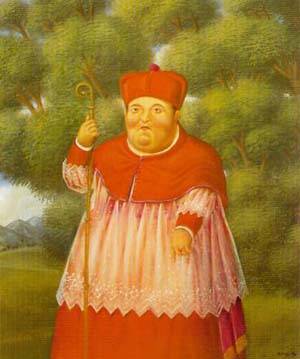
"Monsignor" - Fernando Botero

As one might expect,Botero is one of my favorite contemporary painters. Others are George Tooker (deceased) Jared French (deceased) and Frida Kahlo (deceased) -to name a few.

Botero's clerical paintings certainly resonate with me. Their voluminous presence does not imply a shred of mockery, nor is it meant to. Their baroque oppulence says much more about status, position, worldly honor, even pomposity, etc. Nevertheless, in our anorexic culture the images remind me of the more common temptations vexing the celibate. If one successfully avoids sins of impurity, the next greatest temptation is usually gluttony, or seeking in food consolations the denial of intimacy imposes. This means of course that the celibate has not developed an adequate interior life that ought to be the reward of the vow of chastity, as well as the defense against loneliness. An unhappy celibate often uses food to fill a void, or deal with an unresolved conflict. Sometimes the celibate does use sex, sometimes possesions or travel, sometimes alcohol or drugs, and sometimes in severe cases, it's all of these things. Aside from all of this, I just like Botero's work.

From the Dialogue


Pictured, St. Catherine of Siena, beseiged by devils, but she herself is not one. (Refer to my post yesterday.)

Still troubled by events in the Archdiocese and deceptive clergy, I returned in prayer to the Dialogue of St. Catherine of Siena. She wrote about the troubles and scandals of her own day, not in order to spread scandal but to reassure the faithful that Our Lord was aware of what was going on and was going to remedy it. She spoke that her words might bring to repentence those who offend God and give scandal to the faithful. That we might listen to her discourse again, I will quote from the Dialogue concerning homosexual priests.

"I am telling you this to make you see what great purity I demand of you and them, and especially of them (priests), in this sacrament. But they do just the opposite to me, for they come to this mystery wholly impure - and not simply with the sort of impurity and weakness to which all of you are naturally inclined because of your weak nature (although reason can calm its rebellion if free choice so wills). No, these wretches not only do not restrain their weakness; they make it worse by committing that cursed unnatural sin. As if they were blind and stupid, with the light of their understanding extinguished, they do not recognize what miserable filth they are wallowing in. The stench even reaches up to me, supreme Purity, and is so hateful to me that for this sin alone five cities were struck down by my divine judgment. For my divine justice could no longer tolerate it, so despicable to me is this abominable sin. The stench displeases not only me, as I have said, but the devils as well, those very devils these wretches have made their masters. It is not its sinfulness that displeases them, for they like nothing that is good. But because their nature is angelic, that nature still loathes the sight of that horrendous sin actually being committed. It is true that it was they (the devils) who shot the poisoned arrows of concupiscence, but when it comes to the sinful act itself they flee..."

Perhaps I will do best in the future to simply let the saints speak for me, although someone will still attempt to refute them as well. Our Lord is aware of what is going on, yet why does He delay the correction? St. Catherine pray for us for patience - but not too much patience! With your prayers help us in our repentance to be faithful to the Holy Father and the dogma of faith. Amen.

Sunday, May 21, 2006

Painting of a Bishop

"Bishop in the Woods" Fernando Botero

I like this image as well. It speaks to me. Representational art is more effective in expressing ideas - for me at least - than words. Sometimes when I express myself in words it sounds too harsh or mean-spirited. When I paint something, and maybe when Botero and other artists do so, even if its "in your face" one may always excuse what may seem confrontational. If a painting is naive, as many Latin American works can be, and the style I like, one might overlook many things, dismissing it in precisely that way, calling it naive. Thus the painter may speak his mind with impunity.

Monday, May 15, 2006

The myth of St. Sebastian.


Who was he anyway?
Is it true what some people say?

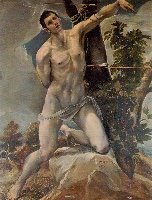
The dates of St. Sebastian's martyrdom are not known. In fact very little is actually known about him save that he was a Roman soldier martyed under Diocletian and he was buried on the Appian Way where his catacombs exist today. (St. Philip Neri used to pass his nights there in prayer.) Sebastian's feast day is January 20. St. Ambrose claims Sebastian was born in Milan, others claim Gaul as his birthplace.

The classic story is that St. Sebastian was an officer in the Roman army and arrested for being a Christian. He was sentenced to death to be shot with arrows. Bound to a column or a tree, the archers left him for dead. St. Irene, the widow of another martyr discovered he was still alive when she went to collect his body for burial. She nursed him back to health and it is said that Sebastian continued to witness and evangelize his fellow troops. (In the ancient hagiographies there is a lengthy exortation to martyrdom supposedly spoken by Sebastian. It's a beautiful treatise and may be found in an Orthodox book called, "The Arena" by Archbishop Brianchinov.) Eventually the Emperor learned of Sebastian's recovery and had him arrested once again and ordered him to be battered to death with cudgels, which finally killed him.

Sebastian has been venerated since the earliest ceturies but it was in the Renaissance that his cult became widespread in the West, due mainly to the many painters who chose to depict his dramatic martyrdom. He is most always depicted as a young, robust, athletic, and handsome man - nearly naked and bound to a tree, shot through with arrows. For centuries he has been the patron of athletes and soldiers and because of his faith and courage he became popular as a role model for boys and men.

I do not know how long ago homosexuals decided St. Sebastian was their special patron, but somewhere along the line they did. There is absolutely no historical foundation for this claim. Anyone may claim a saint to be their personal patron but it is not morally permissable to claim a saint as a patron for a sinful way of life. How did this distortion arise?

To be sure it is the celebration of the male physique when painters depicted him half naked. Homosexuality is much about physical attraction and narcissism, hence the attraction to a naked saint. His being tied to a tree may appeal to the more base behaviors some homosexuals engage in, known as bondage and discipline. I would wager the entire myth is based upon wishful (if not lustful) thinking. There exist fictional stories of his life that claim he was a homosexual officer attached to the Roman Imperial Court. The only tale that could possibly be tolerated is the one that says he was martyred because when he became a Christian he renounced and condemned homosexual activity and therefore was put to death. Naturally active homosexuals reject that story, nevertheless it too is fabricated.

Those who wish to promote the homosexual agenda will claim anybody and everybody as being gay, it's a gradiose lie. As a martyr however, Sebastian's intercession is powerful with God, and since he was a "whole" and uncorrupted man, he would indeed be a good patron for anyone struggling with same-sex attraction - especially men. (At another date I'll dispel the myth about the saint lesbians claim as their own.)

Saturday, May 13, 2006

May 13


John Paul II and Sr. Lucia

On the day of the beatification of her cousins Jacinta and Francisco.

They died in the same year and they were both chosen by Our Lady - she, to spread devotion to her Immaculate Heart, and he - he was the Pope of the prophecies, her servant and instrument. It was 25 years ago today that her hand guided the bullet that was to kill him, yet she saved his life. He understood the meaning and import of Fatima in a new light. Of all the Pope's to know the "third secret" he was the one who understood it and revealed it to the Church and the world. This extraordinary intellectual Pope with the simple piety of a peasant, he knew the secret. I am convinced that this is what motivated him. He is Our Lady's Pope, the Fatima Pope, and I dare say, the Pope of John Bosco's vision as well. He has led us into the new millenium and now watches over us from Heaven. Sr. Maria Lucia de Jesus of the Immaculate Heart and Pope John Paul II, with the little Shepherds, Francisco and Jacinta, pray for us now and at the hour of our death. Amen.